DeFi can feel like a giant crypto supermarket: one aisle for lending, another for swaps, another for staking, yield, and tokenized real-world assets. The problem is that not every project is solving the same need, which is why finding the “best” DeFi protocol is less about hype and more about picking the right tool for the job.
In this guide, we break down the most promising DeFi projects shaping 2026 by category, user type, and blockchain. The aim is simple: help our readers understand what each protocol does, where it stands out, and what risks matter before putting money onchain.
Editor's Note (June 4, 2026): We fully updated this article in June 2026 to reflect the current DeFi landscape, including major lending, DEX, liquid staking, restaking, RWA, yield, Solana, Base and infrastructure protocols. We also reorganized the guide by category, user type and blockchain, added clearer risk warnings, refreshed the project shortlist, and included practical guidance on comparing DeFi protocols before connecting a wallet or depositing funds.
Quick Answer: Best DeFi Projects in 2026
The best DeFi projects in 2026 are not all competing for the same job. Aave is the strongest pick for lending and borrowing, Uniswap for DEX liquidity, Lido for liquid staking, Morpho for advanced lending vaults, EigenLayer and Ether.fi for restaking, Pendle for yield trading, Ethena for synthetic dollar yield, Ondo for tokenized Treasuries, Jupiter for Solana swaps, Hyperliquid for onchain perps, Aerodrome for Base liquidity and Chainlink for DeFi infrastructure.
Aave
Best for users who want a mature onchain money market for lending crypto or borrowing against collateral.
Uniswap
Best for wallet-based token swaps across Ethereum and major Layer 2 networks with deep DeFi liquidity.
Lido
Best for ETH holders who want staking rewards without running validator infrastructure or locking up 32 ETH directly.
Morpho
Best for advanced users who understand isolated lending markets, vault selection, curator risk and collateral settings.
Sky and Spark
Best for users who want collateral-backed stablecoin exposure, lending, borrowing and onchain savings products.
EigenLayer
Best for advanced users who understand ETH staking and want exposure to shared security and AVS reward opportunities.
Ether.fi
Best for users who want a more accessible route into liquid restaking through eETH or weETH.
Pendle
Best for advanced users who want to split principal from future yield and trade fixed or variable yield exposure.
Ethena
Best for advanced users who understand synthetic dollars, derivatives-based hedging, funding rates and peg risk.
Ondo Finance
Best for eligible users who want tokenized exposure to short-term U.S. Treasury-linked products.
Jupiter
Best for Solana users who want routed swaps across fragmented liquidity venues.
Hyperliquid
Best for experienced traders who understand perpetual futures, margin, funding rates and liquidation risk.
Aerodrome
Best for users who want Base-native trading, liquidity provision and incentive-driven DEX exposure.
Chainlink
Best for users and builders who want to understand the oracle, data and cross-chain infrastructure behind DeFi.
Disclaimer
This guide is for educational purposes only and is not financial advice. A strong DeFi protocol does not always mean a strong token investment. DeFi can involve risks. Always use official URLs, verify token contracts, review fees and approvals, start with a small test transaction and never connect a wallet holding funds you cannot afford to lose.
Disclosure
Some links in this guide may be affiliate links. If you choose to use a service through these links, we may earn a commission at no additional cost to you.
Best DeFi Projects at a Glance
Project | Best For | Category | Main Chains | Token | Beginner Fit | Main Risk | Why It Made the List |
|---|---|---|---|---|---|---|---|
Lending and Borrowing | Money Market | Ethereum, Arbitrum, Optimism, Polygon, Avalanche | AAVE | Medium | Liquidation Risk | Battle-Tested Lending Leader | |
Token Swaps | DEX | Ethereum, Unichain, Base, Arbitrum, Optimism | UNI | Medium | Slippage and Fake Tokens | Flagship AMM With Deep Liquidity | |
ETH Liquid Staking | Liquid Staking | Ethereum | LDO | Medium | stETH Peg and Validator Risk | Made Staking Flexible and Usable in DeFi | |
Advanced Lending Yield | Lending Vaults | Ethereum, Base | MORPHO | Advanced | Vault Curator Risk | Strong Pick for Isolated Lending Markets | |
Restaking | Restaking | Ethereum | EIGEN | Advanced | Extra Slashing and Smart Contract Risk | Defined the Restaking Category | |
Liquid Restaking | Liquid Restaking | Ethereum | ETHFI | Advanced | Restaking Stack Risk | More User-Facing Restaking Route | |
Fixed Yield and Yield Trading | Yield Markets | Ethereum, Arbitrum | PENDLE | Advanced | Yield Pricing Risk | Turns Future Yield Into a Tradable Market | |
Synthetic Dollar Yield | Stablecoin Yield | Ethereum | ENA | Advanced | Basis Trade and Peg Risk | High-Yield Synthetic Dollar Model | |
Tokenized Treasuries | RWA | Ethereum, Solana, XRP Ledger | ONDO | Medium | Issuer and Redemption Risk | Reader-Friendly Entry Into Tokenized Treasuries | |
Solana Swaps | DEX Aggregator | Solana | JUP | Beginner to Medium | Route and Liquidity Risk | Core Routing Layer for Solana DeFi | |
Perp Trading | Derivatives DEX | Hyperliquid L1 | HYPE | Advanced | Liquidation Risk | Leading Onchain Perps Venue | |
Oracles and Data | Infrastructure | Multi-Chain | LINK | Not User-Facing | Oracle and Dependency Risk | Critical Data Layer for DeFi |
How We Chose The Best DeFi Projects (Methodology)
Our selection criteria included:
- Category fit: Whether the protocol clearly serves a major DeFi use case such as lending, swaps, staking, restaking, RWAs, yield trading, perps or infrastructure.
- Protocol usage: TVL, liquidity, trading activity, integrations, network presence and real onchain demand.
- Track record: How long the project has operated, how it has handled market stress, upgrades, exploits, governance changes and user growth.
- Security posture: Audits, bug bounties, smart contract design, oracle setup, admin controls and known protocol risks.
- Liquidity and execution: Depth of markets, withdrawal access, slippage risk, route quality and the reliability of swaps, lending pools or yield markets.
- User fit: Whether the protocol suits beginners, ETH holders, stablecoin users, traders, advanced yield users, Solana users, Base users or developers.
- Risk profile: Liquidation risk, smart contract risk, peg risk, slashing risk, curator risk, issuer risk, governance risk and regulatory exposure.
- Token relevance: Whether the project’s token has a clear role in governance, incentives, staking, fees or protocol growth, without treating token performance as the main reason for inclusion.
- Chain support: Availability on Ethereum, Layer 2s, Solana, Base or other major networks, along with how useful the protocol is on each chain.
- Transparency: Clear documentation, visible onchain data, understandable yield sources and enough public information for users to evaluate the protocol.
The final list favors DeFi projects with strong category leadership, real utility, visible adoption and clear risk disclosures. We also prioritized protocols that help users solve a specific problem, rather than projects that only look attractive because of token hype or high advertised yields.
What Counts as a DeFi Project?
A DeFi project is a blockchain-based protocol that uses smart contracts to let users manage financial activity without a traditional intermediary such as a bank, broker, or exchange. In practice, that usually happens through non-custodial DApps connected to a wallet.
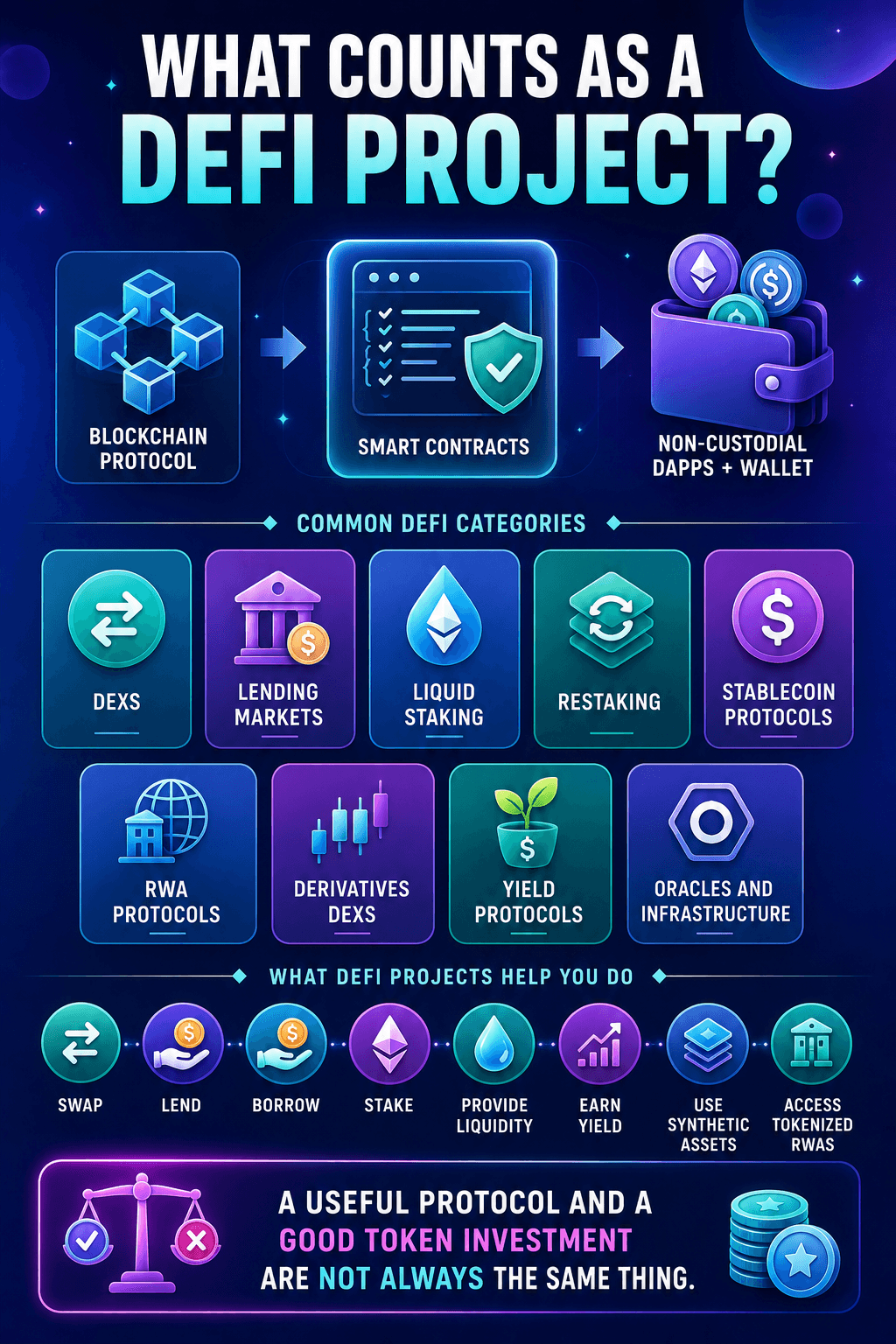 A DeFi Project is a Blockchain-Based Protocol that Uses Smart Contracts to Let Users Manage Financial Activity without a Traditional Intermediary
Common DeFi categories include:
- DEXs
- Lending Markets
- Liquid Staking
- Restaking
- Stablecoin Protocols
- RWA Protocols
- Derivatives DEXs
- Yield Protocols
- Oracles and Infrastructure
DeFi project can help users swap, lend, borrow, stake, provide liquidity, earn yield, use synthetic assets, or access tokenized real-world assets onchain. A useful protocol and a good token investment are not always the same thing.
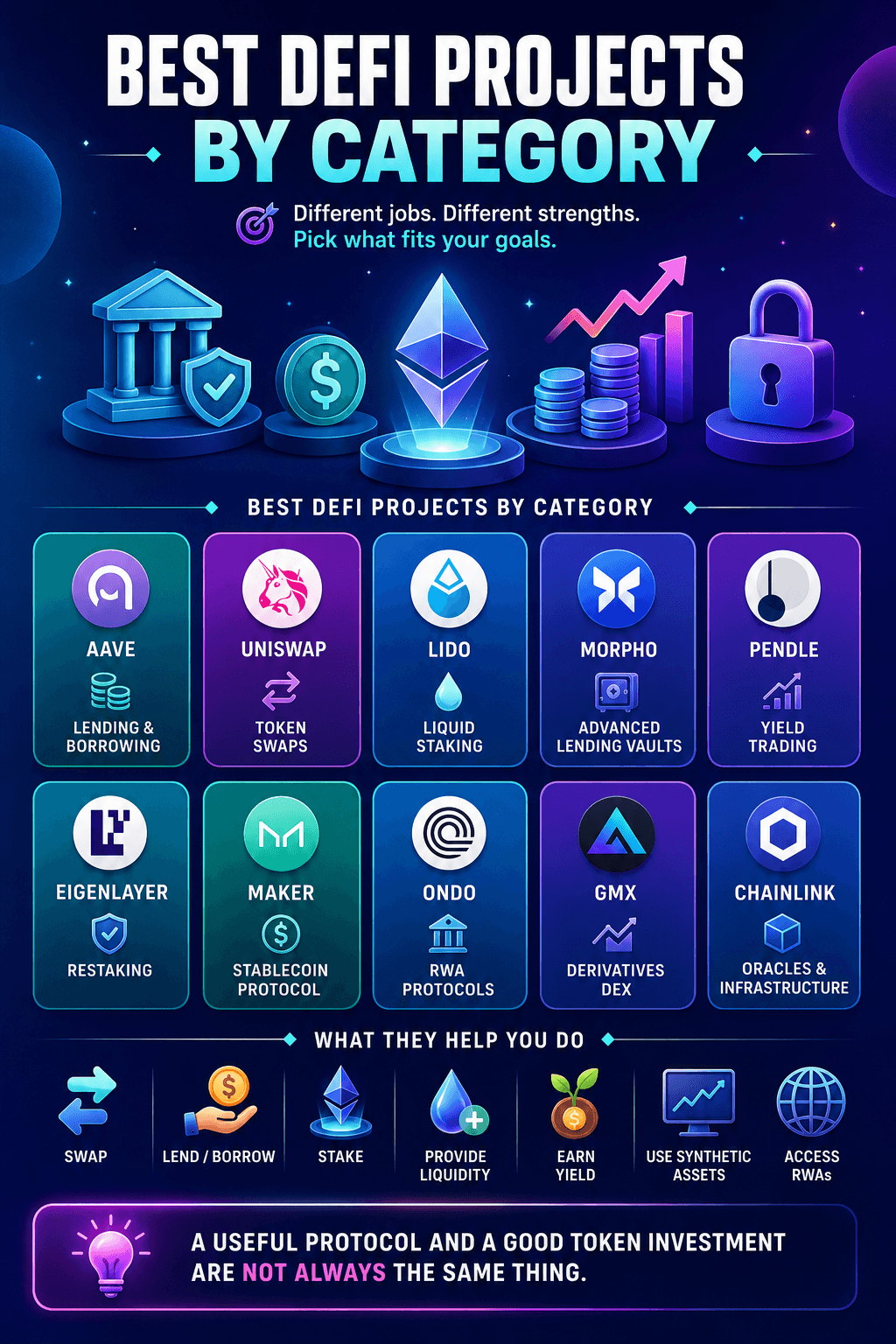 Comparing different DeFi Protocals as if they were Direct Rivals can be Misleading
Best DeFi Projects by Category in 2026
Not all DeFi protocols are trying to do the same job, so comparing them as if they were direct rivals can be misleading. A better approach is to group them by what they help users do, whether that is lending, swapping, staking, restaking, yield farming, accessing RWAs, or powering DeFi infrastructure.
The projects below are organized by category first, with a clear focus on what each protocol does best, where it stands out, and what risks users should understand before using it.
1
Aave: Best DeFi Project for Lending and Borrowing
Category: Lending and borrowing · Best for: Borrowing against collateral
⌄
Aave: Best DeFi Project for Lending and Borrowing
Aave remains one of the clearest examples of what DeFi does well. It gives users a way to earn interest on idle crypto or borrow against it without needing a bank, loan officer, or centralized platform in the middle.
2
Uniswap: Best DeFi Project for Token Swaps
Category: DEX · Best for: Token swaps without centralized custody
⌄
Uniswap: Best DeFi Project for Token Swaps
Uniswap remains the flagship decentralized exchange for users who want to swap tokens directly from their wallet. Instead of matching buyers and sellers through a centralized order book, it uses onchain liquidity pools and smart contract rules to keep markets running.
3
Lido: Best DeFi Project for Liquid Staking
Category: Liquid staking · Best for: ETH staking without running a validator
⌄
Lido: Best DeFi Project for Liquid Staking
Lido made liquid staking much easier for everyday users. Instead of needing 32 ETH and the technical setup required to run a validator, users can stake ETH through the protocol, receive stETH, and keep that position usable across DeFi.
4
Morpho: Best DeFi Project for Advanced Lending Vaults
Category: Advanced lending · Best for: Custom lending exposure through vaults
⌄
Morpho: Best DeFi Project for Advanced Lending Vaults
Morpho is better thought of as an advanced lending toolkit than a beginner’s first DeFi app. It can offer more control and better capital efficiency, but that flexibility also means users need to pay much closer attention to risk.
5
Sky and Spark: Best DeFi Project for Stablecoin Credit Markets
Category: Stablecoin credit · Best for: Collateral-backed stablecoin markets
⌄
Sky and Spark: Best DeFi Project for Stablecoin Credit Markets
Sky and Spark represent the modern version of the MakerDAO ecosystem. Sky is the broader stablecoin system built around collateral-backed assets like DAI and USDS, while Spark is the user-facing lending and savings layer that lets people borrow, lend, and earn yield within that same credit network.
6
EigenLayer: Best DeFi Project for Restaking
Category: Restaking · Best for: Shared security exposure
⌄
EigenLayer: Best DeFi Project for Restaking
EigenLayer is the protocol that pushed restaking into the DeFi mainstream. It gave ETH holders and users of liquid staking tokens a way to extend Ethereum-based security to other services, but it also introduced a more complicated layer of rewards and risks.
7
Ether.fi: Best DeFi Project for Liquid Restaking
Category: Liquid restaking · Best for: Accessible restaking exposure
⌄
Ether.fi: Best DeFi Project for Liquid Restaking
Ether.fi is a more user-facing way to access liquid restaking. Instead of stopping at basic ETH staking, it adds another layer that lets users keep exposure to staked ETH while also participating in the restaking economy.
8
Pendle: Best DeFi Project for Fixed Yield and Yield Trading
Category: Yield trading · Best for: Fixed yield and future yield exposure
⌄
Pendle: Best DeFi Project for Fixed Yield and Yield Trading
Pendle is one of the more unusual DeFi protocols on this list, which is why it often confuses first-time users. At its core, Pendle gives people a way to separate principal from yield, making future returns something they can trade instead of just passively receive.
9
Ethena: Best DeFi Project for Synthetic Dollar Yield
Category: Synthetic dollar yield · Best for: Advanced yield users
⌄
Ethena: Best DeFi Project for Synthetic Dollar Yield
Ethena is one of the highest-interest and highest-risk protocols on this list, so it needs to be understood on its own terms. It is built around a synthetic dollar model rather than a traditional fiat-backed stablecoin, which is exactly why it can look attractive in good conditions and fragile in stressed ones.
10
Ondo Finance: Best DeFi Project for Tokenized Treasuries
Category: RWAs · Best for: Tokenized Treasury exposure
⌄
Ondo Finance: Best DeFi Project for Tokenized Treasuries
Ondo Finance is one of the easiest ways to understand why RWAs have become such a major DeFi theme. Instead of focusing only on native crypto assets, it brings products tied to traditional instruments like short-term U.S. Treasuries onchain.
11
Jupiter: Best DeFi Project for Solana Swaps
Category: Solana swaps · Best for: Smart route discovery on Solana
⌄
Jupiter: Best DeFi Project for Solana Swaps
Jupiter is the protocol most closely associated with how trading works across Solana. Rather than acting like a single exchange, it helps users find the best route across the network’s available liquidity, which is why it has become so central to Solana DeFi.
12
Hyperliquid: Best DeFi Project for Onchain Perpetual Trading
Category: Perpetual trading · Best for: Advanced onchain derivatives traders
⌄
Hyperliquid: Best DeFi Project for Onchain Perpetual Trading
Hyperliquid is built for a very different type of DeFi user than Aave or Uniswap. It focuses on high-speed onchain perpetual futures trading, which makes it one of the most closely watched platforms in the rise of decentralized derivatives.
13
Aerodrome: Best DeFi Project on Base
Category: Base DeFi · Best for: Base-native trading and liquidity
⌄
Aerodrome: Best DeFi Project on Base
Aerodrome is the clearest example of a protocol built specifically to become Base’s main liquidity venue. It combines a DEX with a token-incentive system, which helps explain why it became such a central part of Base DeFi.
14
Chainlink: Best DeFi Infrastructure Project
Category: DeFi infrastructure · Best for: Oracle services and cross-chain infrastructure
⌄
Chainlink: Best DeFi Infrastructure Project
Chainlink is different from the other names on this list because it is not mainly a lending app, DEX, or staking protocol. Instead, it provides core infrastructure that helps other DeFi protocols work by bringing external data onchain in a way smart contracts can use.
Best DeFi Projects by User Type
Different DeFi users need different tools. A beginner, a trader, and an RWA researcher are not solving the same problem.
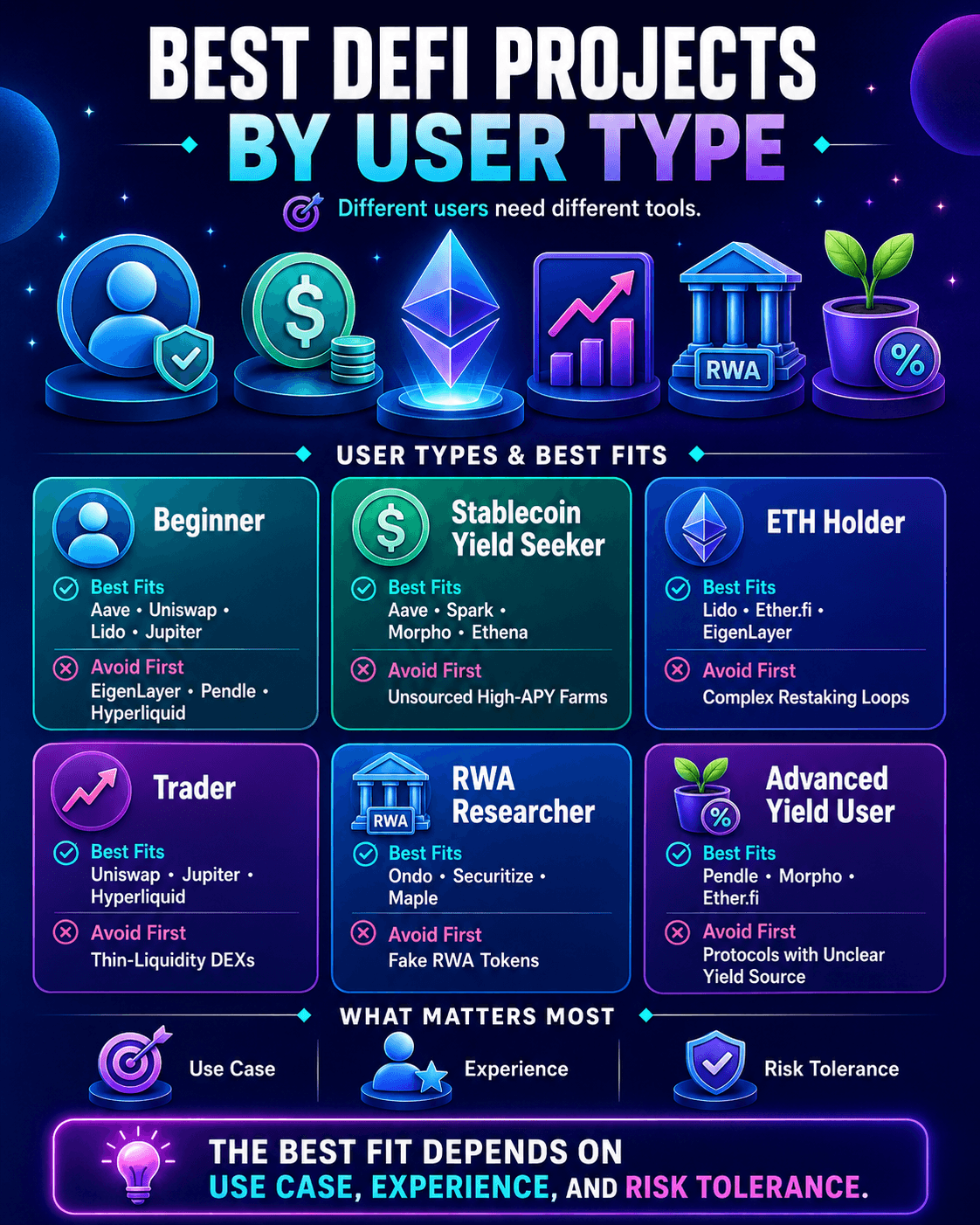 A Beginner, a Trader, and an RWA Researcher are not Solving the Same Problem
User Type | Best Fits | Avoid First |
|---|---|---|
Beginner | Aave, Uniswap, Lido, Jupiter | EigenLayer, Pendle, Hyperliquid |
Stablecoin Yield Seeker | Aave, Spark, Morpho, Ethena | Unsourced High-APY Farms |
ETH Holder | Lido, Ether.fi, EigenLayer | Complex Restaking Loops |
Trader | Uniswap, Jupiter, Hyperliquid | Thin-Liquidity DEXs |
RWA Researcher | Ondo, Securitize, Maple | Fake RWA Tokens |
Advanced Yield User | Pendle, Morpho, Ether.fi | Protocols with Unclear Yield Source |
The best fit usually comes down to use case, experience level, and risk tolerance. In DeFi, choosing the right tool matters just as much as choosing the right protocol.
Best DeFi Projects by Blockchain
Different blockchains tend to be stronger in different parts of DeFi. Even so, the main ranking in this article stays category-first, because users should usually choose by use case before chain.
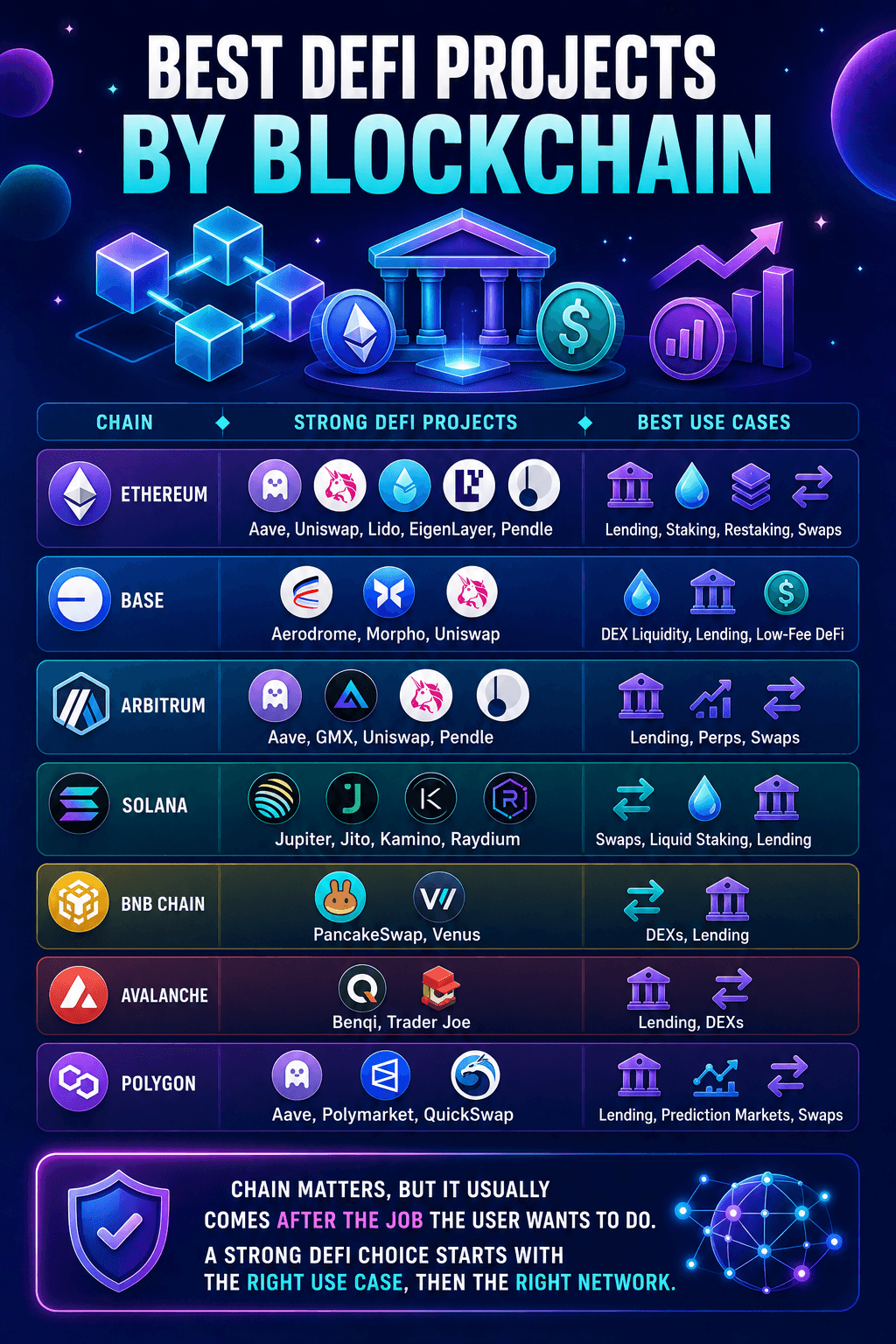 Different Blockchains Tend to be Stronger in Different Parts of DeFi
Chain | Strong DeFi Projects | Best Use Cases |
|---|---|---|
Ethereum | Aave, Uniswap, Lido, EigenLayer, Pendle | Lending, Staking, Restaking, Swaps |
Base | Aerodrome, Morpho, Uniswap | DEX Liquidity, Lending, Low-Fee DeFi |
Arbitrum | Aave, GMX, Uniswap, Pendle | Lending, Perps, Swaps |
Solana | Jupiter, Jito, Kamino, Raydium | Swaps, Liquid Staking, Lending |
BNB Chain | PancakeSwap, Venus | DEXs, Lending |
Avalanche | Benqi, Trader Joe | Lending, DEXs |
Polygon | Aave, Polymarket, QuickSwap | Lending, Prediction Markets, Swaps |
Chain usually comes after the job the user wants to do. A strong DeFi choice starts with the right use case, then the right network.
How to Compare DeFi Projects Before Using Them
A DeFi protocol can look strong on the surface and still carry hidden risks. That is why it helps to use a simple checklist before connecting a wallet or depositing funds.
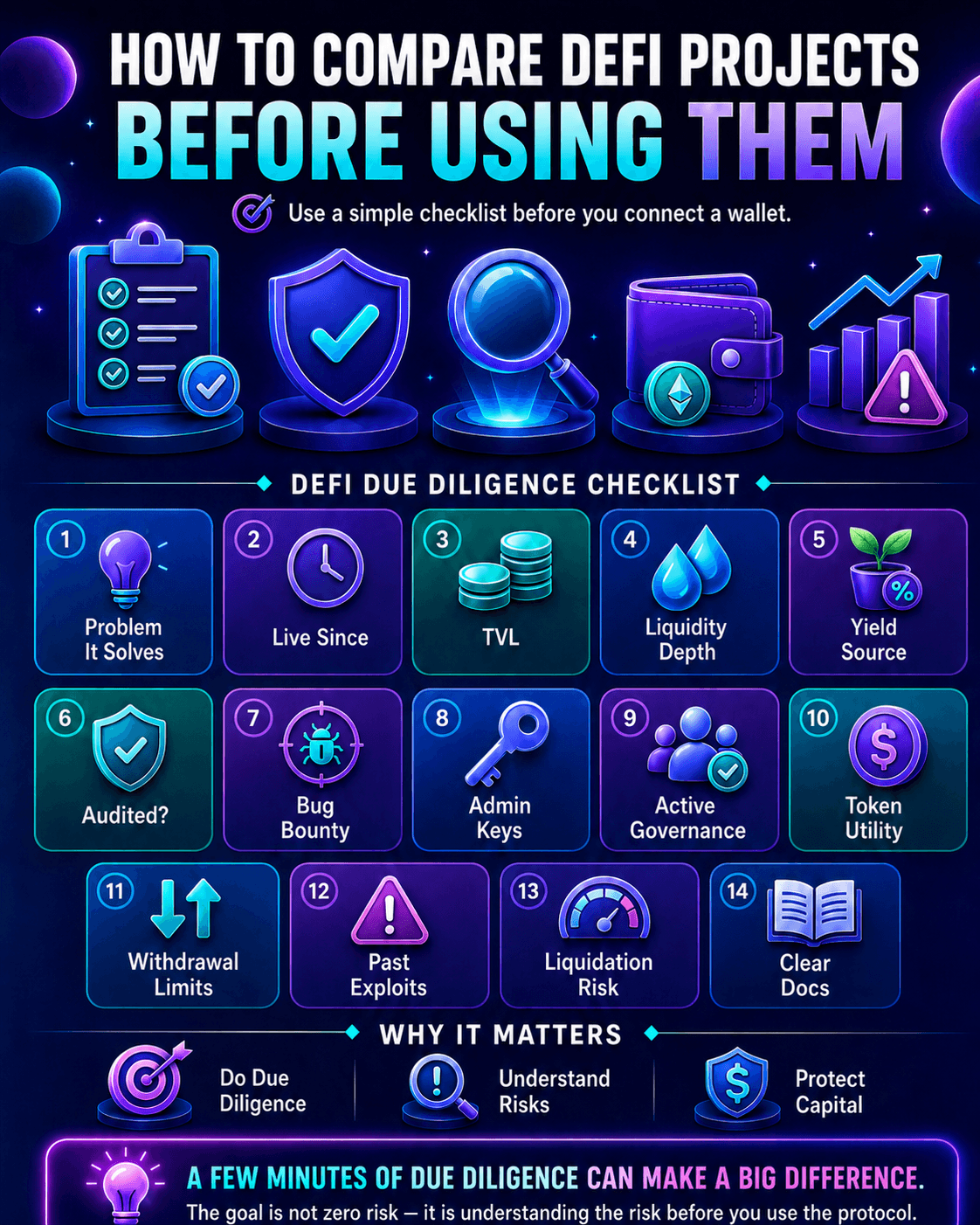 A DeFi Protocol can Look Strong on the Surface and still Carry Hidden Risks
- What problem does the protocol solve?
- How long has it been live?
- How much TVL does it have?
- Is liquidity deep enough?
- Where does yield come from?
- Has it been audited?
- Does it have a bug bounty?
- Who controls admin keys?
- Is governance active?
- Is the token useful or mostly speculative?
- Are there withdrawal limits?
- Has the protocol suffered an exploit?
- Can users get liquidated?
- Are the docs clear?
In DeFi, a few minutes of due diligence can make a big difference. The goal is not to find a protocol with no risk, but to understand the risks before using it.
Where Does DeFi Yield Come From?
DeFi yield can come from several different sources, and not all of them carry the same level of risk. Understanding that source is one of the most important parts of evaluating any protocol.
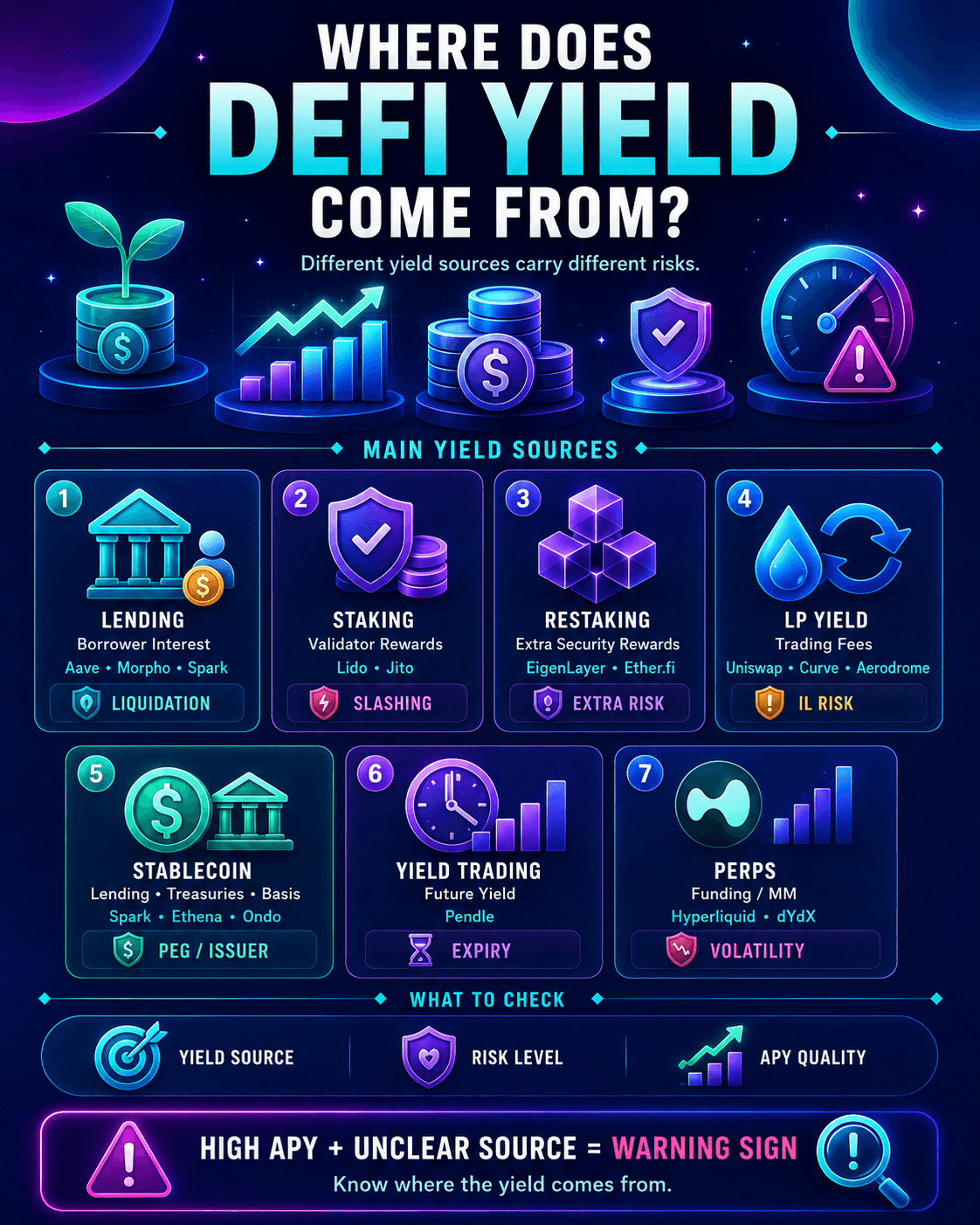 DeFi Yield can Come from several different Sources, and not All of them Carry the same Level of Risk
Yield Type | Source | Example Projects | Main Risk |
|---|---|---|---|
Lending Yield | Borrower Interest | Aave, Morpho, Spark | Liquidation and Utilization Risk |
Staking Yield | Validator Rewards | Lido, Jito | Slashing and Peg Risk |
Restaking Yield | Extra Network Security Rewards | EigenLayer, Ether.fi | Extra Slashing and Smart Contract Risk |
LP Yield | Trading Fees and Incentives | Uniswap, Curve, Aerodrome | Impermanent Loss |
Stablecoin Yield | Lending, Treasury Yield, Basis Trade | Spark, Ethena, Ondo | Peg, Issuer or Strategy Risk |
Yield Trading | Priced Future Yield | Pendle | Expiry and Liquidity Risk |
Perp Trading Yield | Funding, Market Making, Incentives | Hyperliquid, dYdX | Liquidation and Volatility |
If a protocol cannot clearly explain where its yield comes from, that should be treated as a warning sign. In DeFi, high APY without a clear source is usually a risk signal, not a free opportunity.
Main Risks of Using DeFi Projects
DeFi can be useful and efficient, but it also exposes users to risks that do not show up in traditional finance. The key is to understand where those risks come from before using a protocol.
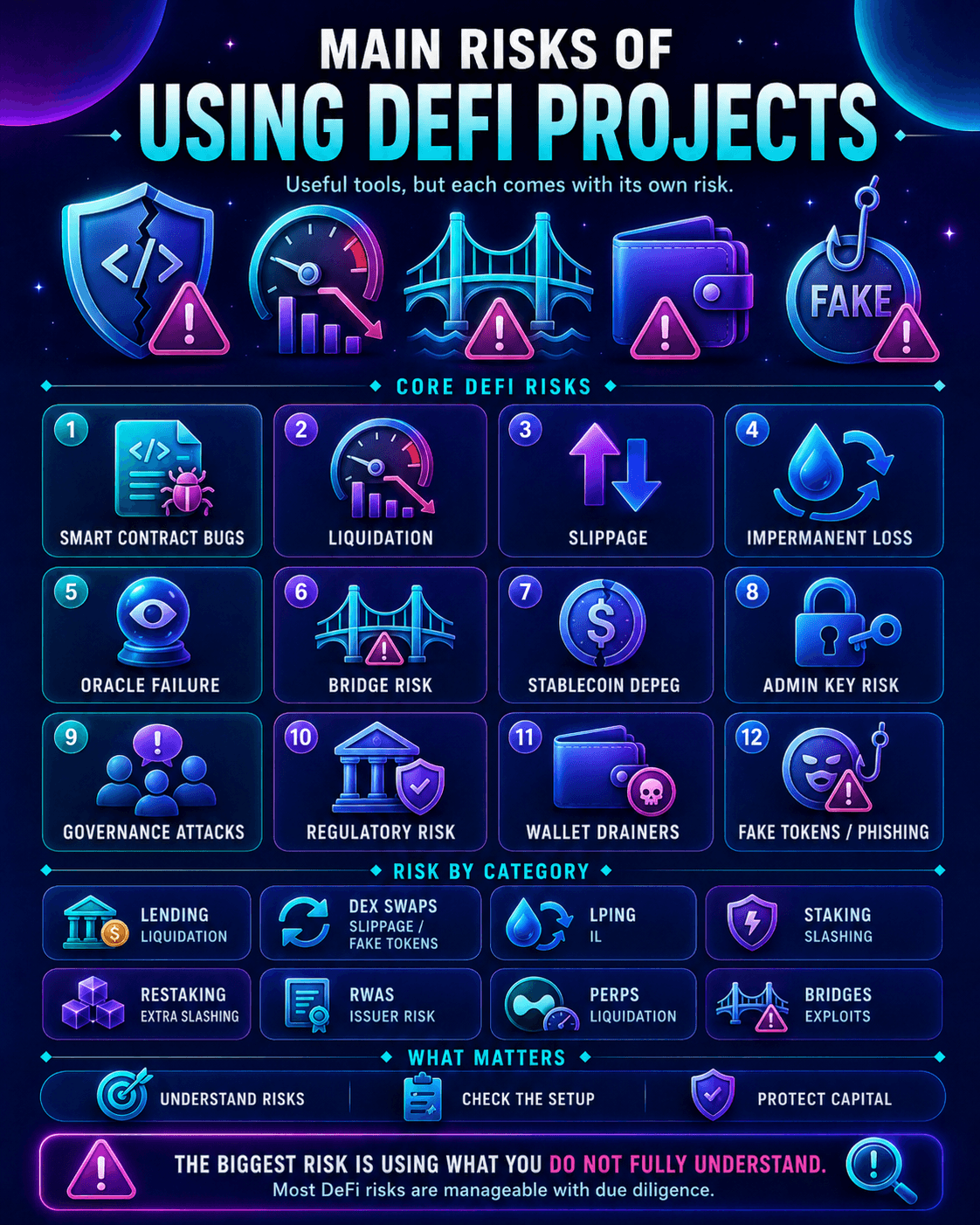 The Key is to Understand where Risks Come from before Using a Protocol
- Smart Contract Bugs: If the code breaks or is exploited, user funds can be lost even when the protocol looks legitimate.
- Liquidation: In lending and leveraged trading, a sharp move in collateral value can force positions to close automatically.
- Slippage: A trade can execute at a worse price than expected, especially in volatile or low-liquidity markets.
- Impermanent Loss: Liquidity providers can end up worse off than simply holding their tokens if prices move unevenly.
- Oracle Failure: If a protocol relies on bad or delayed price data, it can trigger incorrect liquidations or misprice assets.
- Bridge Risk: Moving assets across chains adds another layer of smart contract and operational risk.
- Stablecoin Depeg: A stablecoin can drift away from its target price, sometimes gradually and sometimes very quickly.
- Admin Key Risk: If a small group controls upgrade keys or emergency functions, users are also trusting that control structure.
- Governance Attacks: Poor governance design can allow bad proposals or concentrated voting power to push harmful changes.
- Regulatory Risk: Rules can affect how some DeFi products, especially stablecoins and RWAs, operate over time.
- Wallet Drainer Risk: Signing the wrong transaction or exposing a seed phrase can empty a wallet fast.
- Fake Tokens and Phishing Links: Scam tokens, copied websites, and fake approvals are still some of the easiest ways for users to lose funds.
Category | Main Risk |
|---|---|
Lending | Liquidation |
DEX Swaps | Slippage and Fake Tokens |
LPing | Impermanent Loss |
Staking | Slashing and Withdrawal Delay |
Restaking | Extra Slashing Layers |
RWAs | Issuer and Redemption Risk |
Perps | Liquidation |
Bridges | Exploits and Delayed Finality |
Most DeFi risks are manageable, but only if users know what they are dealing with. In practice, the most dangerous setup is not always the highest-yield one, but the one the user does not fully understand.
How Beginners Can Start With DeFi More Safely
The safest way to start with DeFi is slowly. For beginners, the goal is not to do everything at once, but to build confidence without taking unnecessary risk.
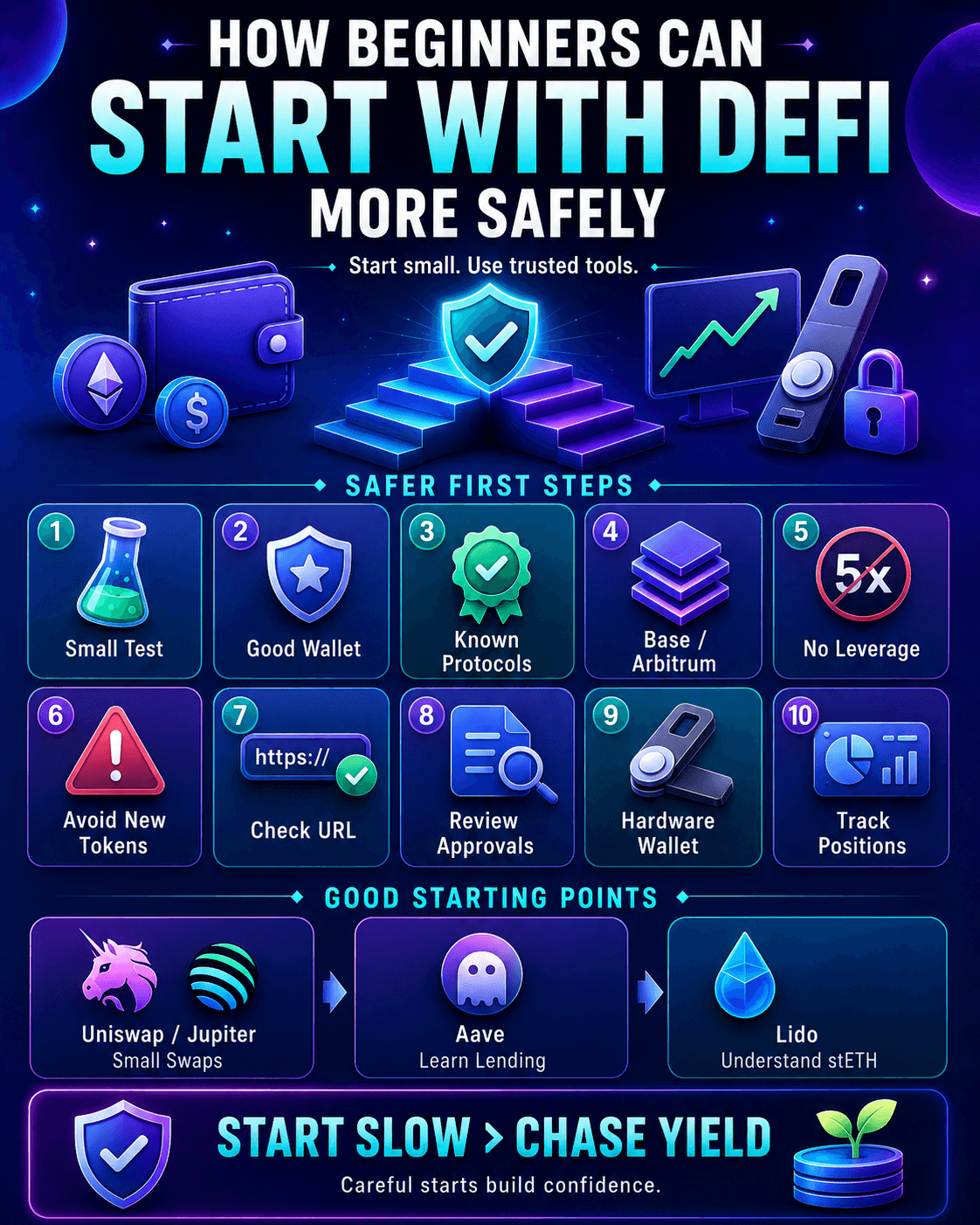 The Safest Way to Start with DeFi is Slowly
- Start with a small test amount.
- Use a reputable Crypto Wallet.
- Stick to known protocols only.
- Start on a lower-fee network or Layer 2 such as Base or Arbitrum.
- Avoid leverage.
- Avoid new tokens with thin liquidity.
- Check the URL carefully before connecting a wallet.
- Review token approvals before signing.
- Keep long-term funds in a hardware wallet.
- Track positions with DeFiLlama, Zapper, DeBank, or wallet dashboards.
Good beginner starting points include small swaps on Uniswap or Jupiter, lending stablecoins on Aave only after understanding liquidation and withdrawal risk, and staking ETH through Lido only after understanding how stETH works. DeFi gets easier once the basics become routine. A careful start usually teaches more than chasing yield too early.

Best DeFi Projects: Final Verdict
The best DeFi projects in 2026 are less like rivals in one race and more like specialists on a well-built team. Aave, Uniswap, and Lido still make the strongest starting points for most users because they cover the core jobs of lending, swapping, and liquid staking without forcing people straight into DeFi’s deepest end.
From there, the landscape gets more adventurous. Morpho, Pendle, Ethena, EigenLayer, and Ether.fi suit advanced users, while Ondo, Jupiter, Aerodrome, Hyperliquid, and Chainlink show where DeFi is expanding next. The smartest way to choose is simple: pick the job first, then the protocol.