Bitget offers spot trading, futures, and copy trading, but how safe is it after its September 2026 security breach? Despite reporting that customer balances remained intact, the $388 million incident raised serious questions about its custody infrastructure and withdrawal security.
This guide examines Bitget's security measures, Proof of Reserves, Protection Fund, regulatory status, and breach recovery to assess whether it remains a trustworthy exchange in 2026.
Editor's Note (Nov. 12, 2026): We fully updated this article in November 2026 to reflect the latest developments in Bitget's security, regulatory status, and user protections. This update includes an in-depth analysis of the September 2026 security breach, forensic findings, and recovery efforts, alongside updated Proof of Reserves figures and Protection Fund disclosures. We also expanded our coverage of custody risks, account security, withdrawal restrictions, and regional regulations, added a clearer safety assessment methodology, and refreshed our comparison of Bitget with Binance, Bybit, and Kraken.
Quick Answer: Is Bitget Safe in 2026?
Bitget offers strong account security features, Proof of Reserves and a dedicated Protection Fund, but its September 2026 security breach exposed serious weaknesses in internal withdrawal authorization. Bitget reported that customer balances remained intact and completed its withdrawal recovery plan on October 2, 2026. It remains an option for eligible active traders who understand centralized custody risks. However, its recent breach, conditional compensation arrangements and jurisdiction-specific regulatory limitations make it unsuitable as risk-free storage for substantial long-term holdings.
Bitget Safety: Key Findings
-
Security track record: A major breach in September 2026 Bitget suffered approximately $388 million in unauthorized transfers from hot and warm wallets on September 24, 2026. Mandiant and SlowMist identified compromised security infrastructure and withdrawal authorization controls. Bitget reported no customer balance losses or confirmed private-key theft.
-
Proof of Reserves: 115% coverage, with limitations Bitget's October 30, 2026 report disclosed a 115% aggregate reserve ratio across 19 assets. Merkle-tree verification allows users to check their inclusion in a published snapshot, but it does not prove full solvency, cover undisclosed liabilities or guarantee future withdrawals.
-
Customer protection: The Protection Fund is not insurance Bitget reported using its Protection Fund to absorb the September breach and subsequently replenished its resources. However, compensation depends on eligibility and investigation. The fund does not guarantee reimbursement for phishing, trading losses, insolvency or every future security incident.
-
Custody security: Layered wallets still carry counterparty risk Bitget uses hot, warm and cold wallet infrastructure, alongside internal authorization controls. Its September breach demonstrated that attackers can exploit withdrawal systems without confirmed private-key theft. Exchange customers remain dependent on Bitget's custody and transaction approval processes.
-
Account protection: Multiple security controls are available Bitget supports passkeys, hardware security keys, authenticator-based 2FA, withdrawal whitelisting, anti-phishing codes, device management and restricted API permissions. These features help prevent account takeovers but cannot eliminate exchange-level custody or insolvency risks.
-
Withdrawals: Restored after the breach, but interruptions remain possible Bitget suspended withdrawals following the September 24 attack and reopened services in stages, completing its announced recovery plan on October 2, 2026. Future network maintenance, security changes, KYC reviews and account restrictions can still delay access to funds.
-
Regulation: Legal protections vary by jurisdiction Bitget disclosed an Austrian MiCAR application in July 2026, but no matching authorization was identified in the ESMA CASP register checked in November. Bitget Global restricts U.S. users, while UK onboarding limitations and Australia's warning about unlicensed futures highlight regional compliance concerns.
-
Overall verdict: Suitable for limited trading exposure, with caution Bitget may suit eligible traders who need spot, futures or copy-trading services and keep only necessary working balances on the exchange. Its recent breach, custody arrangements and conditional protection mechanisms make securely managed self-custody a more appropriate consideration for substantial long-term holdings.
Disclaimer
This assessment uses publicly available information through Nov. 12, 2026. This article is for educational purposes only and does not constitute financial, investment or legal advice.
Disclosure
Some links in this guide may be affiliate links. If you choose to use a service through these links, we may earn a commission at no additional cost to you.

Bitget Safety At A Glance
| Assessment Area | Information |
|---|---|
| Security record | A material September breach; published forensic investigations and subsequent remediation disclosures |
| Customer asset custody | Hot, warm, and cold wallet layers; users retain exposure to exchange-controlled authorization systems |
| Proof of Reserves | October publication reported 115% coverage across 19 assets; a snapshot with limited scope |
| Protection Fund | Replenishment disclosed after the breach; compensation remains subject to eligibility and assessment |
| Regulation | Permissions and restrictions depend on the contracting entity, jurisdiction, and service |
| Withdrawal reliability | Incident-related suspension ended; network maintenance and individual restrictions can still interrupt access |
| Account security | Documented passkeys, 2FA, whitelisting, device controls, and API permissions |
| Overall assessment | Consider for working trading balances; substantial residual counterparty risk remains |
| Best For | Not Ideal For |
|---|---|
| Eligible traders who understand custody and execution risks | Users seeking guaranteed compensation or bank-like deposit protection |
| Users prepared to configure security and maintain withdrawal backups | Beginners who may confuse platform safeguards with protection from leveraged losses |
| Traders keeping balances proportionate to their activity | Holders concentrating substantial long-term savings on one exchange |
How We Assessed Bitget's Safety (Methodology)
An exchange needs evidence across several independent layers before it deserves a favorable safety judgment. A certificate, reserve percentage, or emergency fund answers only part of the question.
We assess Bitget across six criteria, giving custody and actual incident outcomes the greatest weight. That reflects the central risk of a centralized exchange: customers depend on the operator to protect and return assets.
| Assessment Criterion | Weight | High Assessment Requires | Medium Assessment Means | Low Assessment Means |
|---|---|---|---|---|
| Asset custody and cybersecurity | 25% | Independently examined wallet controls, access separation, and remediation evidence | Documented controls with incomplete independent validation | Material control failures with inadequate remediation evidence |
| Security history and incident response | 20% | Effective containment, transparent investigation, and independently supported recovery | Material breach followed by documented but partly self-reported recovery | Ongoing compromise, opaque losses, or unresolved customer impairment |
| Financial transparency and protection | 20% | Broad liability coverage, independent assurance, and clear compensation rights | Verifiable reserve tools or a fund with scope and legal limitations | Documented backing shortfalls or materially misleading disclosures |
| Regulation and legal safeguards | 15% | Relevant authorization and clear custody rights for the user's entity | Partial permissions or uncertain recovery rights | Prohibited access or unlicensed regulated services in the relevant jurisdiction |
| Operational reliability and access to funds | 10% | Substantiated availability, clear restrictions, and effective escalation | Temporary disruption or incomplete performance evidence | Persistent, documented inability to access eligible funds |
| Individual account-security controls | 10% | Strong controls independently tested, including recovery and withdrawal paths | Strong documented features without end-to-end testing | Material weaknesses in authentication or withdrawal safeguards |
Evidence was checked on Nov. 12, 2026. The assessment prioritizes regulator records, contract terms, original forensic reports, and dated reserve disclosures. Company statements are identified where they establish the reported outcome rather than independently prove it. Unverified customer complaints do not carry the same weight as documented failures.
Was Bitget Hacked? Its September 2026 Security Incident Explained
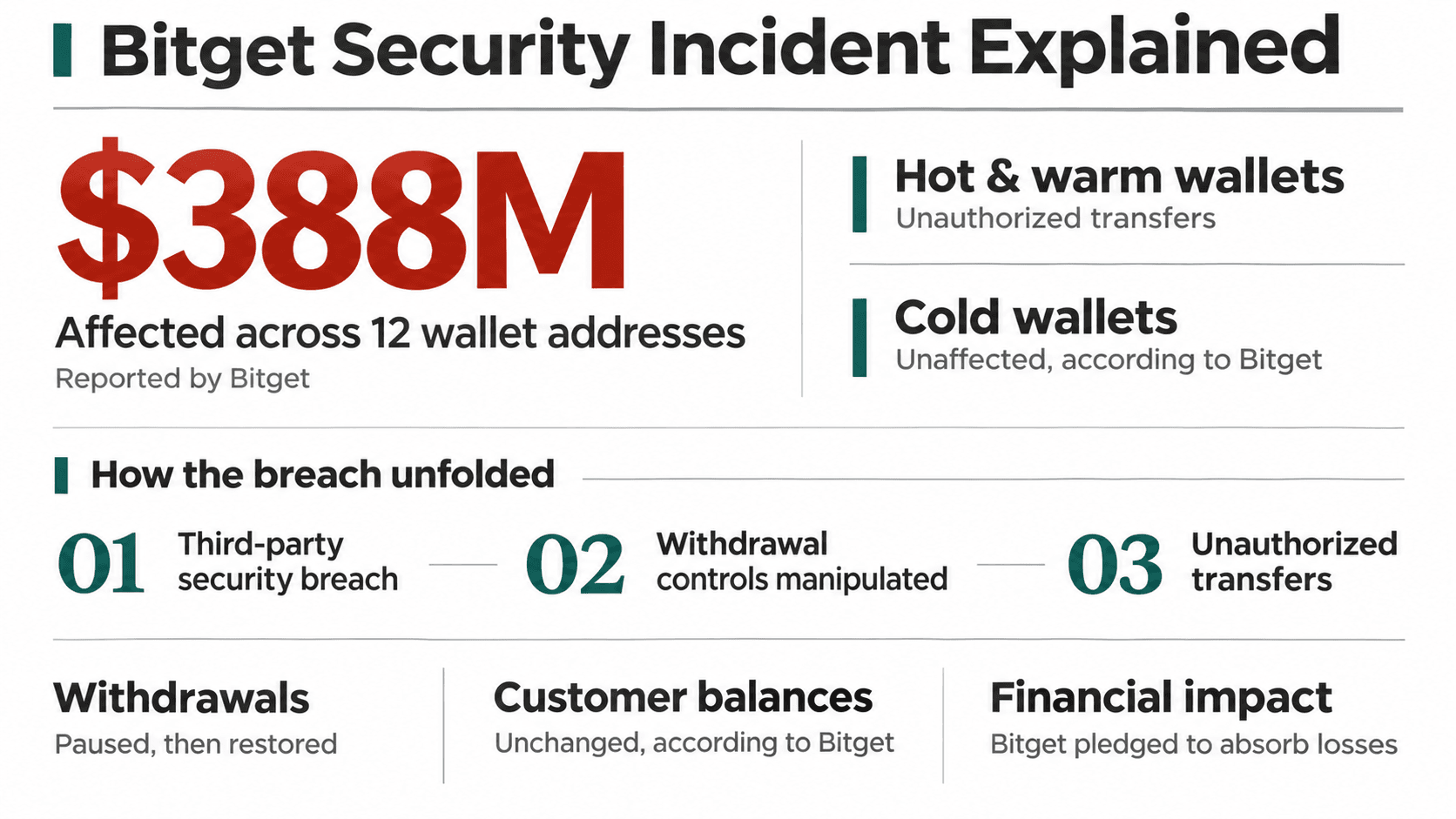
Yes. Bitget experienced unauthorized transfers from hot and warm wallet infrastructure on Sept. 24, 2026. Published investigations support a compromise of internal systems used to process withdrawals, while Bitget reported that customer ledger balances and cold wallets remained unaffected.
 Inside Bitget’s September Breach and Its Recovery Response
What Happened During the Sept. 24, 2026 Hack?
The attacker obtained privileged access through third-party security infrastructure and used it to reach Bitget's wallet environment. Bitget's final incident accounting put the affected amount at approximately $388 million across 12 wallet addresses.
The two forensic reports describe the intrusion in more detail, though their findings cover different stages of the investigation. Mandiant's Sept. 28 status report identified privileged access to two security appliances, a web shell, and lateral movement into a production wallet job server. Its findings were preliminary, with the investigation still ongoing.
SlowMist's investigation progress report traced the earliest logged malicious activity to Aug. 31, 2026. It identified a zero-day vulnerability affecting one security product and recovered a customized withdrawal tool. The tool forged risk-control parameters to invoke the withdrawal process. SlowMist also cautioned that its analysis depended on the materials supplied for examination.
This attack illustrates why protecting private keys is only one part of custody security. An attacker who can make a legitimate signing system accept fraudulent instructions may move assets without extracting the signing keys. Bitget disclosed no private-key compromise, and Mandiant recorded that Bitget had found no evidence of one.
Were Customer Funds Affected, and How Did Bitget Respond?
Bitget stated that customer balances remained accurate and that it would absorb the financial impact through its Protection Fund.
| Date | Incident And Recovery Milestone |
|---|---|
| Sept. 24, 2026 | First unauthorized transfer at 18:31 UTC; reconciliation discrepancy detected at 19:05 UTC; platform withdrawal requests blocked |
| Sept. 24, 2026 | Highest-level emergency response activated at 19:14 UTC; wallet withdrawal and signing services shut down at 21:44 UTC |
| Sept. 25–26, 2026 | Root cause identified; isolation, remediation, and security checks preceded a phased reopening plan |
| Sept. 28–30, 2026 | BTC, ETH, and USDT withdrawals reopened in stages; forensic reports and fund-replenishment updates became available |
| Oct. 2, 2026 | Remaining token withdrawals, fiat, and C2C services restored, completing the announced recovery plan |
Bitget subsequently disclosed credential resets, permission reviews, third-party remediation, and stronger multi-level withdrawal approvals. These measures address the identified failure path. The forensic reports establish findings about the intrusion; they do not certify every production control deployed afterward.
How Does Bitget Protect Customer Funds and Accounts?
Bitget combines exchange-controlled custody safeguards with settings customers can enable. Each layer addresses different threats, so users need both a defensible custody arrangement and a properly secured account.
Bitget's Cold Storage, Wallet Infrastructure and Security Controls
Bitget describes a three-tier wallet architecture using hot, warm, and cold storage. The layers differ in their exposure and accessibility:
- Hot wallets: Online infrastructure processes routine withdrawals. Fast access also gives attackers an accessible target.
- Warm wallets: An intermediate operational layer replenishes hot wallets under additional controls. The exact implementation varies between custodians.
- Cold wallets: Offline signing arrangements isolate keys from routine online infrastructure. Moving assets still requires a secure authorization process.
Offline private-key generation, controlled key access, and multi-signature approval can reduce the chance that one compromised device or employee releases funds.
September exposed a weakness in the route from internal access to transaction execution. Cold wallets reportedly remained outside the compromised environment, but substantial operational assets were accessible through fraudulent instructions.
Bitget announced ISO/IEC 27001:2022 certification in August 2024. ISO 27001 concerns an information security management system. Its value depends on the certified entity, scope, validity, and surveillance process.
For users, crypto security starts with understanding which risks a setting actually addresses. An exchange certificate cannot replace withdrawal controls, and a customer passkey cannot repair vulnerable exchange infrastructure.
Account Security Features Users Can Enable
Bitget documents a useful set of account controls, including passkeys and external security keys such as YubiKey. Compatible FIDO2 security keys provide phishing-resistant authentication without requiring users to type a reusable login code into a website.
Prioritize these settings before depositing a meaningful balance:
- Secure login and recovery. Use a unique password, protect the linked email account, and add a passkey or compatible hardware security key. Keep a secure backup authentication method.
- Enable authenticator-based 2FA. Bitget supports Google Authenticator. An authenticator avoids SMS-specific risks such as SIM swapping, although typed codes can still be phished.
- Restrict withdrawals. Activate the withdrawal whitelist and verify saved addresses carefully. An approved address is only useful if it belongs to the intended recipient and supports the chosen network.
- Check communications and devices. Set an anti-phishing code, verify unfamiliar messages through Bitget's official verification channel, and review trusted devices and security alerts. A familiar code should never override a suspicious request.
- Limit API access. Grant only the permissions an integration needs, bind permitted IP addresses, and revoke unused keys. Bitget's API documentation distinguishes trading, transfer, and withdrawal permissions; a trading bot rarely needs unrestricted asset-transfer powers.
Together, these controls reduce account takeover and withdrawal abuse. They do not protect against exchange insolvency or a compromise of internal wallet authorization.
Bitget Wallet is a separate self-custodial product with a different custody arrangement. Bitget stated that its Wallet infrastructure was unaffected by the exchange incident.
Can Bitget's Proof of Reserves Be Trusted?
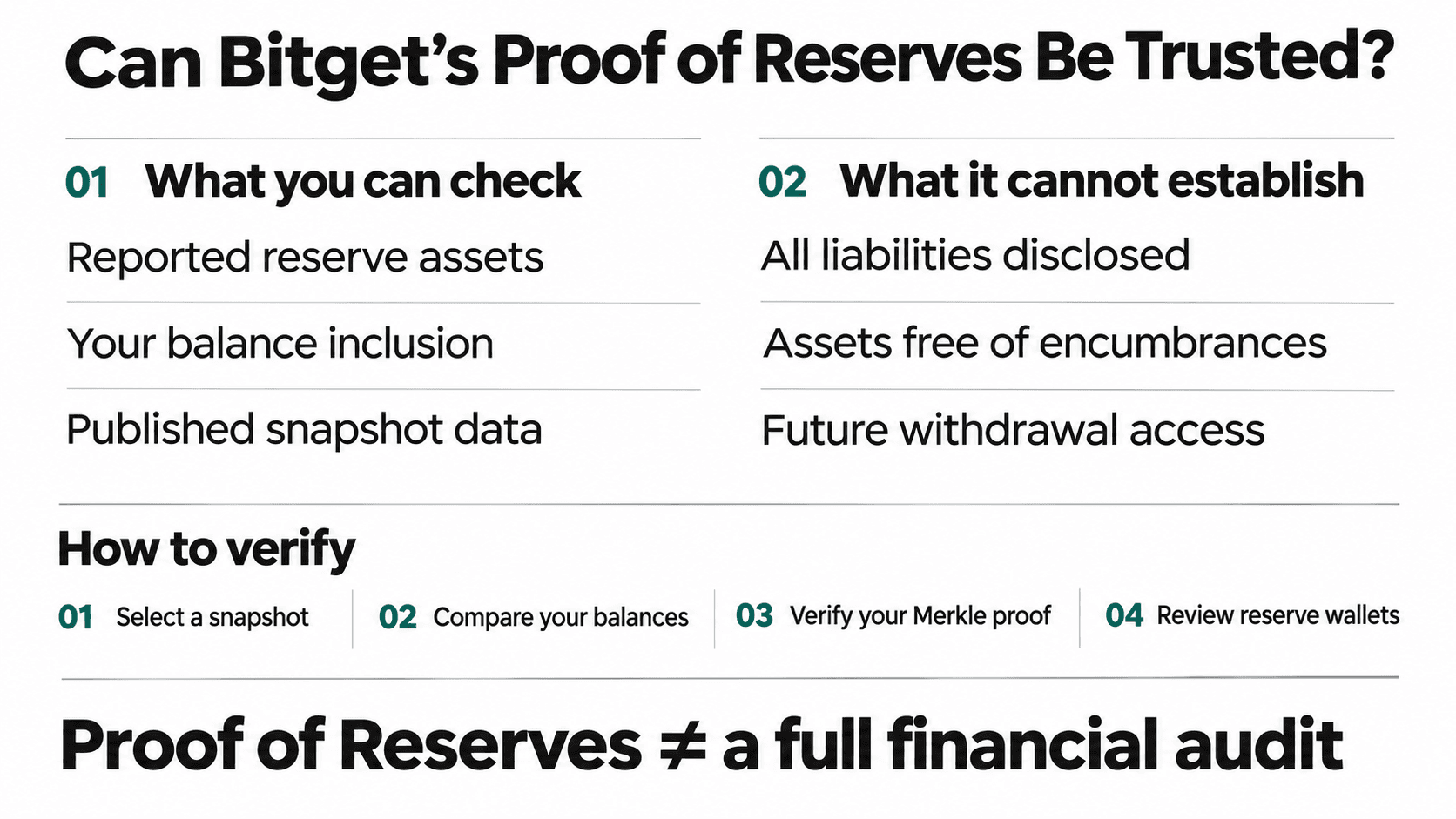
Bitget's Proof of Reserves provides useful evidence about declared assets and covered balances at a particular time. It does not establish the exchange's complete financial condition or guarantee that withdrawals will remain available.
 Examining Bitget’s Reserve Coverage, Verification Tools and Limitations
What Bitget's Latest Reserve Figures Show
Bitget's Oct. 30, 2026 publication reported a 115% aggregate reserve ratio across 19 covered assets. Its monthly program had expanded from four assets in September, broadening the balances users could examine.
| Report | Publication Date | Underlying Snapshot Date | Aggregate Ratio | Asset Coverage |
|---|---|---|---|---|
| September update | Sept. 30, 2026 | Sept. 29, 2026, at 09:00 UTC | 131% | 19 assets |
| October update | Oct. 30, 2026 | Separate capture time should be taken from the selected PoR record; publication date is not the snapshot timestamp | 115% | 19 assets |
The September snapshot reported every covered asset above 100%. October's release likewise reported at least 1:1 backing for tracked assets, including reserves associated with BTC, Ethereum, Tether (USDT), and USD Coin (USDC).
A 115% aggregate ratio means reported reserve value exceeded the covered liability value by 15% under that calculation.
The decline from 131% does not itself establish insolvency, since reserve ratios move with customer liabilities, withdrawals, asset composition, prices, and methodology. Comparing identical assets under identical assumptions is more informative than comparing the headline percentages alone.
How to Verify Bitget's Reserves and Understand Their Limitations
Users can verify whether their balances were included in a disclosed snapshot through a Merkle tree. This structure combines account records into a root hash, allowing an individual to check inclusion without seeing every other user's balance.
The Bitget verification process follows these steps:
- Open the official Proof of Reserves page while logged in and select the relevant snapshot.
- Choose My Proof Of Assets and compare the included balances with your records for that timestamp.
- Use the verification function to check the path from your account record to the published Merkle root.
- For local verification, download the proof data and use Bitget's open-source MerkleValidator from its official repository.
- Separately examine the disclosed reserve addresses and the evidence of wallet control. Do not confuse an address's balance with a complete statement of customer liabilities.
Successful inclusion proves that your record belongs to the published dataset. It cannot establish that every other customer obligation was included, that reserve assets are free of encumbrances, or that the exchange has no undisclosed borrowing or corporate debts.
The assurance available depends on the type of evidence:
- Cryptographic verification checks specified data and relationships, such as inclusion in a Merkle tree.
- Third-party attestation or verification examines defined assertions under a stated scope and procedure.
- A financial-statement audit examines financial statements under applicable auditing standards, including a broader view of liabilities and disclosures.
Does Bitget's Protection Fund Insure Customer Deposits?
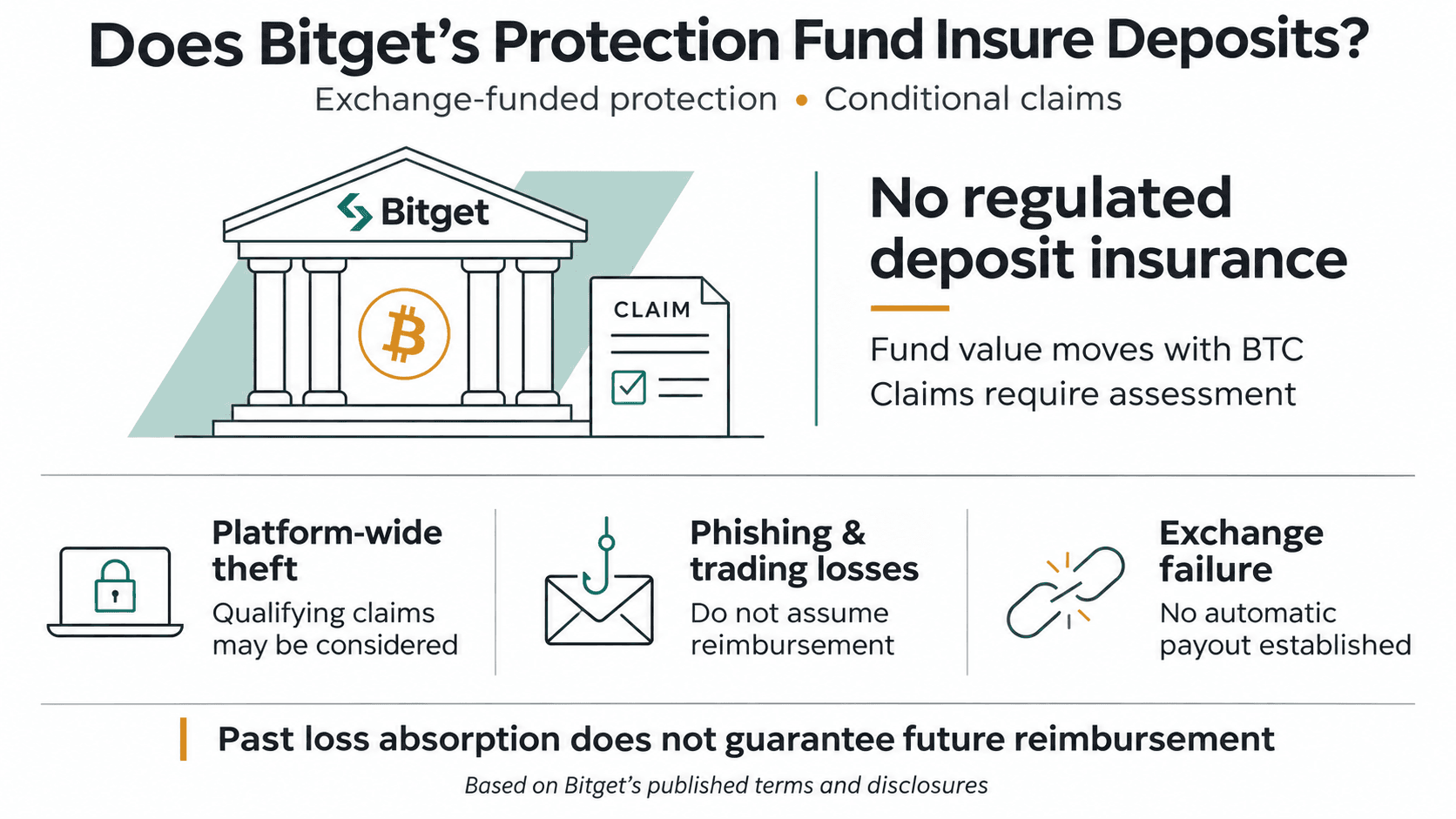
No. The Bitget Protection Fund is an exchange-funded financial safeguard with conditional claims procedures. It does not establish regulated deposit insurance or an unconditional right to reimbursement.
 Understanding Bitget’s Protection Fund Coverage and Payout Limitations
How the Bitget Protection Fund Works and Was Used After the Hack
Bitget established the fund to provide an additional pool of assets for qualifying losses. Following September's breach, it disclosed that the fund absorbed the incident's financial impact, allowing customer account balances to remain unchanged.
The disclosures track the fund before and after replenishment:
| Reporting Point | Disclosed Fund Position | How To Read It |
|---|---|---|
| Sept. 24, 2026 incident notice | More than $464 million | Pre-replenishment incident-era valuation; not a current balance |
| Sept. 30, 2026 announcement | Replenished above $300 million | Dated company disclosure of restored financial resources |
| Incident hub last updated Oct. 13, 2026 | 3,705 BTC and more than $314 million | Published post-replenishment figures; not a verified November valuation |
The Sept. 30 replenishment announcement and Oct. 13 incident hub support those historical figures.
The Protection Fund page provides the route to its disclosed wallet information. Users can follow official addresses to a blockchain explorer, record the BTC quantity and time, and apply a price from the same timestamp. Address visibility alone does not establish exclusive ownership, absence of pledges, or legal ring-fencing.
Because the fund holds Bitcoin, its dollar value fluctuates. Even a constant BTC balance can fund less compensation during a market decline, especially when losses are measured in dollars or stablecoins.
Bitget describes the fund as separate from PoR backing.
What Losses Does the Protection Fund Actually Cover?
The published policy centers on qualifying platform-wide events. Bitget reserves the right to assess claims and investigate losses, which makes eligibility and investigation central to any payment.
| Loss Scenario | Documented Position | Compensation Implication |
|---|---|---|
| September 2026 platform breach | Bitget disclosed use of the fund to absorb the loss | Evidence of a past response; no universal future guarantee |
| Future platform-wide theft unrelated to user actions or trading | Users may submit qualifying claims | Assessment and investigation apply |
| Individual phishing or stolen personal credentials | Not established as blanket coverage; user-attributable events fall outside the stated platform-event eligibility | Reimbursement should not be assumed |
| Liquidation, poor trades, or copy-trading losses | Trading behavior falls outside the stated eligibility | No basis to treat the fund as trading-loss insurance |
| Insolvency, business failure, or operational interruption | No automatic payout or bankruptcy-remote entitlement verified | Coverage and recovery rights remain unestablished |
Bitget's explanatory material also describes a 30-day claim submission window. Anyone making a claim should obtain the applicable process and decision in writing.
The FDIC does not insure crypto assets or protect against the failure of a crypto exchange. An exchange-operated fund also differs from an independently underwritten insurance policy with defined insured parties, limits, and exclusions. Its usefulness depends on available resources and the operator's ability and obligation to deploy them.
Is Bitget Regulated, and Who Legally Holds Your Crypto?
Bitget's legal protections depend on the entity serving you, the services you use, and your jurisdiction. A registration in one country cannot establish authorization for every activity worldwide.
Bitget's Regulatory Status and Country Restrictions
AML registration for a virtual asset service provider does not necessarily authorize derivatives, establish custody protections, or create compensation rights.
| Jurisdiction | Verified Status | Access Or Service Implications | Regulatory Implication |
|---|---|---|---|
| United States | Listed among Bitget Global's prohibited countries in the reviewed Terms of Use | U.S. users are excluded under those terms | Overseas registrations do not override the restriction |
| EU/EEA | July 2026 Austrian MiCAR application disclosed; no Bitget match found in ESMA's downloadable CASP register checked November 6, 2026 | No verified MiCAR authorization for Bitget was established; Global's terms also prohibit several EU countries | An application does not confer CASP permission |
| United Kingdom | Bitget's published UK notice restricts new-user onboarding pending compliance measures | No later official reopening notice was verified here; retail crypto derivatives remain subject to FCA restrictions | Website accessibility does not establish permission or eligibility |
| Australia | ASIC warned about unlicensed Bitget crypto futures offered by BTG Technology Holdings Limited and related entities | ASIC states that Bitget lacks the AFS licence required for those financial products | AUSTRAC registration would not substitute for derivatives authorization |
Bitget disclosed its Austrian application on July 2, 2026. We searched the ESMA CASP register for Bitget across its fields, including commercial names and websites, and found no match. That finding supports withholding an authorization claim; it does not establish the confidential status of the application within the FMA.
ESMA's statement on the end of MiCA transitional periods explains the requirement for authorization and the narrow reverse-solicitation exception for non-EU firms. Ordinary access to a global website should not be mistaken for EU regulatory protection.
In Australia, ASIC's warning specifically concerns unlicensed financial products and missing investor safeguards. AUSTRAC registration addresses a different regulatory function. In the UK, Bitget's onboarding restriction notice and the FCA's retail crypto-derivatives rules should be read separately.
When a jurisdiction becomes restricted, an exchange may stop onboarding, limit trading, or require account closure and withdrawals within stated deadlines. Security and compliance reviews can still affect access during that process. Existing users should preserve transaction records and follow the official entity-specific exit instructions.
Are Customer Assets Segregated, and What Happens if Bitget Fails?
Bitget Global's reviewed terms describe a ledger-based entitlement, with no on-chain segregation from other users' and business assets. That creates a different legal and operational arrangement from controlling assets through a self-custodial wallet.
Section 19.12 of the Terms of Use states that credited digital assets are not segregated on-chain into separate wallets from other customer assets or assets maintained for business purposes. It also disclaims trustee duties and describes the user's right to receive the same type and quantity of assets credited to the account.
Those provisions do not, by themselves, prove customer assets have been misused. They do, however, mean an individual balance is not a dedicated, identifiable collection of coins in a wallet reserved for that customer. Offline storage describes technical protection; legal segregation concerns ownership, enforceability, and recovery rights.
If the operator fails, recovery depends on the applicable entity, governing law, asset treatment, and insolvency proceedings. The reviewed evidence does not justify declaring a universal creditor priority or guaranteed recovery percentage. The global terms identify BTG Technology Holdings Limited; users contracting through another entity need that entity's documents.
There is also a newly announced alternative custody route. Bitget launched its Open Custody Network on Nov. 5, 2026, describing trading access backed by assets held with participating external providers. That arrangement requires its own eligibility, settlement, and custody review. It does not automatically change the rights attached to an ordinary exchange balance.
What Risks Remain When Using Bitget?
Users can lose access through restrictions or outages, and lose money through market exposure, even when their accounts have not been hacked. These risks require different responses.
Withdrawal Suspensions, Frozen Accounts and Compliance Reviews
A platform-wide suspension affects withdrawal infrastructure or a service route. An account restriction applies to a particular user, often because of security checks, identity verification, or compliance review. September's shutdown demonstrated the first risk; routine KYC and AML screening can create the second.
Bitget documents 24-hour restrictions after certain security changes, including password and authentication resets. Pending KYC, unusual activity, open orders, copy trades, and Earn positions can also reduce what is immediately withdrawable. The displayed total balance may therefore include funds that remain committed elsewhere.
Use this sequence to identify the problem:
- Is there an official service notice? If yes, identify the affected asset, network, or platform function and the latest restoration update.
- Is the restriction account-specific? Read the security and KYC prompts. Check recent credential changes and any requests for additional information.
- Are the funds available? Review open orders, margin, product lockups, unsettled transactions, and the available withdrawal balance.
- Has a transaction been broadcast? A transaction hash points toward blockchain confirmation or receiving-platform checks. No hash may indicate processing inside the exchange.
- Does it require review? Open a ticket through official support, supply the requested evidence securely, request the escalation or appeal route, and preserve case numbers and responses.
Blockchain congestion and an exchange-imposed compliance hold have different causes. Repeatedly submitting withdrawals will not resolve a compliance review. Never send a private key or recovery phrase to anyone offering to unlock the account.
Public complaints can reveal recurring issues worth investigating, but they rarely disclose the complete compliance record. No representative withdrawal-failure rate or independently tested support-resolution time was established here. That limits operational confidence without proving that every complaint reflects a platform failure.
Futures, Copy Trading and Platform Reliability Risks
Perpetual futures introduce leverage, liquidation, and funding exposure alongside custody risk. An account can lose its collateral through normal contract mechanics while the exchange remains solvent and uncompromised.
Bitget uses mark prices and maintenance-margin rules in its liquidation framework. That mark price can differ from the last traded price displayed on a chart. If the relevant equity falls below the required margin, positions may be liquidated; funding payments can further reduce equity over time.
An outage adds another problem: the trader may be unable to add collateral, close exposure, or cancel an order while prices continue moving. Stop-loss orders also depend on triggering and execution conditions, so their presence does not establish a guaranteed exit price.
Copy trading passes strategy decisions to a lead or Master Trader without transferring away the follower's losses. Trader selection, leverage, timing, and slippage can produce a different outcome from the leader's published performance. Bitget's copy-trading guide also documents copy failures and execution controls, which can leave followers with incomplete replication.
Before connecting automation, check permission scope, maximum order size, margin mode, disconnection behavior, and how to revoke access. Even a correctly functioning API can execute a losing strategy. Bitget's Protection Fund should not be assumed to reimburse liquidation, ordinary trading losses, or losses from following another trader.
Is Bitget Safer Than Binance, Bybit and Kraken?
There is no defensible universal winner across these exchanges. The stronger comparison examines incident outcomes, financial assurance, and jurisdiction-specific rights using consistent definitions. A larger reserve ratio cannot settle those questions.
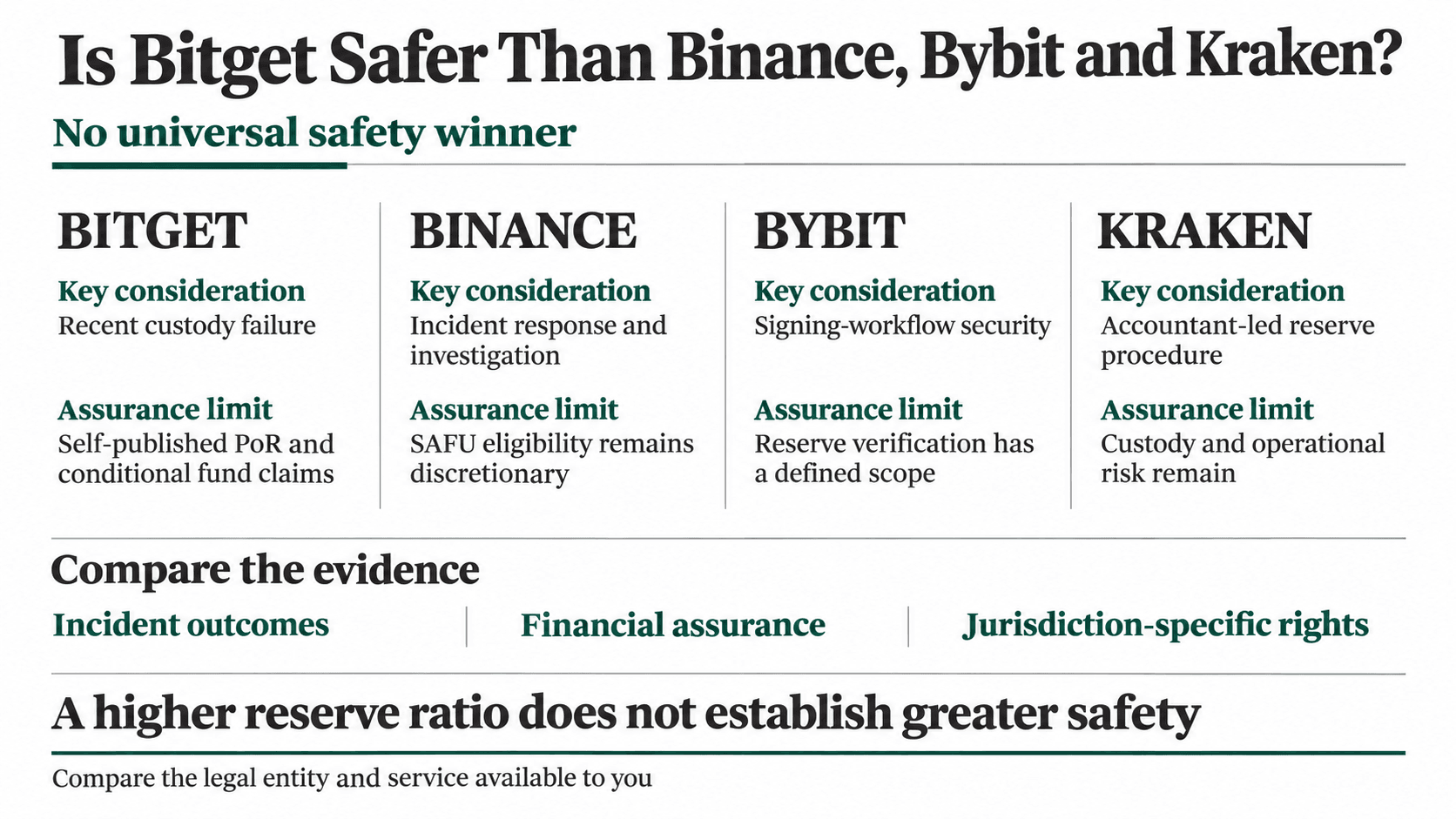 Comparing Bitget’s Security With Binance, Bybit and Kraken
The comparison below reflects evidence checked on Nov. 12, 2026. Historical incidents are identified by date; they should not be treated as measurements of current attack probability.
| Criterion | Bitget | Binance | Bybit | Kraken |
|---|---|---|---|---|
| Material security incidents | Sept. 24, 2026 wallet-infrastructure breach; approximately $388 million | 7,000 BTC stolen in 2019; separate Oct. 29, 2026 incident reported at approximately $6.34 billion | Approximately $1.5 billion stolen in February 2025 | June 2024 funding-system bug; Kraken reported no customer assets affected |
| Custody protections | Layered wallets; internal authorization failures exposed in September | Operational-wallet authorization examined in ongoing October investigation | Multisig cold-wallet transaction workflow compromised in 2025 | Funding controls patched after the 2024 vulnerability; custody still depends on the operator |
| Reserve transparency | Monthly self-published Merkle-tree PoR; 19 assets in October report | PoR with Merkle/zero-knowledge verification tools; recent remediation requires careful snapshot reading | October 27, 2026 snapshot reported 50 assets and Hacken verification | Independent accountant-led PoR procedure; published asset scope and snapshot limitations |
| Financial protection mechanism | Exchange-funded Protection Fund; claims assessed | SAFU and company funds; eligibility remains discretionary | Reported loss absorption and reserve restoration; derivatives insurance fund serves a separate purpose | No comparable universal customer-compensation fund verified here |
| Regulatory coverage | Austrian application disclosed; no Bitget entry found in ESMA CASP file | Entity-specific permissions, including ADGM arrangements; access varies | Bybit EU GmbH listed as MiCAR-authorized | Kraken entities listed as MiCAR-authorized; other permissions vary by service |
| Account-security controls | Passkeys, authenticator 2FA, withdrawal whitelist, restricted APIs | Passkeys, 2FA, and withdrawal-address controls | Passkeys, 2FA, and withdrawal-security settings | Passkeys, 2FA, Master Key, and Global Settings Lock |
| Main user-protection limitation | Recent breach plus unresolved full-liability and compensation assurance | Very recent material breach and ongoing investigation | Severe historical signing-workflow failure; regional entities differ | PoR and authorization still do not eliminate custody or operational risk |
For eligible EU users prioritizing an identifiable MiCAR-authorized counterparty, Kraken or Bybit EU offers a clearer starting point than Bitget's pending application. Experienced traders considering Bitget should weigh its trading utility against recent custody and access failures. Switching to Binance solely on brand size would overlook its recent incident.
For product-level differences, our Binance vs. Bitget comparison and Bitget vs. Bybit comparison provide broader context.

Final Verdict: Should You Trust Bitget With Your Crypto?
Bitget deserves consideration as a trading venue for eligible users, but the evidence supports a conditional safety judgment and limited counterparty exposure. Its account controls, reserve disclosures, Protection Fund, and reported preservation of customer balances are meaningful strengths. Still, the breach and withdrawal shutdown show the consequences when exchange-side controls fail.
For active traders, keeping a working balance proportionate to planned activity is more defensible than treating Bitget as a default savings account. Configure security, confirm local eligibility, and retain a practical withdrawal route. Beginners should understand the product before depositing, especially when copy trading or leverage is involved.
For high-balance and long-term holders, reserve percentages leave too many questions unanswered about legal recovery, future compensation, and access during disruption. Properly managed self-custody can reduce exchange counterparty exposure, while transferring responsibility for recovery and signing to the holder. Our hardware wallet comparison helps assess that trade-off.
Coin Bureau's overall assessment is cautious, Bitget can serve a defined trading purpose, but users should accept its custody and regulatory limitations explicitly and keep exchange exposure within an amount they can afford to have inaccessible or at risk.