Last Updated: February 21st, 2026|70 mins

Crypto Tax Free Countries You Should Know in 2026

Education

Crypto wealth is global by default, but tax systems are not. As portfolios grow and bull cycles return, the question shifts from “what should I buy?” to “where should I live?” For many investors, relocation feels like the cleanest way to protect gains. Yet the reality is more layered. Tax residency rules, exit regimes, business classification, and lifestyle trade-offs all shape the outcome more than a headline rate ever will.

This guide breaks down what actually works in 2026. Not just the countries that advertise 0%, but the conditions, timing, and structural decisions that determine whether a move meaningfully reduces your tax burden. The goal is clarity over hype, so you can evaluate relocation as a strategic decision, not a reaction to market noise.

Editor’s Note: We fully updated this guide in February 2026 to reflect how crypto tax “havens” actually work in practice, not just on headlines. This refresh adds a faster Quick Answer shortlist, a new 2026 comparison table for side-by-side rule checks, and a 90-second “find your best fit” filter based on passport, crypto activity and budget. We also rebuilt the country section into consistent profiles, expanded the relocation playbook with documentation and day-counting guidance, and added clearer coverage of exit tax traps and business reclassification. As always, tax rules can change, so treat this as a starting point and confirm specifics with a qualified tax professional before acting.

Quick Answer: The Best Crypto Tax-Free Countries in 2026

Use this to shortlist fast. “0%” depends on your passport, your activity (investor vs business), and whether you actually become resident.

Best Picks by Profile

  • Best true 0% overall: UAE (Dubai / Abu Dhabi) — 0% personal income + capital gains · Residency: medium (visa route) · Fits: non-US investors who can relocate cleanly.
  • Best for active traders: UAE — 0% on personal gains · Residency: medium · Fits: frequent traders who want a clear headline regime (watch business optics).
  • Best for long-term HODLers: Germany (or Portugal) — 0% after 12+ months · Residency: medium to hard (EU admin) · Fits: patient sellers with low turnover.
  • Best for US citizens: Puerto Rico — potential 0% on qualifying post-move gains · Residency: hard (bona fide tests + compliance) · Fits: US holders willing to truly relocate.
  • Best “budget move” option: El Salvador — 0% on qualifying digital assets · Residency: easier/cheaper than most · Fits: low-budget, Bitcoin-centric relocators (expect banking friction).

60-Second Reality Check

  • “Tax-free” ≠ “no reporting:” Most serious jurisdictions still expect declarations, records, and clean source-of-funds proof.
  • Your citizenship may still tax you (US): Moving abroad alone doesn’t reset US tax; only narrow frameworks materially change outcomes.
  • Many “0%” regimes still tax business activity: mining, validator income, employment income, and organized/structured trading can fall into income or corporate layers.
Coinbase

2026 At-a-Glance Comparison Table

Once you know roughly where you fit, the next move is comparison, not storytelling. You need a side-by-side view of how the main jurisdictions treat personal crypto gains, what happens if your activity looks like a business, and what it realistically takes to become resident in 2026.

This is not meant to be academically exhaustive. It is meant to help you eliminate obvious non-fits fast. These are the 2026-current headline rules for individual investors. Corporate structuring, exit taxes, and edge cases require deeper modelling.

CountryPersonal Capital GainsShort-Term RulesBusiness Classification RiskStaking / DeFiResidency RouteSetup Cost (Est.)Best ForBiggest Catch
UAE (Dubai / Abu Dhabi)0% personal income & capital gainsNo long/short distinction9% corporate tax if activity deemed a businessGenerally 0% personally; corporate tax if structured via companyFree-zone company + visa, employment visa, golden visa$5k–$20k+Active traders & high-volume investorsCorporate reclassification risk + higher living costs
El Salvador0% on qualifying digital assetsNo formal holding period distinctionMining or structured activity can trigger income/corporate taxOften aligned with gains unless clearly business-likeInvestor or temporary residence<$10kBudget Bitcoin-centric investorsBanking friction + emerging-market institutional risk
Germany0% after 1-year holding period<12 months taxed at progressive income ratesHigh-frequency trading may trigger professional statusTaxed as incomeEU work, Blue Card, self-employment$5k–$15kLong-term HODLersStrict enforcement + high short-term taxation
Portugal0% if held >12 months<365 days taxed ~28%Professional trading taxed as incomeUsually taxed as incomeD7, D8 digital nomad, EU routes$5k–$15kPatient investors & remote workersNo longer a blanket 0% regime
SingaporeNo capital gains taxFocus is on business classificationFrequent trading taxed as business incomeTaxed as incomeEmployment pass or investor route$15k–$50k+Founders & high-income professionalsHigh cost of living + strict substance standards
Switzerland0% for private investorsNo fixed window; pattern mattersProfessional trader status triggers income tax + social contributionsIncome taxable; annual wealth tax appliesWork, self-employment, wealth permits$20k–$50k+Wealthy conservative HODLersWealth tax + classification scrutiny
Puerto Rico (US only)0% local tax on qualifying post-move gainsDepends on sourcing & decree rulesBusiness income taxed under local rulesOften treated as incomeBona fide PR residency + Act 60 decree$20k–$100k+High-net-worth US citizensStrict IRS scrutiny + presence tests
Cayman Islands / Bermuda0% personal & corporateNo distinctionSubstance rules apply to companiesStructured at 0% locallyInvestment-based residence programs$50k–$250k+Ultra-high-net-worth individuals & fundsExtremely expensive + fully transparent reporting

This table does one thing well: it shows you that “0% crypto tax” is not one category. There are pure 0% personal regimes, conditional 0% regimes, US-only special cases, and ultra-high-net-worth offshore plays.

Now layer your reality on top of it:

  • Under $10k budget → El Salvador is realistically the only Tier-1 entry point.
  • EU passport + patient strategy → Germany or Portugal often outperform pure tax havens once lifestyle and compliance are priced in.
  • US citizen → Puerto Rico is the only internal lever that meaningfully changes your outcome.
  • High-frequency trader → UAE remains the cleanest headline jurisdiction in 2026.
  • Ultra-high net worth → Cayman or Bermuda becomes viable, but at a real cost.

The table narrows your options. The next section narrows them further using passport, profile, and budget.

Find Your Best Tax Haven in 90 Seconds

You’ve already seen the headline picks and the comparison table. This section is where the article stops being a list and starts behaving like a filter.

Run this in order. Passport first, because some people cannot “move their tax problem away.” Then the crypto profile, because the same country can be perfect for HODLing and terrible for farming yield. Then budget and tolerance, because the cheapest plan that you can actually execute beats the perfect plan you’ll never finish.

If you’re unfamiliar with the term, read our guide on what HODL means in crypto before going further.
Find Your Crypto Tax Haven

Step 1: What passport do you hold?

Before you even look at the UAE, Portugal, or El Salvador, ask one question: Can your home country still tax you after you leave?

  • US passport: The US taxes citizens on worldwide income and gains, so “moving to a 0% country” does not solve the problem by itself. The two realistic levers are Puerto Rico-style frameworks or the extreme option of renouncing. Anything else is a lifestyle move, not a tax reset.
  • EU/UK passports: You usually get taxed based on residency, not citizenship, but the exit process matters. Some countries care about where your life stays anchored, not just how many days you spend abroad. If you cleanly establish residency elsewhere and properly break ties, the UAE and other low-tax hubs can work. Within Europe, Germany and Portugal can be powerful for long-term investors, but the reporting burden is heavier and tightening.
  • Other passports (India, LATAM, SEA, Africa, etc.): Many countries in this bucket also tax residents rather than citizens, which means relocation can genuinely change your tax outcome if you break residency cleanly. The real risk is sloppy execution: leaving behind strong ties, triggering “deemed disposal” style rules, or continuing to operate as if nothing changed.

That’s the passport filter. Now we match the tax regime to how you actually use crypto.

Step 2: What’s your crypto profile?

This is the fork that most “top 10 countries” articles ignore. A jurisdiction that looks perfect for capital gains can turn expensive fast once your activity is treated as income or business revenue.

  • Long-term investor: Your edge comes from holding-period rules and private investor treatment. Germany and Portugal fit this profile well because they reward patience. Switzerland and Singapore can also work when your activity looks like wealth management, not structured trading. The main risk is accidentally behaving like a professional trader through frequency, leverage, or systematic strategies.
  • Active trader: You need jurisdictions where frequent activity does not automatically turn into punitive income tax. UAE is the cleanest headline play for many non-US traders because there’s no personal capital gains tax, but you have to watch the line where you look like a trading business. Cayman and Bermuda are for higher-net-worth setups, not casual retail relocations.
  • DeFi farmer: Here’s where most “0% capital gains” stories fall apart. Staking rewards, farming yield, liquidity incentives, and airdrops often get treated as income-like, even when spot investing gains are treated favorably. You want jurisdictions with low personal tax overall, and where you can cleanly separate personal investing from structured operations. This profile also has the highest recordkeeping burden, because reporting standards are getting stricter.
  • Miner: Mining and validator revenue is rarely treated like casual capital gains. It tends to be business income, which shifts the game to corporate rules, power costs, compliance, and operational substance. A “0% personal gains” country can still be a mediocre mining base if the business layer is taxed, banking is hostile, or infrastructure is unreliable.
  • Founder (token/business): Founders are not picking a tax haven; they are picking an operating jurisdiction. Banking access, legal clarity, counterparties, and investor comfort matter as much as tax. UAE, Singapore, Switzerland, and Cayman/Bermuda appear repeatedly here, but each one demands substance and clean documentation. If you’re building something real, the wrong jurisdiction can block exchanges, banking, or investors, even if the tax rate looks attractive.

Now you’ve narrowed by passport and behavior. Next is the constraint that quietly decides what you’ll actually do.

What’s your budget and tolerance?

This is the reality filter. A plan is only “best” if you can execute it without quitting halfway.

  • Budget under $10k: You’re in lean territory. El Salvador becomes the most realistic Tier-1 option. Some EU routes can be low-cost on paper, but paperwork and timelines can punish low-tolerance movers.
  • Budget $10k to $50k: This is the practical range for most serious relocations. It opens UAE free-zone style residency, Portugal routes, and several EU options depending on your passport and income proof. It also gives you room to pay for proper legal and tax help, which is usually the difference between a clean relocation and future headaches.
  • Budget $50k to $250k: You can afford smoother execution: better advisors, better housing, fewer compromises. Switzerland becomes more viable. UAE becomes easier to structure cleanly. You also have room for layered planning if you’re separating personal investing from business operations.
  • Budget $250k+: At this point, you’re not shopping for a country, you’re designing a system. Puerto Rico starts making sense for US citizens with large portfolios. Cayman/Bermuda structures become realistic if your use case is institutional or fund-like. The main risk here is complexity drift, where you build something impressive that is fragile or impossible to maintain.
  • Low vs high paperwork tolerance: Low tolerance usually points toward friction-light execution hubs, but you still need clean compliance. High tolerance opens more EU-style options where benefits exist, but documentation never ends.

Now we convert all of that into a short list you can actually use.

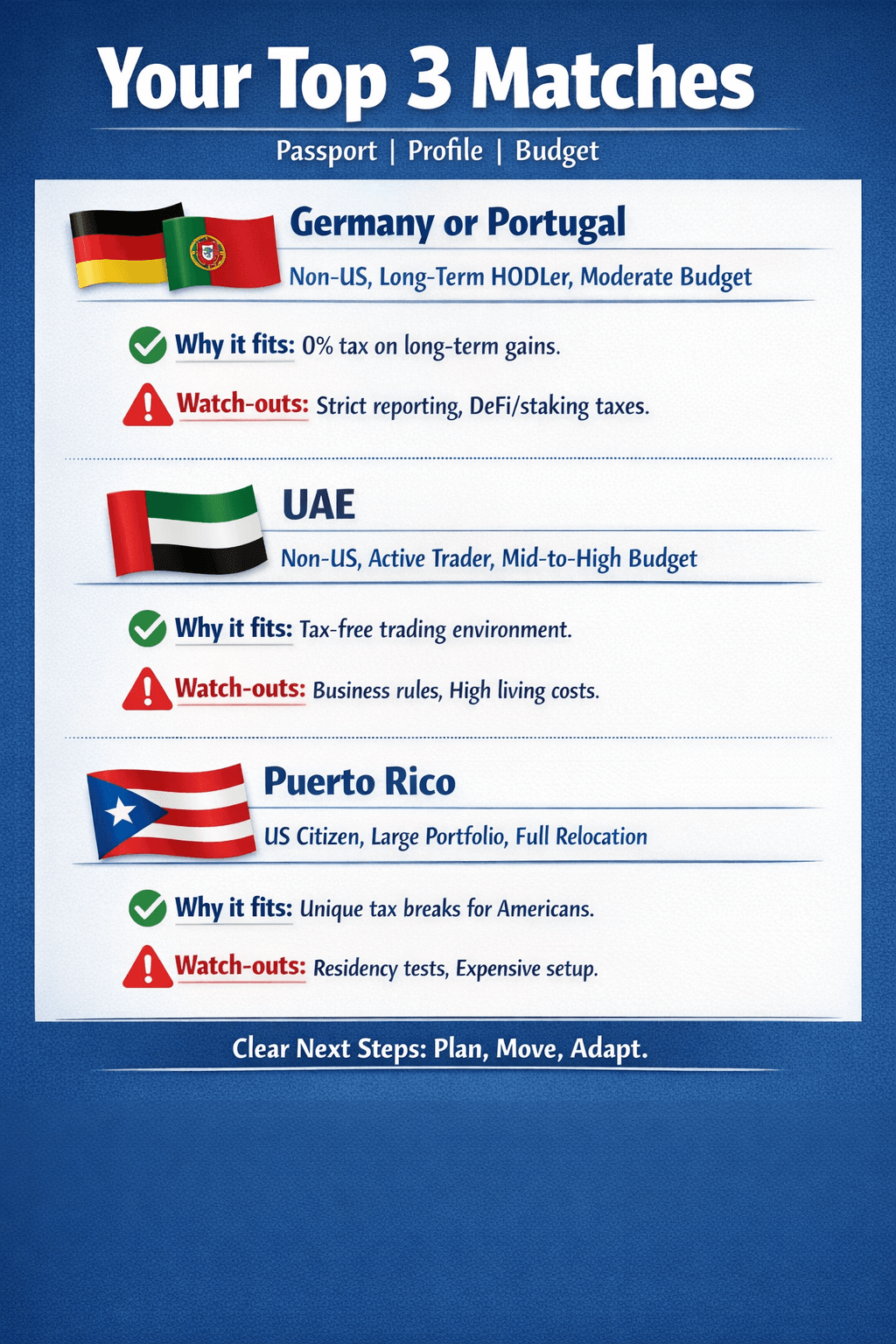
Your Top 3 Matches 

Once you’ve answered passport, profile, and budget honestly, you should land on a shortlist that looks like this: a small set of best fits, each with one reason it works, one reason it can fail, and a clear next step.

Match 1: Non-US, long-term HODLer, moderate budget → Germany or Portugal

  • Why it fits: Holding-period based 0% outcomes are achievable for private investors who sell infrequently and can wait a year. EU infrastructure is strong, and the lifestyle is easier to sustain long-term.
  • Watch-outs: Selling too soon flips your rate fast. Staking and DeFi income can create tax events even when long-term gains are favorable. Reporting is strict and getting stricter.

Match 2: Non-US, active trader, mid-to-high budget → UAE

  • Why it fits: Clean headline environment for personal gains with strong exchange access and practical residency pathways. This is where many serious traders land when they want clarity and speed.
  • Watch-outs: If your activity looks like a business, you can fall into the corporate layer. Cost of living is real. Substance expectations are rising as reporting tightens.

Match 3: US citizen, large portfolio, ready to fully relocate → Puerto Rico

  • Why it fits: It’s one of the only frameworks that can materially change outcomes for US citizens without leaving the US system entirely, assuming bona fide residency is established and maintained.
  • Watch-outs: Presence tests and compliance are strict. It is expensive to execute correctly. It is politically visible, so the risk of rules not theoretical.

The Country Tiers

Not all “0% crypto tax” jurisdictions are built the same. Some are structurally zero for individuals. Some are zero only if you meet specific holding or classification rules. Others work only in narrow, high-net-worth, or passport-specific situations.

Think of this as four buckets. Once you know the bucket, you stop confusing fundamentally different regimes.

Tier 1: True 0%

These are jurisdictions where individuals face 0% personal income or capital gains tax on crypto under normal private-investor behavior. The simplicity is the draw.

  • UAE (Dubai / Abu Dhabi): Individuals pay 0% personal income and capital gains tax. There is no short-term versus long-term distinction. The watch-out is classification. If your trading activity is structured like a business, the 9% corporate layer can apply. For non-US traders who can relocate cleanly, this remains one of the clearest headline regimes in 2026.
  • El Salvador: Capital gains on qualifying digital assets are 0%. There is no holding-period distinction for typical investors. The trade-off is infrastructure maturity, banking access, and political risk. For lower-budget relocations, it is one of the few verifiable pure 0% entry points.

Tier 1 works best for active traders and straightforward investors who want clarity over nuance.

Tier 2: 0% With Conditions

These jurisdictions can produce 0% outcomes, but only under defined rules. For disciplined investors, this tier often delivers better long-term stability than chasing pure tax havens.

  • Portugal (holding period rules): Gains on crypto held more than 12 months can remain untaxed at the personal level. Short-term gains are taxed. It rewards patience. It penalizes turnover.
  • Germany (holding period + thresholds): Private crypto gains can be tax-free after a one-year holding period. Sell before that and progressive income rates apply. An activity that resembles professional trading can change classification entirely.
  • Singapore (personal vs business distinction): There is no capital gains tax, but frequent or systematic trading can be taxed as business income. It works well for genuine investors and founders who maintain clean substance.
  • Switzerland (private wealth vs professional activity distinction): Private investors can realize gains tax-free, but professional traders are taxed as income and subject to social contributions. Wealth tax also applies annually, even if gains are exempt.

Tier 2 is often underestimated. For long-term investors who can hold, it can outperform Tier 1 once compliance risk and relocation friction are factored in.

Tier 3: Special Status/Special Cases

These are not universal plays. They work only if your profile fits very specific conditions.

  • Puerto Rico (US citizens only, decree compliance): For US citizens, Puerto Rico under Act 60 can reduce local tax on qualifying post-move gains. It requires bona fide residency and strict compliance. It is not casual. It is administrative.
  • Cayman/Bermuda (high-cost residency pathways): These jurisdictions offer 0% personal and corporate tax environments. They are realistic primarily for ultra-high-net-worth individuals, fund managers, and institutional operators who can afford high setup and substance costs.
  • Narrow-profile jurisdictions: Certain smaller states or regimes can work for very specific use cases, such as token founders with legal structuring needs. These are rarely mass-market solutions and often depend on the changing regulatory treatment.

Tier 3 is about precision. If you qualify, it can be powerful. If you don’t, it is expensive noise.

Tier 4: Low-Tax Alternatives Worth Considering

Not every smart move is 0%. In some cases, predictably low tax beats fragile zero.

  • Malta: With proper structuring, some capital gains can be treated favorably. It is more planning-heavy than headline 0% jurisdictions, but can be stable within the EU framework.
  • Slovenia: Often favorable for private investors under specific interpretations, but not universally 0%. Compliance and clarity matter.
  • Other structured EU options: Several European jurisdictions offer moderate, predictable tax treatment combined with strong infrastructure and legal certainty. For risk-averse investors, that trade-off can make more sense than chasing absolute zero.

Tier 4 is for people who care about legal stability, lifestyle, and banking access more than squeezing the rate to the last percentage point.

The real question is not “Which country is best?” It is “Which tier matches your passport, behavior, and risk tolerance?”

Country Profiles

Each country profile below follows the same structure, so you can compare cleanly. No storytelling fluff. Just what matters: tax reality, residency mechanics, costs, risks, and who it actually suits in 2026.

We begin with the jurisdiction most readers search first.

United Arab Emirates (UAE)

Infrastructure-first 0% headlines, strong banking and exchange access. The real risk is classification and documentation.

0% personal crypto tax (headline) Tax verified: Feb. 21, 2026 Visa verified: Feb. 21, 2026
0% personal crypto tax (headline)
Tax info last verified: Feb. 21, 2026 Visa info last verified: Feb. 21, 2026

United Arab Emirates (UAE)

If you are a non-US active trader or a high-volume investor, the UAE is usually the first serious candidate. It dominates “0% crypto tax” headlines for a reason. But headline simplicity hides execution nuance.

What’s “0%” here? No personal income tax and no personal capital gains tax for individuals.
Where does tax show up? When activity is treated as a business through a company structure (9% federal corporate tax may apply).
What triggers “business” optics? Structured trading desks, mining/validators, organized yield operations, token ventures.
Time to execute Commonly 1–3 months. Banking delays can push toward ~6 months.

Quick Facts Box

Snapshot
Best for
Active traders, high-volume investors, and founders who want a 0% personal-tax environment with strong banking and exchange access.
Capital gains tax (personal)
0% for individuals.
Trading as a business
9% federal corporate tax may apply if the activity is classified as business through a company structure.
Staking/DeFi
Depends on classification. Passive investing may remain personal. Systematic, structured activity can look like business.
Residency route (headline)
Free-zone company + residence visa, employment visa, or investment visa.
Time to set up
Commonly 1–3 months.
Typical total cost
Often $5k–$20k for a lean setup; higher for premium zones.
Tax info last verified
Feb. 21, 2026

Structured Breakdown

Scannable

Crypto Tax Snapshot

  • Personal layer: no personal income tax and no personal capital gains tax. If you are properly resident and have broken tax ties elsewhere, typical investing gains can land at 0%.
  • Main risk: classification. The line is “private investor” vs “business activity.”
  • Where 9% shows up: structured desks, mining/validators, organized yield operations, token ventures can move into corporate territory.
  • Staking/DeFi/airdrops: not automatically taxed personally. Systematic income-like operations can look commercial.

Residency Pathways

  • Free-zone company + residence visa: most common route (company → residence visa → Emirates ID → local presence).
  • Employment visa: if you have a qualifying UAE employer.
  • Investment/long-term residence routes: higher capital thresholds, often used by wealthier individuals.
  • Execution note: substance matters more over time, especially with tighter global reporting.

Step-by-Step Timeline

  1. Month 1Company formation paperwork, visa initiation, tax ID setup where applicable, early banking conversations.
  2. Month 2Lease agreement or Ejari registration, biometrics, Emirates ID process.
  3. Month 3Visa stamping, bank account stabilization, operational setup.
  4. Fast lane vs slow laneFast: clean documents + experienced advisors can hit ~3 months. Slow: banking delays can push toward ~6 months.

Documents Checklist

  • Passport and clear background documentation
  • Proof of funds/income
  • Lease agreement
  • Health insurance
  • Company incorporation documents (if relevant)
  • Apostilles and certified translations if required

Shortcut: having these ready before you land saves months.

Cost of Living and Lifestyle

  • Rent: moderate to high (varies by emirate and neighborhood)
  • Healthcare: strong private options, mandatory insurance
  • Safety: very high
  • Internet & infrastructure: reliable and modern
  • Climate: hot most of the year
  • Who will hate this place: wants EU-style walkable culture or low-cost living
  • Who will thrive: traders/founders who value infrastructure, speed, connectivity

Common Mistakes

  • Assuming 0% personal tax means “no structure needed.”
  • Running business-like trading personally without clarity.
  • Failing to break residency ties in the old country.
  • Ignoring banking substance requirements.

Verdict: Who Should Choose the UAE in 2026

Ideal profile

  • Non-US active trader
  • High-volume investor
  • Founder needing strong banking + exchange access

Avoid if

  • You cannot genuinely relocate
  • Your budget is extremely tight
  • You want a fully anonymous, zero-reporting environment

The UAE works because it is simple at the personal level and structured at the business level. If you execute cleanly, it remains one of the strongest crypto relocation options in 2026.

El Salvador

Ideology-first 0%. Low-cost entry into a true 0% capital gains framework for qualifying digital assets, with emerging-market trade-offs.

0% capital gains (qualifying digital assets) Tax verified: Feb. 21, 2026 Visa verified: Feb. 21, 2026
0% capital gains (qualifying digital assets)
Tax info last verified: Feb. 21, 2026 Visa info last verified: Feb. 21, 2026

El Salvador

If the UAE represents infrastructure-first 0%, El Salvador represents ideology-first 0%. It built its digital asset positioning around Bitcoin (for the official legislative text, see the full decree).

What’s “0%” here?0% capital gains tax (personal) on qualifying digital asset gains.
Where does tax show up?Mining, organized trading, or business-style activity can trigger income/corporate tax.
Big watchoutBanking depth and institutional stability are thinner than Tier 1 hubs.
Time to executeCommonly 2–6 months depending on paperwork and local process speed.

Quick Facts Box

Snapshot
Best for
Bitcoin-centric investors, lower-budget relocators, and early adopters comfortable with emerging markets.
Capital gains tax (personal)
0% on qualifying digital asset gains.
Trading as a business
Mining, organized trading, or commercial activity can trigger income or corporate tax.
Staking/DeFi
Depends on classification; systematic yield can look commercial.
Residency route (headline)
Investor residency or other temporary-to-permanent residence pathways.
Time to set up
Commonly 2–6 months, depending on paperwork and local process speed.
Typical total cost
Often under $10k for basic relocation; varies with legal support and housing.
Tax info last verified
Feb. 21, 2026

Structured Breakdown

Scannable

Crypto Tax Snapshot

  • Headline rule: El Salvador does not tax capital gains on qualifying digital assets.
  • No holding-period games: no short-term vs long-term distinction like Germany/Portugal, so active investors avoid threshold management.
  • Caution: mining ops, structured desks, token ventures can move into commercial treatment.
  • Staking/yield: may look income-like if systematic.
  • Reality check: less attractive if you require institutional-grade banking stability or deep capital markets access.

References: full decree · Bitcoin City project coverage

Residency Pathways

  • Investor residency: capital-based qualification pathways.
  • Temporary residence routes: convertible to longer-term status depending on compliance and presence.
  • Who typically qualifies: individuals willing to establish real local ties, not a paper presence.
  • Processing: commonly 2–6 months depending on documentation quality and legal support.
  • Presence: minimum presence rules matter if using El Salvador as a tax residency base.

Step-by-Step Timeline (Month 1 to Month 3/6)

  1. Month 1Residency application preparation, document legalization, local contact establishment.
  2. Month 2Submit residency application, secure housing, local registration steps.
  3. Months 3–6Biometrics, approvals, residency documentation issuance.
  4. Fast lane vs slow laneFast: clean paperwork + experienced local legal help. Slow: documentation gaps or inconsistent presence.

The environment requires comfort with emerging-market administration.

Documents Checklist

  • Passport and background documentation
  • Proof of funds or qualifying investment
  • Local lease or housing agreement
  • Criminal record certificate
  • Apostilles and certified translations

Paperwork can be lighter than many EU jurisdictions, but it is still structured.

Cost of Living and Lifestyle

  • Rent: lower relative to UAE or EU capitals
  • Healthcare: improving but variable
  • Safety: improved significantly, though perception varies internationally
  • Internet: generally reliable in urban centers
  • Climate: tropical
  • Who will hate this place: wants ultra-polished infrastructure and global banking depth
  • Who will thrive: Bitcoin-native investors comfortable with emerging-market environments

Common Mistakes

  • Assuming 0% capital gains equals zero compliance
  • Underestimating banking friction
  • Failing to establish a genuine local presence
  • Ignoring home-country exit tax rules

Relocation still requires clean break mechanics.

Verdict: Who Should Choose El Salvador in 2026

Ideal profile

  • Non-US Bitcoin-focused investor
  • Budget-conscious relocator
  • Individual comfortable with emerging-market environments

Avoid if

  • You need advanced banking and capital market depth
  • You require EU-level administrative predictability
  • Your income model is heavily yield- or business-driven

El Salvador is pure in its headline simplicity. It is not engineered for everyone. For the right profile, it delivers one of the clearest 0% personal gain frameworks available.

Portugal

Not a blanket 0% anymore. Portugal now rewards holding discipline: 0% after 12 months, ~28% if you sell earlier.

0% after 12 months (personal) Tax verified: Feb. 21, 2026 Visa verified: Feb. 21, 2026
0% after 12 months (personal)
Tax info last verified: Feb. 21, 2026 Visa info last verified: Feb. 21, 2026

Portugal

Portugal used to dominate every “crypto tax haven” list. In 2026, it is no longer a blanket 0% jurisdiction. But for the right investor, it may still be one of the smartest plays in Europe.

Key rule0% if crypto is held for more than 12 months (365+ days).
Short-term costSell earlier and gains are taxed at ~28% (flat rate).
Business riskProfessional/systematic activity can be taxed as income.
Execution realityPaperwork-heavy: typically 3–9 months due to backlogs.

Quick Facts Box

Snapshot
Best for
Long-term investors, EU movers, and digital nomads with moderate trading frequency.
Capital gains tax (personal)
0% if crypto is held for more than 12 months.
Short-term gains
Taxed at approximately 28% (flat rate).
Trading as a business
Professional or systematic activity taxed as income.
Staking/DeFi
Generally treated as income.
Residency route (headline)
D7 passive income visa, D8 digital nomad visa, or EU freedom of movement.
Time to set up
Typically 3–9 months, depending on consulate and SEF/AIMA backlog.
Typical total cost
Often $5k–$15k, including legal support and initial housing.

Structured Breakdown

Scannable

Crypto Tax Snapshot

  • Core rule: the 12-month holding threshold.
  • 0% path: hold for more than 365 days before selling.
  • Taxed path: sell earlier and you trigger ~28% taxation.
  • Classification line: business-like or professional activity can move you to income taxation.
  • Staking/DeFi: typically treated as income streams, not capital gains.

Portugal rewards holding discipline, not trading velocity.

Residency Pathways

  • D7 Visa: passive income (dividends, rental income, pensions, etc.).
  • D8 Digital Nomad Visa: remote workers meeting income thresholds.
  • EU citizens: freedom of movement.
  • Presence risk: to anchor tax residency cleanly, physical presence matters (often 183+ days or habitual residence).

Step-by-Step Timeline (Month 1 to Month 3/6)

  1. Month 1NIF (tax number), bank account setup, housing lease secured.
  2. Month 2–3Visa submission (if non-EU), translations, apostille.
  3. Months 3–6Biometrics appointment, residence card issuance, local registration.
  4. Fast lane vs slow laneFast: EU passport holders. Slow: non-EU applicants facing appointment backlogs.

Portugal rewards organization. It punishes procrastination.

Documents Checklist

  • Passport
  • Criminal record certificate
  • Proof of income or financial means
  • Portuguese tax number (NIF)
  • Lease agreement
  • Health insurance
  • Apostilled and translated documents

Documentation is heavier than in some jurisdictions, but predictable.

Cost of Living and Lifestyle

  • Rent: moderate, rising in Lisbon and Porto
  • Healthcare: strong public and private systems
  • Safety: high
  • Internet: reliable
  • Climate: mild, especially coastal
  • Who will hate this place: high-frequency traders who cannot wait 12 months to exit positions
  • Who will thrive: long-term investors who want EU stability and lifestyle quality

Common Mistakes

  • Selling before the 12-month threshold
  • Assuming staking rewards are tax-free
  • Failing to maintain physical presence
  • Misclassifying systematic trading as casual investing

Portugal is stable, but not casual.

Verdict: Who Should Choose Portugal in 2026

Ideal profile

  • Long-term crypto holder
  • EU-focused relocator
  • Remote worker with moderate turnover

Avoid if

  • You trade frequently
  • You rely heavily on DeFi yield
  • You want pure 0% with no holding conditions

Portugal is not flashy anymore. But for disciplined investors, it may still be one of the most balanced crypto-friendly jurisdictions in Europe.

Germany

Rules-based 0% in Europe: tax-free private gains after a one-year holding period, with strict classification and recordkeeping expectations.

0% after 1 year (private gains) Tax verified: Feb. 21, 2026 Visa verified: Feb. 21, 2026
0% after 1 year (private gains)
Tax info last verified: Feb. 21, 2026 Visa info last verified: Feb. 21, 2026

Germany

Germany does not advertise itself as a crypto haven. Yet for disciplined investors, it can deliver 0% on private crypto gains after a one-year holding period. This is a rules-based system that rewards patience and punishes velocity.

Key rule0% for private individuals after a 1-year holding period.
Short-term costSell within 12 months: taxed at progressive income tax rates (can exceed 40%).
Classification riskHigh-frequency/systematic activity can trigger professional trader treatment.
Admin realityOften 3–12 months depending on city and route.

Quick Facts Box

Snapshot
Best for
Long-term investors who can hold for 12+ months.
Capital gains tax (personal)
0% after a 1-year holding period for private individuals.
Short-term gains
Taxed at progressive income tax rates (can exceed 40% depending on bracket).
Trading as business
High-frequency or systematic trading may trigger “professional trader” classification.
Staking/DeFi
Generally treated as income at personal rates.
Residency route (headline)
EU freedom of movement, employment, or self-employment visa.
Time to set up
3–12 months, depending on the city and immigration route.
Typical total cost
$5k–$15k initial relocation; higher in major cities.

Structured Breakdown

Scannable

Crypto Tax Snapshot

  • Core rule: hold crypto for more than one year and private sale gains can be tax-free.
  • Short-term penalty: sell within 12 months and gains are taxed at your personal income rate (high earners can exceed 40%).
  • Classification line: commercial-looking trading can remove the one-year benefit if treated as professional activity.
  • Income-like flows: staking, yield farming, mining, and DeFi rewards are generally treated as income.
  • Recordkeeping: Germany expects detailed documentation, especially acquisition dates.

References: best DeFi staking platforms · Bitcoin cloud mining platforms

Residency Pathways (How to actually move)

  • EU citizens: direct residency via freedom of movement.
  • Employment visa/Blue Card: skilled professionals with qualifying contracts.
  • Self-employment visa: entrepreneurs who meet economic interest criteria.
  • City variance: processing differs significantly by city. Three months is fast; twelve months is common in larger cities.
  • Presence: if you claim German tax residency, you are expected to actually live there.

Step-by-Step Timeline (Month 1 to Month 3/6)

  1. Month 1Register local address, obtain tax ID (Steuer-ID), open bank account.
  2. Month 2–3Residence permit application (if non-EU), health insurance setup, local registrations.
  3. Month 3–6+Residence card issuance, full tax registration confirmation.
  4. Fast lane vs slow laneFast: EU citizen in smaller city. Slow: non-EU applicant in Berlin or Munich.

Administrative patience is part of the deal.

Documents Checklist

  • Passport
  • Local lease agreement
  • Health insurance proof
  • Proof of income or employment contract
  • Criminal record certificate (for certain visas)
  • Apostilled documents where required

Documentation-heavy, but predictable.

Cost of Living and Lifestyle

  • Rent: high in Berlin, Munich, Frankfurt; lower in smaller cities
  • Healthcare: strong public system
  • Safety: high
  • Internet: reliable, not cutting-edge everywhere
  • Climate: temperate
  • Who will hate this place: high-frequency traders who need rapid turnover
  • Who will thrive: long-term investors who value legal certainty and EU stability

Common Mistakes

  • Selling before the 12-month mark
  • Misclassifying active trading as private investing
  • Poor recordkeeping of acquisition dates
  • Underestimating local income tax rates

Germany rewards rule-followers. It punishes improvisation.

Verdict: Who Should Choose Germany in 2026

Ideal profile

  • Long-term crypto holder
  • EU passport holder or skilled professional
  • Investor willing to follow strict holding discipline

Avoid if

  • You trade frequently
  • You depend heavily on staking yield
  • You want a light administrative environment

Germany is not a “crypto haven” in marketing language. But for disciplined investors, it may be one of the most legally durable options in Europe.

Singapore

No capital gains tax, but income tax bites hard when activity looks commercial. Great for structured investors, risky for aggressive retail trading.

No capital gains tax Tax verified: Feb. 21, 2026 Visa verified: Feb. 21, 2026
No capital gains tax
Tax info last verified: Feb. 21, 2026 Visa info last verified: Feb. 21, 2026

Singapore

Singapore does not have a capital gains tax. That single structural fact makes it attractive to crypto investors. The nuance: income is taxed aggressively when activity looks commercial.

What’s “0%” here?No capital gains tax, if activity stays investment-grade.
Where tax shows upBusiness-like trading and recurring yield often treated as income.
Rates to rememberIndividuals up to 24% income tax; companies 17% corporate tax (headline).
Entry realitySelective residency (EP, EntrePass, GIP) and high substance expectations.

Quick Facts Box

Snapshot
Best for
High-income professionals, founders, structured investors needing Asia access.
Capital gains tax
No capital gains tax.
Short-term vs long-term
No formal distinction; classification matters more than holding period.
Trading as a business
If deemed trading stock or business activity, profits are taxed at personal or corporate rates.
Staking/DeFi
Often treated as income if recurring or structured.
Residency route
Employment Pass (EP), EntrePass, or Global Investor Programme.
Time to set up
3–12 months, depending on visa and structure.
Typical total cost
$15k–$50k+, depending on company setup and housing.

Structured Breakdown

Scannable

Crypto Tax Snapshot

  • Capital gains: not taxed in Singapore.
  • Investment-grade behavior: buy, hold, sell as private wealth management is typically not taxed as gains.
  • Classification trap: frequent transactions, structured systems, leverage, or crypto as primary income can trigger business treatment.
  • When classified as business: individuals can pay progressive income tax (up to 24%); companies pay corporate tax (17% headline).
  • Staking/yield: often treated as income when received if recurring or structured.

Singapore is powerful for long-term investors and founders building legitimate businesses. It is less attractive for aggressive retail traders hoping for blanket 0%.

Residency Pathways

  • Employment Pass (EP): professionals earning above minimum salary thresholds.
  • EntrePass: startup founders.
  • Global Investor Programme (GIP): high-net-worth individuals investing substantial capital.
  • Substance: not a casual “digital nomad” entry point. Expectations are high.

Step-by-Step Timeline (Month 1 to Month 3/6)

  1. Month 1Secure employment or initiate company incorporation. Begin visa application.
  2. Month 2–3Receive In-Principle Approval, relocate, complete biometrics and formalities.
  3. Month 3–6+Finalize EP or investor approval. Establish banking and tax registration.
  4. Fast lane vs slow laneFast: sponsored employment route. Slow: entrepreneur/investor pathway with regulatory review.

Singapore rewards structured preparation.

Documents Checklist

  • Passport
  • Employment contract or business plan
  • Bank statements/proof of funds
  • Educational qualifications
  • Police clearance (in certain cases)
  • Health insurance
  • Corporate documentation and capital injection proof (for company formation)

Cost of Living and Lifestyle

  • Rent: among the highest in the region
  • Healthcare: excellent
  • Infrastructure: world-class
  • Internet: extremely strong
  • Safety: very high
  • Climate: humid and tropical year-round
  • Who will hate this place: budget nomads and speculative traders looking for minimal structure
  • Who will thrive: founders, professionals, investors valuing regulatory clarity and deep markets

Common Mistakes

  • Assuming “no capital gains tax” means zero tax on everything
  • Failing to distinguish trading income from investment gains
  • Running high-frequency strategies without corporate structuring
  • Ignoring documentation standards

Singapore does not tolerate ambiguity in classification.

Verdict: Who Should Choose Singapore in 2026

Ideal profile

  • Long-term investor with structured portfolio
  • Founder building Web3 or fintech infrastructure
  • High-income professional seeking an Asia hub

Avoid if

  • You are a small-scale retail trader
  • Your relocation budget is limited
  • You expect lax reporting or light compliance

Singapore is not a tax haven in the stereotypical sense. It is a disciplined financial jurisdiction that can exempt capital gains when activity remains investment-grade.

Switzerland

0% capital gains for private investors, but wealth tax and “professional trader” classification can flip the outcome fast. Canton nuance matters.

0% gains (private investor) Tax verified: Feb. 21, 2026 Visa verified: Feb. 21, 2026
0% gains (private investor)
Tax info last verified: Feb. 21, 2026 Visa info last verified: Feb. 21, 2026

Switzerland

If Singapore is “no capital gains tax, but classification decides everything,” Switzerland is the European version with one extra layer: wealth tax and canton-by-canton nuance. The game is staying on the right side of “private investor” versus “professional trader.”

0% pathPrivate investor disposals typically not taxed as capital gains.
Flip riskProfessional trader classification turns gains into income and may trigger social contributions.
Swiss extra layerWealth tax applies annually to net assets (rates vary by canton).
Cost realityPremium base: often $20k–$50k+ just to land cleanly.

Quick Facts Box

Snapshot
Best for
High-net-worth HODLers, conservative investors, founders who value stability and predictable rule-of-law.
Capital gains tax (personal)
Typically 0% for private investors on disposal of private assets, including crypto.
Short-term vs long-term
No formal holding-period rule; classification matters more than time held.
Trading as a business
If classified as a professional trader, gains are taxed as income and may trigger social contributions.
Staking/DeFi
Rewards are typically treated as income.
Wealth tax
Applies annually to net assets, including crypto, with rates varying by canton.
Residency route (headline)
Employment, self-employment, EU free movement (where applicable), or high-net-worth arrangements in some cantons.
Typical total cost
Often $20k–$50k+ due to housing and advisory costs.

Structured Breakdown

Scannable

Crypto Tax Snapshot

  • Private investor gains: disposals can be effectively 0% regardless of holding period, if behavior looks like personal wealth management.
  • Classification policing: if trading looks professional, gains are treated as income (and may involve social security contributions).
  • Wealth tax: annual tax on net assets including crypto, varying by canton.
  • Income-like flows: staking, DeFi rewards, mining, and yield are generally treated as income when received.

Switzerland is best understood as: 0% on gains for private behavior, taxable on income-like flows, and taxable annually via wealth tax.

Residency Pathways

  • Employment permits: skilled roles with Swiss employers.
  • Self-employment permits: more difficult, requires an economic value case.
  • EU/EEA free movement: easier entry, still canton-administered.
  • High-net-worth arrangements: in some cantons, possible lump-sum style frameworks under strict rules (not guaranteed).
  • Canton choice: matters for taxes, lifestyle, and permit feasibility (Zug and Zurich are common crypto-adjacent hubs).

Step-by-Step Timeline (Month 1 to Month 3/6)

  1. Month 1Secure employer route or permit plan. Prepare documentation, submit permit application through canton.
  2. Month 2–3Lease secured, registration initiated, health insurance locked, permit processing continues.
  3. Month 3–6+Residence permit issued, banking established, tax residence becomes clean with real ties and presence.
  4. Fast lane vs slow laneFast: EU passport holder with employment. Slow: non-EU applicants or self-employment permits.

Switzerland rewards preparation and clean documentation.

Documents Checklist

  • Passport
  • Employment contract or proof of self-employment viability
  • Proof of funds
  • Lease agreement
  • Health insurance
  • Criminal record certificate (for certain routes)
  • Apostilled translations when needed

Swiss admin is strict and expects high-quality documentation.

Cost of Living and Lifestyle

  • Rent: very high in Zurich, Zug, Geneva
  • Healthcare: mandatory and expensive, excellent quality
  • Safety: extremely high
  • Infrastructure: excellent
  • Internet: strong
  • Climate: varies by region; winters can be heavy depending on canton
  • Who will hate this place: anyone trying to do “low-cost tax migration”
  • Who will thrive: those who value stability and predictable systems enough to pay for them

Common Mistakes

  • Trading frequently and triggering professional trader classification
  • Ignoring the wealth tax impact on large holdings
  • Assuming DeFi/staking rewards are treated like capital gains
  • Choosing a canton without modeling taxes and lifestyle costs

Switzerland is forgiving to disciplined private investors. It is expensive for everyone else.

Verdict: Who Should Choose Switzerland in 2026

Ideal profile

  • High-net-worth investor with low turnover
  • Founder or professional needing a stable European finance base
  • Conservative investor optimizing for long-run legal certainty

Avoid if

  • You trade frequently or run systematic strategies personally
  • You expect zero tax on yields and income-like rewards
  • You have a tight relocation budget

Switzerland can be near-0% capital gains in practice, but only if you stay private-investor clean and can absorb wealth tax plus a high-cost base.

Puerto Rico

US-only play. Potential 0% on certain gains under incentives, but only with bona fide residency, sourcing discipline, and documentation-first living.

Potential 0% (US-only incentives) Tax verified: Feb. 21, 2026 Visa verified: Feb. 21, 2026
Potential 0% (US-only incentives)
Tax info last verified: Feb. 21, 2026 Visa info last verified: Feb. 21, 2026

Puerto Rico

Puerto Rico is not a generic tax haven. It is a US-only framework that can materially reduce certain taxes for Americans, but it comes with strict residency tests, paperwork, and lots of ways to mess it up.

Who this is forUS citizens only. If you are not a US citizen, skip this.
Main dividing linePre-move vs post-move gains and sourcing, not short-term vs long-term.
Core requirementBona fide residency tests with real presence and ties.
Big riskAudit survivability depends on documentation quality year after year.

Quick Facts Box

Snapshot
Best for
High-net-worth US crypto investors willing to genuinely relocate and live most of the year in Puerto Rico.
Capital gains tax (personal)
Can be 0% on certain gains under local incentive decrees, subject to sourcing and compliance.
Short-term vs long-term
Not the main axis; pre-move vs post-move and sourcing rules matter more.
Trading as a business
Business income has its own treatment; structuring matters a lot.
Staking/DeFi
Often treated as income; careful classification is essential.
Residency route (headline)
Become a bona fide Puerto Rico resident and comply with incentive program requirements.
Time to set up
3–12 months to establish residency cleanly and align structures.
Typical total cost
Often $20k–$100k+, including relocation, legal, compliance, and housing.

Structured Breakdown

Scannable

Crypto Tax Snapshot

  • What it can do: reduce or eliminate Puerto Rico tax on certain capital gains once you qualify and comply.
  • What it does not do: it does not magically erase US taxation across the board.
  • Key axis: gains attributable before bona fide residency vs gains accrued and realized after the move, under program requirements.
  • Income-like flows: staking and DeFi returns are typically treated as income-like and can complicate the “0% gains” headline.
  • Trading optics: organized trading can shift you into categories where the benefit shrinks or requires careful structuring.

Puerto Rico works when paperwork and residency reality match the marketing.

Residency Pathways

  • No visa process: the process is proving residency.
  • Bona fide tests: meaningful physical presence each year, stronger ties to PR than mainland, and real local integration.
  • Common steps: primary home, PR driver’s license, local registrations, local spending, limiting mainland ties that undermine residency claims.

This is a compliance regime, not a lifestyle suggestion.

Step-by-Step Timeline (Month 1 to Month 3/6)

  1. Month 1Secure housing, establish PR address, start presence tracking day one, plan incentive application with professionals.
  2. Month 2–3Shift life anchors: registrations, banking, license, primary residence evidence. Submit incentive paperwork if not already done.
  3. Month 3–6+Continue building residency proof, finalize approvals, align tax year positioning, document tie shifts from the mainland.
  4. Fast lane vs slow laneFast: pre-planned move with strong documentation. Slow: partial movers trying to maintain two lives.

The time cost is manageable. The compliance intensity is not optional.

Documents Checklist

  • Proof of PR primary residence (lease or deed)
  • Detailed travel and presence logs
  • Evidence of PR ties (licenses, registrations, local accounts)
  • Evidence of reduced mainland ties (often relevant)
  • Program application documentation and ongoing compliance requirements

Documentation is the entire strategy.

Cost of Living and Lifestyle

  • Housing: can be expensive in common newcomer areas
  • Insurance: often higher and more complex than expected
  • Infrastructure: good in pockets, uneven outside key urban zones
  • Safety: neighborhood dependent
  • Climate: tropical, with storm and hurricane risk
  • Who will hate this place: wants “tax savings without lifestyle disruption”
  • Who will thrive: willing to actually live there and treat it as a real relocation

Common Mistakes

  • Trying to split time too evenly between PR and the mainland
  • Realizing gains that accrued before the move and expecting 0% treatment
  • Weak documentation of presence and ties
  • Ignoring ongoing compliance requirements year after year

Puerto Rico is often less about tax rates and more about audit survivability.

Verdict: Who Should Choose Puerto Rico in 2026

Ideal profile

  • US citizen with a large crypto portfolio where savings justify the cost and effort
  • Willing to live most of the year in Puerto Rico
  • Comfortable running a documentation-first lifestyle

Avoid if

  • You cannot commit to presence and tie shifts
  • Your portfolio is too small for the costs and scrutiny
  • You want a low-effort solution

Puerto Rico can be one of the few genuinely effective tax reduction routes for Americans, but it demands real relocation and real compliance. Half measures usually fail.

Cayman Islands/Bermuda

True offshore 0% at the local level, built for UHNW and institutions. The barrier is cost, access, and substance under global reporting.

0% income + gains (local) Tax verified: Feb. 21, 2026 Visa verified: Feb. 21, 2026
0% income + gains (local)
Tax info last verified: Feb. 21, 2026 Visa info last verified: Feb. 21, 2026

Cayman Islands/Bermuda

Cayman and Bermuda are the closest things in this guide to structural 0% environments across the board. But they are built for high-net-worth individuals, funds, and institutional structures. They are not casual relocation hubs.

Local tax layerNo personal income tax. No capital gains tax. No traditional corporate income tax.
Not invisibilityFully integrated into CRS/FATCA style reporting and information exchange.
Substance mattersEconomic substance rules apply. Pure shell setups face scrutiny.
Cost barrierOften $50k–$250k+ once real estate and advisory costs are included.

Quick Facts Box (must be visible without scrolling much)

Snapshot
Best for
Ultra-high-net-worth individuals, crypto funds, structured entities.
Capital gains tax (personal)
0%.
Income tax (personal)
0%.
Corporate tax
0% locally, subject to economic substance rules.
Short-term vs long-term
No distinction.
Staking/DeFi
No local income tax, but global reporting still applies.
Residency route (headline)
High-investment residency certificates or company-based residence.
Typical total cost
$50k–$250k+ once real estate and advisory costs are included.

Structured Breakdown

Scannable

Crypto Tax Snapshot

  • Local headline: no local tax on capital gains, income, corporate profits, inheritance, or dividends.
  • Not invisibility: both jurisdictions participate in global reporting frameworks (CRS/FATCA and CARF-style exchange momentum).
  • Residency break: moving without fully breaking tax residency elsewhere does not protect you if your home country taxes globally.
  • Economic substance: companies must demonstrate meaningful local presence depending on activity.
  • Practical truth: structurally clean if you fully relocate and sever old tax residency, but access and cost are the barrier.

Residency Pathways

  • Investment-driven: significant real estate purchases or direct investment certificates.
  • High-net-worth programs: capital commitments are substantial and background checks rigorous.
  • Company-based residence: director roles tied to locally registered entities.
  • Presence: meaningful physical presence is required for defensible use.

These are not digital nomad visas.

Step-by-Step Timeline (Month 1 to Month 3/6)

  1. Month 1Engage local legal counsel. Begin due diligence. Prepare proof of funds and investment documentation.
  2. Month 2–3Complete property acquisition or qualifying investment. Submit residence application. Begin banking setup.
  3. Month 3–6+Receive residence certificate. Establish local ties. Shift financial flows.
  4. Fast lane vs slow laneFast: high-liquidity applicant with clean documentation. Slow: complex structures, fund setups, multi-entity arrangements.

Documents Checklist

  • Passport
  • Extensive proof of the source of funds
  • Investment or property documentation
  • Criminal record certificate
  • Health insurance
  • Corporate documentation, if applicable

KYC expectations are high.

Cost of Living and Lifestyle

  • Housing: extremely expensive
  • Cost of goods: high due to import dependency
  • Healthcare: private, high quality, high cost
  • Safety: generally strong
  • Internet: good, island-based
  • Climate: tropical, hurricane exposure
  • Who will hate this place: anyone trying to relocate under $200k total cost
  • Who will thrive: those treating this as a strategic capital base, not a lifestyle experiment

Common Mistakes (Cayman/Bermuda-Specific)

  • Using paper residency without meaningful presence
  • Ignoring home-country exit taxes
  • Assuming anonymity equals non-reporting
  • Underestimating economic substance requirements

The 0% headline works only when the structure is clean.

Verdict: Who Should Choose Cayman/Bermuda in 2026

Ideal profile

  • $5M–$10M+ portfolio holders
  • Crypto fund operators
  • Institutional players needing a neutral 0% base

Avoid if

  • Portfolio is under seven figures
  • You want a low-cost relocation
  • You cannot fully sever previous tax residency

Cayman and Bermuda are structurally powerful but economically exclusive. For most readers, they are aspirational Tier 3 options rather than realistic first moves.

Malta

Marketed as “crypto island,” but it is not a pure 0% haven. It is a structure-led EU option: optimize properly, don’t expect blanket tax-free.

Structure-led (not blanket 0%) Tax verified: Feb. 21, 2026 Visa verified: Feb. 21, 2026
Structure-led (not blanket 0%)
Tax info last verified: Feb. 21, 2026 Visa info last verified: Feb. 21, 2026

Malta

Malta is frequently marketed as “crypto island.” The reality is more nuanced. It is not a pure 0% haven like the UAE or Cayman, but it can be structurally attractive for EU-based investors who want flexibility without stepping completely offshore.

How it worksTax treatment depends heavily on classification: investment (capital) vs trading/business (revenue).
Who it favorsEU-facing founders and structured participants optimizing via companies.
Common taxable flowsStaking/DeFi typically income; mining is business by default.
Big watchoutCompliance and EU-wide reporting obligations (DAC8 from 2026 onward).

Quick Facts Box (must be visible without scrolling much)

Snapshot
Best for
EU-oriented investors, founders, and structured crypto participants who want flexibility rather than absolute 0%.
Capital gains tax (personal)
Favourable treatment for certain private crypto gains; not blanket 0%.
Trading as business
Taxed as trading income (progressive rates up to 35% before refund mechanisms).
Staking/DeFi
Typically treated as income; structuring matters.
Short-term vs long-term
No simple 1-year exemption rule like Germany; classification depends on intent and activity.
Residency route (headline)
Nomad Residence Permit, Permanent Residence Programme (investment-based), EU work/self-employment routes.
Time to set up
3–9 months, depending on the route.
Typical total cost
$10k–$50k+, depending on visa type and property commitments.

Structured Breakdown

Scannable

Crypto Tax Snapshot

  • Classification-driven: investment (capital nature) vs trading/business (revenue nature).
  • Private holdings: long-term passive investing can receive favourable treatment, but not blanket 0%.
  • Trading/operations: systematic trading and structured activity likely taxed as business income.
  • Income-like flows: staking/DeFi yields generally treated as income; mining is business by default.
  • Founder angle: refund mechanisms can reduce effective corporate tax rates in structured cases.

This is not “do nothing, pay nothing.” It is “structure properly and optimize.”

Residency Pathways

  • Nomad routes: lighter capital requirements, requires proof of income and health insurance.
  • Investment-based routes: property purchase or rental plus government contributions.
  • Presence: physical presence is expected for tax residency, often 183+ days for clean anchoring.

Step-by-Step Timeline

  1. Month 1Prepare documents, income proof, criminal record certificate, engage local advisor if needed.
  2. Month 2–3Secure lease/property. Submit residence application. Begin bank discussions.
  3. Months 3–6Residence card approval. Activate tax registration.
  4. Fast lane vs slow laneFast: Nomad route with clean documentation. Slow: investment route with property and compliance reviews.

Documents Checklist

  • Valid passport
  • Clean criminal record
  • Proof of foreign income
  • Health insurance
  • Lease or property contract
  • Source of funds documentation
  • Apostilles and certified translations may be required

Cost of Living and Lifestyle

  • Rent: €1,500–€3,000/month in central areas
  • Healthcare: high-quality private system
  • Safety: strong
  • Internet: reliable
  • Climate: Mediterranean
  • Who will hate this place: expects full 0% tax with no structuring
  • Who will thrive: EU-facing founders and moderate investors valuing regulatory clarity

Common Mistakes

  • Assuming “crypto-friendly” equals tax-free
  • Mixing personal trading with structured business activity
  • Ignoring EU-wide reporting obligations (DAC8 from 2026 onward)
  • Underestimating corporate compliance costs

Malta rewards deliberate planning, not casual relocation.

Verdict: Who Should Choose Malta in 2026

Ideal profile

  • EU-oriented investors who want flexibility
  • Crypto founders needing an EU legal base
  • Structured participants willing to optimize via companies

Avoid if

  • You are an aggressive trader expecting 0% with no complexity
  • You have a minimal relocation budget
  • You want pure tax haven simplicity

Malta sits firmly in Tier 4: not zero, but strategically usable.

Practical Relocation Playbook 

Pre-Move Checklist 

This is the unglamorous prep phase. Done properly, it prevents six-month delays and audit nightmares.

Banking & Financial Prep

  • Open an internationally usable bank account if possible.
  • Separate “savings wallet” and “spending wallet” for crypto.
  • Download full transaction history from every exchange and wallet.
  • Prepare clean source-of-funds documentation for major holdings.
  • Banks and residency programs will ask where your money came from. Screenshots from 2021 are not documentation.

For platform and storage comparisons, see the best crypto exchanges and best crypto wallets.

SIM, Address & Communication Setup

  • Secure a stable mailing address in your destination country.
  • Prepare for SIM registration requirements.
  • Begin shifting subscription and billing addresses where appropriate.
  • Digital presence alignment often matters more than people realize.

Document Apostilles & Legal Prep

  • Criminal record certificate (often required).
  • Birth certificate and marriage certificate, if applicable.
  • Certified translations were needed.
  • Apostilles prepared in advance.
  • Waiting until arrival to gather these can stall your residency.

Insurance & Proof of Funds

  • Valid health insurance is accepted locally.
  • Proof of income or portfolio size.
  • Clean bank statements (3–12 months typically).

Do not underestimate how seriously “proof of funds” is reviewed.

Your First 30 Days

The first month is about building your “center of life” evidence.

Tax authorities look at where your life actually moved, not where your Instagram says you live.

Get Your Tax Number

  • Apply for your local tax ID immediately.
  • Register with local authorities if required.
  • Understand your official residency start date.
  • The date matters for sourcing gains.

Secure Housing Properly

  • Lease or purchase agreement in your name.
  • Utility contracts, where possible.
  • Avoid temporary Airbnb-only setups if long-term residency is your goal.
  • Residency requires substance, not hotel receipts.

Open a Local Bank Account

  • Even if you use crypto primarily, a local account anchors legitimacy.
  • Expect compliance questions about digital assets.
  • Prepare transaction logs and portfolio summaries.

Build “Center of Life” Evidence

  • Local gym, memberships, clubs.
  • Move primary spending activity to local cards.
  • Shift personal and economic ties away from the former country.
  • If audited, you want a clear narrative of relocation.

Staying Compliant 

This is where most people get lazy. This is also where most people lose.

Reporting Discipline

  • Maintain full wallet logs.
  • Keep exchange statements monthly.
  • Document staking rewards and DeFi activity clearly.
  • Track capital gains by acquisition date and cost basis.
  • You should be able to recreate your tax position at any moment.

Residency Day Tracking

  • Track physical presence days precisely.
  • Maintain travel logs.
  • Keep flight confirmations and entry stamps.

For many jurisdictions, one miscounted year can destroy your tax advantage.

Ongoing Local Compliance

  • File annual returns even if the tax due is zero.
  • Renew residence permits on time.
  • Monitor law changes annually.

Crypto tax regimes evolve quickly. A country that is optimal in 2026 may tighten rules in 2028.

Exchange & Banking Hygiene

  • Avoid mixing personal and business activity without structure.
  • Do not trigger business classification unintentionally.
  • Keep large conversions documented.

If you want a comprehensive look at tax treatment across jurisdictions (just as we saw above), check out crypto taxes.

Tax Optimization Strategies 

Relocation is only one lever in crypto tax planning. The deeper layer and often the more impactful one lies in timing, classification, and structural positioning. A well-chosen country can reduce tax exposure, but a poorly sequenced move or misclassified activity can erase those benefits.

This section does not offer prescriptions or shortcuts. Instead, it outlines the strategic pressure points serious investors consider before moving capital or changing residency. The objective is simple: reduce avoidable friction and prevent costly missteps while staying firmly within legal boundaries.

Timing Your Move Around a Bull Run

The single most powerful variable in relocation strategy is timing. Specifically, whether gains are realized before or after a residency shift.

In most tax systems, two moments matter: where you were tax resident when the gain accrued and where you were resident when it was realized. Some jurisdictions focus primarily on realization. Others apply sourcing rules that reach back to pre-move appreciation. A few impose exit taxes that treat assets as if they were sold the moment you leave.

Conceptually, selling before you move creates certainty. You lock in tax under your current system and eliminate ambiguity. Moving before you sell can reduce tax exposure if the new jurisdiction treats future realized gains more favorably but only if the residency change is clean and the legal framework supports it.

The risk lies in assuming that changing location automatically resets tax history. It does not. Strategic investors map the lifecycle of their positions,  acquisition date, holding period, unrealized appreciation, and potential exit triggers , before relocating. Timing, more than destination, often determines the outcome.

Exit Tax and “Leaving Home Country” Pitfalls

Many investors underestimate how difficult it can be to fully leave a high-tax jurisdiction.

Certain countries apply exit tax regimes that treat unrealized gains as if they were realized at the moment of departure. Even without selling a single token, you may owe tax on accumulated appreciation. Other jurisdictions rely on broader residency tests, such as “center of vital interests,” family ties, or habitual residence patterns, which can extend tax obligations beyond physical presence.

The complexity increases when multiple countries claim residency status in the same year. Dual-residency conflicts may require treaty analysis to resolve, and treaty relief is rarely straightforward without advance planning.

This is where professional analysis becomes essential. Exit planning often involves valuation snapshots, restructuring of entities, review of treaty provisions, and careful sequencing of residency termination. Treat relocation as a tax engineering process, not just an immigration decision.

Personal vs Business Classification

One of the most overlooked risks in crypto tax optimization is reclassification. Many jurisdictions distinguish between private investment activity and professional or business activity. The difference can be dramatic. Capital gains may receive favorable or even zero treatment, while business income can be taxed at full progressive rates.

Authorities typically evaluate factors such as trading frequency, use of leverage, systematic strategy execution, short holding periods, capital deployment scale, and organizational structure. There is rarely a single trigger; instead, patterns determine classification. This distinction is particularly relevant for active traders, DeFi participants, validators, miners, and token founders. Recurring yield, organized liquidity provision, or token issuance can shift activity into income or business territory. A relocation to a low-capital-gains jurisdiction offers little benefit if your activity is treated as operating income.

The key insight is structural alignment. Your activity profile must match the jurisdiction’s investor criteria, or your expected advantage may disappear.

DeFi, Staking, Airdrops, NFTs

Crypto returns are not homogeneous. Tax systems frequently differentiate between capital appreciation and income-like receipts.

Staking rewards, validator income, liquidity mining yields, mining output, and certain airdrops are often treated as income at the time of receipt. That means taxation can occur before any sale event. In contrast, appreciation on held tokens or NFTs may fall under capital gains rules upon disposal.

Treatment varies widely across jurisdictions. Some countries tax taking at receipt and again at disposal. Others defer taxation until sale. NFT classification can range from digital assets to collectibles, depending on context and interpretation.

Because crypto taxation often adapts older frameworks to new technology, interpretation evolves. Administrative guidance, court rulings, and regulatory updates can shift outcomes over time. Assumptions based on one country rarely translate cleanly to another.

Robust recordkeeping becomes non-negotiable in this environment. At minimum, investors should maintain acquisition dates, cost basis, fair market value at receipt for income-like events, transaction hashes, gas fees, and disposal details. Blockchain transparency does not replace organized reporting.

Tax optimization is not about chasing zero. It is about sequencing, classification, and defensible structure. When those elements align, relocation and strategy reinforce each other. When they do not, even a 0% headline can become operationally expensive.

If fees matter most in your exchange choice, check out best crypto exchange with lowest fees.

Digital Nomad Visas for Crypto People 

Digital nomad visas sit at the intersection of mobility and tax planning, which is exactly why crypto investors gravitate toward them. They offer legal residency without traditional employment requirements, flexible renewal terms, and access to attractive jurisdictions. But here’s the nuance: a digital nomad visa is primarily an immigration framework. Whether it becomes a tax advantage depends on how long you stay, how you structure income, and how cleanly you exit your previous tax residency.

Used correctly, it can be a staging bridge into a favorable jurisdiction. Used casually, it solves nothing.

Let’s break this down clearly.

The Best Digital Nomad Visa Options

CountryVisa NameMinimum Income (Approx.)DurationCrypto Tax HeadlineBest For
PortugalDigital Nomad Visa€3,000–€3,500+/month1–2 years renewable0% on long-term crypto gains (subject to holding rules)Long-term holders seeking EU base
SpainDigital Nomad Visa€2,500+/month1 year renewableCrypto taxed under progressive regimeLifestyle-focused remote workers
MaltaNomad Residence Permit€2,700+/month1 year renewableStructured treatment possible, not automatic 0%EU-facing freelancers/founders
UAEVirtual Work Residency$3,500+/month1 year renewable0% personal income tax (with real residency)High earners willing to establish UAE base
EstoniaDigital Nomad Visa€3,500+/monthUp to 1 yearCapital/income classification appliesShort-term EU relocation
CroatiaDigital Nomad Residence€2,500+/monthUp to 1 yearDepends on tax residency statusLifestyle-first movers

This table highlights a key distinction: the visa grants permission to reside. Tax treatment depends on whether you become a tax resident and whether you have properly severed your previous residency.

Immigration status and tax residency are related, but they are not the same thing.

When DN Visas Do NOT Solve Your Tax Problem

This is where most crypto relocations go wrong.

DN Visa ≠ Automatic Tax Residency

Holding a digital nomad visa does not automatically change your tax status. In many jurisdictions, tax residency depends on physical presence thresholds, economic ties, and formal registration. Some countries apply the 183-day test. Others rely on broader “center of vital interests” criteria.

You can legally live somewhere under a visa and still owe full tax to your home country.

Unless you have formally exited your previous tax residency and triggered the new one correctly, nothing structurally changes.

The 183-Day Myth

The 183-day rule is widely misunderstood.

In some countries, spending more than 183 days establishes tax residency. In others, additional factors apply: family location, permanent home availability, economic activity, or even habitual patterns across multiple years.

Spending 182 days somewhere does not guarantee protection. Spending 183 days does not guarantee optimization.

Tax authorities look at substance. Where do you sleep? Where do you bank? Where do you generate income? Where is your “center of life”?

Digital nomad visas do not override those questions.

Double-Tax Risk

This is the most dangerous scenario.

Imagine holding a digital nomad visa in Portugal while still considered a resident in your home country. If you sell crypto during that period without having properly shifted residency, your home country may tax you fully.

If you accidentally trigger partial residency abroad at the same time, you could face dual reporting obligations.

Treaties may reduce double taxation in some cases, but relying on treaty relief after a mistake is a defensive strategy. Clean exits are a proactive strategy.

When DN Visas Actually Make Sense

Digital nomad visas are powerful when used deliberately.

They are effective for:

  • Remote crypto professionals earning active income
  • Investors testing a jurisdiction before permanent relocation
  • Individuals transitioning into a country with favorable long-term crypto rules

They provide legal presence and flexibility. They do not replace tax engineering.

Risk & Reality Check 

Up to this point, we’ve mapped the opportunities. Now we need to pressure-test them.

“Tax-free” is seductive language. It implies simplicity, certainty, and clean savings. In practice, every jurisdiction comes with trade-offs, which can be financial, operational, reputational, and personal. The goal of this section is not to scare you away from relocating. It’s to make sure the decision is durable, not impulsive.

Safety, Sanctions, Banking Access, and Reputation Risk

Tax rates are only one variable in a relocation equation. Banking access, financial reputation, and geopolitical stability often matter more over a five-year horizon.

Some jurisdictions with 0% tax have stricter banking due diligence. Others are fully compliant with global reporting frameworks but may trigger enhanced scrutiny when you move large crypto-derived funds. Even in well-regarded locations, banks routinely ask for detailed source-of-funds documentation when crypto is involved. If your records are incomplete, friction increases quickly.

Banking friction varies by region:

  • In parts of the Caribbean, offshore banks are experienced with structured capital but extremely strict on compliance.
  • In certain Middle Eastern jurisdictions, onboarding is generally smoother for high earners with documented income.
  • In parts of Europe, regulatory transparency is high, but scrutiny of crypto-heavy portfolios can be intense.

There is also reputational risk. Some financial institutions in other countries may view certain tax havens as higher-risk jurisdictions. That can affect future banking, investment access, or even lending relationships.

Sanctions exposure and geopolitical alignment also matter. A jurisdiction that looks tax-efficient today may face policy shifts, global pressure, or compliance rule changes later.

A low tax rate does not compensate for losing financial flexibility.

Quality of Life vs Tax Savings

Relocation math is often framed purely in percentage terms: “If I save 20%, I win.” That framing is incomplete.

Saving $20,000 annually while living somewhere that disrupts your career, isolates you socially, or complicates your family life is not optimization. It’s friction disguised as savings.

Consider:

  • Infrastructure reliability
  • Healthcare access
  • Internet stability
  • Travel connectivity
  • Language barriers
  • Schooling if applicable
  • Climate tolerance

In some jurisdictions, housing costs and lifestyle inflation absorb part of your tax savings. In others, the environment may be fantastic for a year but unsustainable in the long term.The real comparison is not tax rate versus tax rate. It’s tax savings versus total life impact.

If the delta meaningfully changes your net worth trajectory, relocation can be justified. If the savings are marginal relative to disruption, staying put and optimizing domestically may be smarter.

When NOT to Move

Relocation is not automatically rational for every crypto investor. One should not move if one's portfolio is small enough that tax savings do not materially change your financial future. A $100,000 portfolio does not justify a complex international move purely for tax reasons.

  • You should also reconsider relocation if you have strong professional or family ties that anchor you physically in one country. Tax residency tests increasingly examine substance, and maintaining two lives rarely holds up under scrutiny.
  • If your residency pathway is unstable, for example, short-term visas without clear renewal options, the strategy becomes fragile. Tax optimization built on a temporary status introduces risk.
  • Finally, if your record-keeping is weak or your crypto activity is complex and poorly documented, relocation may increase your exposure rather than reduce it. Moving jurisdictions does not erase historical reporting obligations.

Relocation works best when it is deliberate, well-documented, and financially proportionate. 

For some more perspective on systemic crypto risks, watch this video from experts at Coin Bureau.

Tools, Services and Resources

At some point, strategy needs infrastructure.

You can read every country profile, understand residency rules, and time your move correctly, but without proper tools and the right professional guidance, execution risk remains high. This section bridges that gap. It’s about knowing when software is sufficient, when expert advice becomes mandatory, and how to approach both intelligently.

Crypto Tax Software

Crypto tax software has matured significantly. For many investors, it provides more than enough structure to stay compliant and organized, especially if your activity is relatively straightforward.

It is generally sufficient when:

  • You operate as a private investor rather than a business
  • Your activity is mostly spot trading and long-term holding
  • Staking and DeFi activity are limited and trackable
  • You are not relocating across borders during the tax year

Modern platforms can aggregate exchange data, calculate cost basis, track capital gains, and export tax-ready summaries. For single-jurisdiction compliance, this often works well but where it falls short is cross-border complexity.

For a side-by-side comparison of leading tools and what they actually handle well, see our crypto tax software guide.

When you relocate, software does not automatically:

  • Analyze exit tax exposure
  • Determine gain sourcing pre- and post-move
  • Interpret business classification risk
  • Apply treaty tie-breaker rules
  • Advice on entity restructuring
  • Software reports transactions. It does not design a tax strategy.

For investors staying in one country with moderate activity, it’s a strong foundation. For cross-border relocators, it’s a data engine,  not a decision engine. 

When to Hire a Professional

There is a clear threshold where DIY planning becomes expensive.

You should strongly consider hiring a tax advisor when:

  • Your portfolio size makes optimization material
  • You are moving countries
  • You operate DeFi, staking, mining, or token-related businesses
  • You are concerned about exit tax exposure
  • You have a dual residency risk

The key is not just hiring someone, but it’s also asking the right questions.

Questions for a Tax Advisor

When interviewing a tax professional, clarity matters more than credentials alone. Consider asking:

  • How is my crypto activity classified in this jurisdiction, investor or business?
  • Does this country impose an exit tax when leaving?
  • How are pre-move unrealized gains treated?
  • Are staking and DeFi rewards taxed at receipt or disposal?
  • What triggers tax residency beyond the 183-day rule?
  • How do tax treaties apply in my specific case?
  • What documentation would protect me in an audit?

A strong advisor should provide structured answers, not vague assurances.

Questions for Immigration Lawyers

Immigration and tax planning must align. Ask:

  • Does this visa route reliably convert into tax residency?
  • What are the renewal risks?
  • What physical presence requirements apply annually?
  • What evidence supports “center of life” in this jurisdiction?
  • How long does status approval realistically take?

Immigration status without tax clarity creates gaps. Tax planning without immigration certainty creates instability.

Newsletter_inline

Final Verdict

There is no universal “best crypto tax haven.. There are only better fits for specific profiles. If you are a high-earner willing to genuinely relocate, jurisdictions like the UAE or certain structured offshore bases can materially reduce tax exposure. If you are an EU-based long-term holder, countries with holding-period exemptions may offer more stability than chasing pure 0%. And if you are a US citizen, the reality is narrower and more technical than most headlines suggest.

The real differentiator is not the country. Its execution. Clean residency shifts, proper documentation, clear classification of your activity, and realistic lifestyle expectations matter more than a 0% headline. A poorly executed move to a tax haven can cost more than staying put. A well-executed one can change your net worth trajectory over a decade.

In the end, tax optimization is a long game. Move only if the math is meaningful, the lifestyle is sustainable, and the compliance structure is defensible. Anything less is just expensive experimentation.

Frequently Asked Questions

Devansh Juneja

Devansh Juneja

Adept at leading editorial teams and executing SEO-driven content strategies, Devansh Juneja is an accomplished content writer with over three years of experience in Web3 journalism and technical writing. 

His expertise spans blockchain concepts, including Zero-Knowledge Proofs and Bitcoin Ordinals. Along with his strong finance and accounting background from ACCA affiliation, he has honed the art of storytelling and industry knowledge at the intersection of fintech.

Join the Coin Bureau Club

Get exclusive access to premium content, member-only tools, and the inside track on everything crypto.

Stay Ahead with Our Newsletter

Weekly crypto insights, expert guides, and in-depth research—delivered straight to your inbox. Stay informed, for free.