AI trading bots promise faster analysis, round-the-clock execution and fewer emotional decisions. But not every automated bot uses AI, and sophisticated software can still lose money quickly.
This guide explains how AI trading bots work, where machine learning adds genuine value, how to judge performance claims and which security, cost and risk controls to check before connecting one to an exchange.
Editor's Note (July 19, 2026): We fully updated this article in July 2026 to clarify what qualifies as an AI trading bot, distinguish genuine machine learning from basic automation, and add deeper coverage of performance evidence, backtesting, API security, costs, scams, risk controls and safe testing. We also expanded the guide to address AI trading agents, model retraining, execution failures and how traders can evaluate providers without relying on marketing claims.
Quick Verdict: What Is An AI Trading Bot?
An AI trading bot uses a trained artificial-intelligence or machine-learning model for a meaningful part of market analysis, signal generation, risk management or trade execution. It can automate a tested strategy, but it cannot guarantee profits or remove the need for human oversight.
Key Takeaways on AI Trading Bots
-
Automation and AI are not the same Automation follows instructions without repeated human input, while AI uses a trained model to produce at least one meaningful decision.
-
Many trading bots do not use AI Grid, DCA and indicator bots may rely entirely on fixed rules, even when the platform describes them using AI-related language.
-
AI usually improves one part of the system A model may classify market regimes, analyse sentiment, forecast volatility, generate signals or optimize order execution.
-
The model does not control every trade decision A separate risk engine should review position size, liquidity, leverage, exposure and loss limits before an order is submitted.
-
Most retail bots do not learn after every trade Many use a static trained model for live predictions, with developers periodically retraining and testing updated versions.
-
Performance depends on the complete system Data quality, strategy design, risk controls, fees, slippage, execution and market conditions all influence the final result.
-
Backtests are not proof of future profits Overfitting, data leakage, unrealistic fills and changing market conditions can turn a profitable simulation into a losing live strategy.
-
API permissions should be tightly restricted Allow only the reading and trading permissions the bot needs, disable withdrawals and use subaccounts, IP restrictions and position limits.
-
Test before committing meaningful capital Inspect the strategy, backtest across different conditions, use paper trading and begin live deployment with limited funds and no leverage.
-
AI cannot guarantee profits Reject providers that promise fixed returns, hide their strategy, rely on screenshots or request permission to withdraw funds.
-
Beginners should favor understandable systems Paper trading and transparent rule-based bots are safer starting points than leveraged, autonomous or unexplained black-box products.
-
Human oversight remains essential Users should monitor performance, reconcile exchange records, review model updates and define clear conditions for shutting the bot down.
Disclaimer
This guide is for educational purposes only and is not financial advice. Automated and AI-assisted trading can result in substantial losses.
Disclosure
Some links in this guide may be affiliate links. If you choose to use a service through these links, we may earn a commission at no additional cost to you.

What Is an AI Trading Bot?
An AI trading bot uses a trained artificial-intelligence or machine-learning model for a meaningful part of market analysis, automated decision-making, risk management or trade execution.
A crypto trading bot may contain one, several or none of these AI functions:
- Pattern detection: The model searches price, trading volume, volatility or order-book data for relationships that preceded certain market outcomes in its training data.
- Market classification: It may label current conditions as bullish, bearish, range-bound, volatile or illiquid, allowing the wider system to select a suitable strategy.
- News and sentiment analysis: Natural-language processing can classify headlines, reports and social posts by tone, relevance or likely market impact.
- Probability estimation: Instead of declaring that a price will rise, a prediction model may estimate the probability of an outcome over a specified period.
- Strategy selection: A hybrid system can choose between trend, mean-reversion or defensive strategies according to the market regime it detects.
- Risk adjustment: The model may reduce position size, tighten exposure limits or reject trades when volatility or correlation rises.
- Signal generation: It can produce buy, sell or hold signals, often with a confidence score rather than a binary instruction.
- Execution optimization: The model may decide how to split an order, where to place limit orders or when available liquidity is too weak to trade.
Automation describes what software does without repeated human input. AI describes how at least one meaningful decision is produced.
Read: How To Set Up A Crypto Trading Bot
Our comparison of the best crypto AI trading bots evaluates current providers by exchange support, features, pricing, safety and user fit.
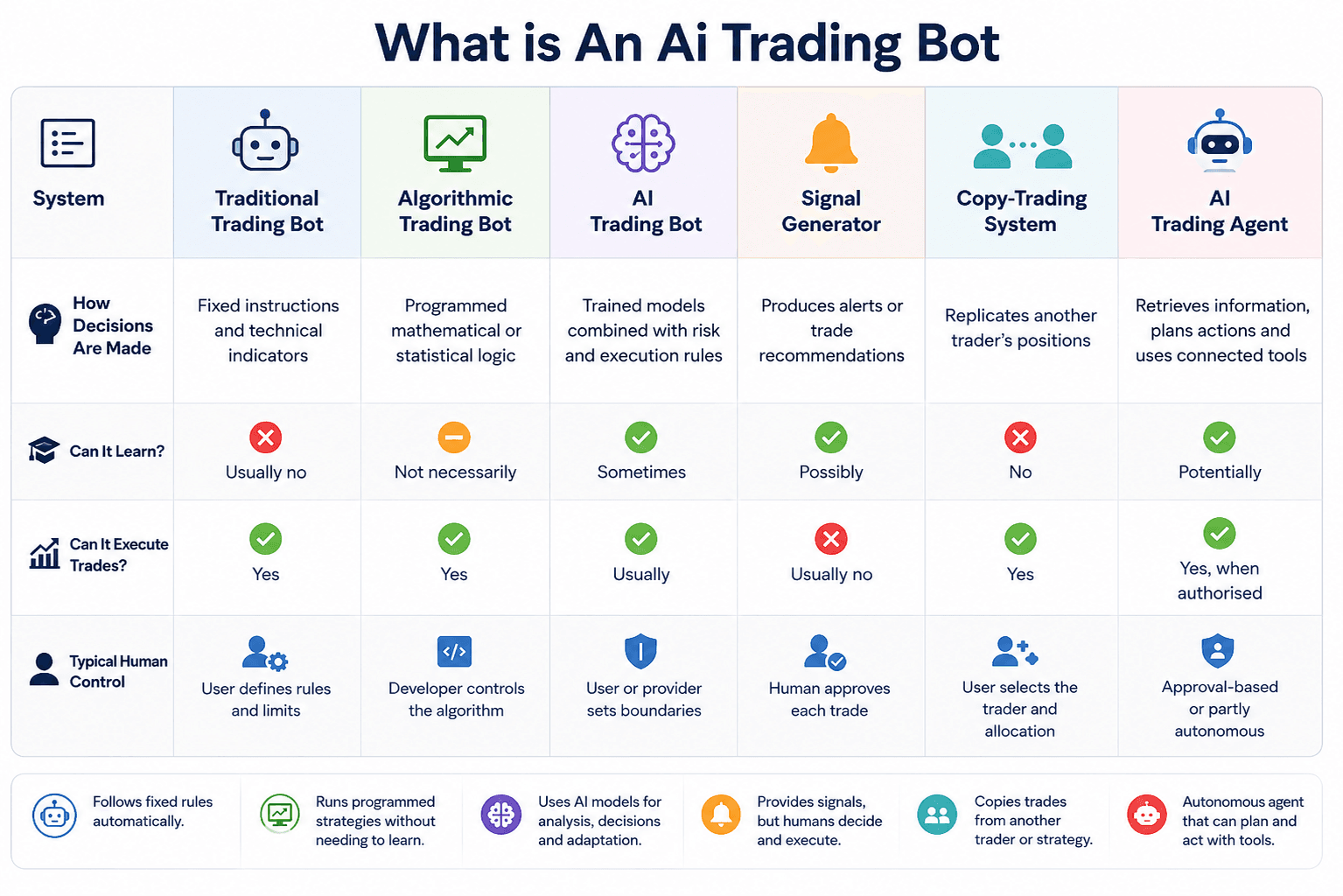 What Separates Genuine AI From Basic Trading Automation
What Makes a Trading Bot an AI Bot?
A bot should use a trained machine-learning model for at least one material part of its decision process before it is described as AI-powered.
Consider a fixed instruction: Buy when the RSI falls below 30 and sell when it rises above 70.
Software can monitor the Relative Strength Index and execute that rule automatically. The instruction remains unchanged until a person edits it. The bot does not learn what an oversold market looks like, estimate whether the signal is reliable or adapt the threshold to current volatility.
A model-driven system might analyze how RSI interacted with trading volume, momentum, volatility and subsequent returns across its training data. It could estimate the probability of a rebound or reject the trade because the market has entered a liquidity crisis where earlier relationships no longer hold.
Most trading systems fit into three categories:
- Rule-based automation: The bot follows fixed conditions based on prices, technical indicators, schedules or account settings.
- Hybrid systems: Fixed rules govern execution and safety while an AI model handles selected tasks such as sentiment analysis, pattern recognition, volatility forecasting or strategy selection.
- Model-driven or agentic systems: A prediction model or autonomous agent plays a wider role in gathering information, planning actions and selecting trades.
The practical test is straightforward: identify the decision produced by the trained model.
A provider should be able to say that its model classifies market regimes, estimates volatility or scores sentiment. If the explanation stops at phrases such as “advanced intelligence,” “smart automation” or “proprietary algorithms,” the AI claim remains unproven.
AI Trading Bot vs Algorithmic Bot vs AI Trading Agent
An AI trading bot is a type of algorithmic trading system, but many algorithmic systems do not use artificial intelligence.
| System | How Decisions Are Made | Can It Learn? | Can It Execute Trades? | Typical Human Control |
|---|---|---|---|---|
| Traditional trading bot | Fixed instructions and technical indicators | Usually no | Yes | User defines rules and limits |
| Algorithmic trading bot | Programmed mathematical or statistical logic | Not necessarily | Yes | Developer controls the algorithm |
| AI trading bot | Trained models combined with risk and execution rules | Sometimes | Usually | User or provider sets boundaries |
| Signal generator | Produces alerts or trade recommendations | Possibly | Usually no | Human approves each trade |
| Copy-trading system | Replicates another trader’s positions | No | Yes | User selects the trader and allocation |
| AI trading agent | Retrieves information, plans actions and uses connected tools | Potentially | Yes, when authorised | Approval-based or partly autonomous |
Algorithmic trading is the broad category. A moving-average crossover bot, a market-making algorithm and a machine-learning prediction model are all algorithmic systems, although only the last one necessarily involves AI.
A signal generator stops before execution. It may produce a trading signal, confidence score or market classification, but a person still decides whether to submit the order.
Copy trading follows the decisions of another trader or strategy account. The copied trader may use algorithms, but the replication system itself does not become AI-powered by association.
An AI trading agent may operate with greater autonomy. It can interpret a natural-language objective, retrieve news or market data, use analytical tools, compare possible actions and interact with an exchange or wallet.
Greater autonomy expands the failure surface. A conventional bot can submit a bad order. An autonomous agent with broad tool access may gather the wrong information, misunderstand an instruction, choose an unsuitable strategy and execute several connected actions before the user intervenes.
Human approval therefore becomes more valuable as the system gains more freedom. An agent that prepares an analysis for review carries less operational risk than one allowed to change leverage, approve tokens and sign transactions without confirmation.
How Does an AI Trading Bot Work?
An AI trading bot collects data, processes it through a model, applies risk rules and sends orders to an exchange or broker through an API.
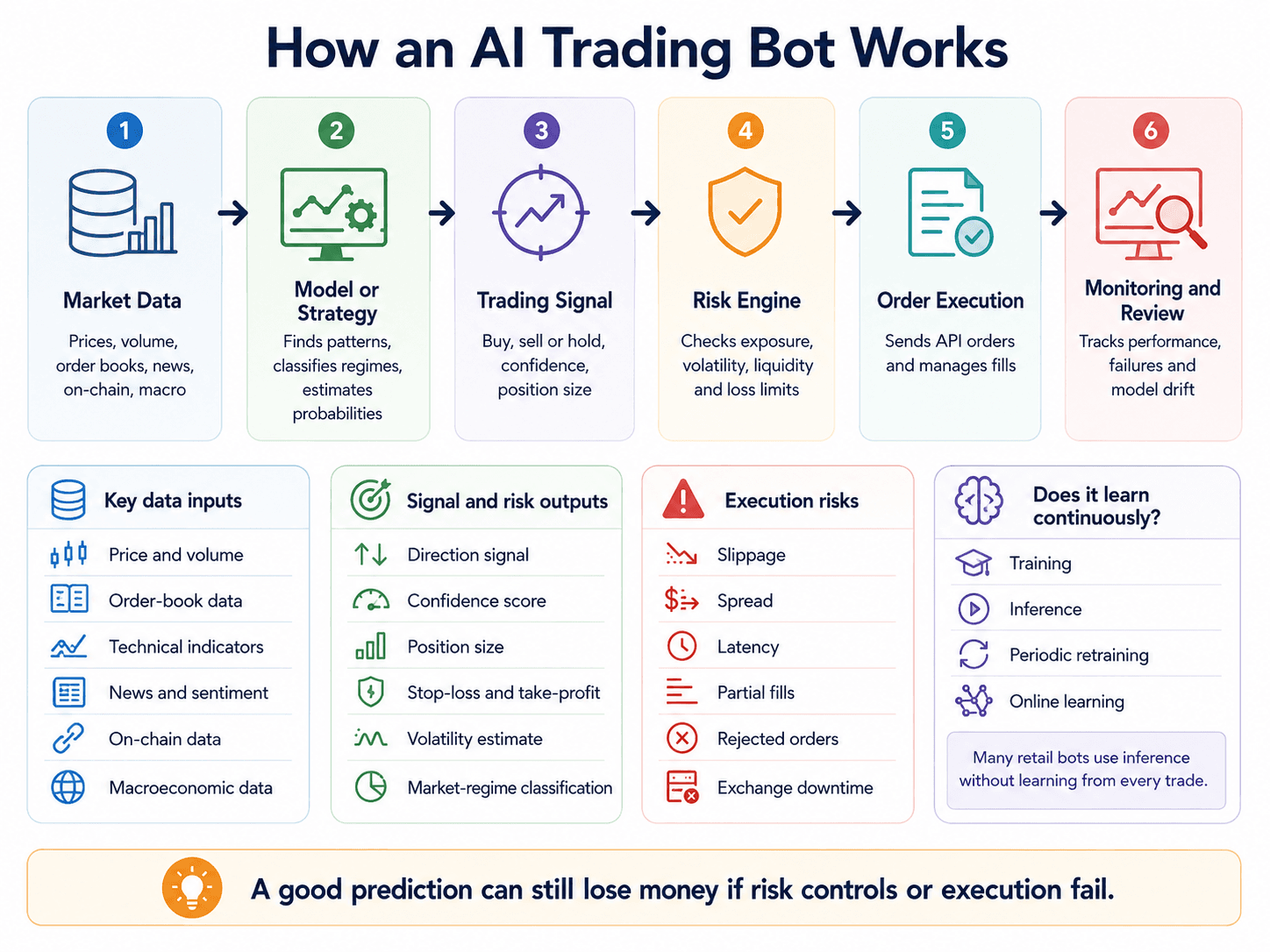 From Market Data to Controlled Live Trade Execution
The basic workflow is:
Market Data → Model or Strategy → Trading Signal → Risk Engine → Order Execution → Monitoring and Review
These stages solve different problems:
- The data layer determines what the system can observe.
- The model interprets those observations.
- The signal converts the model output into a proposed action.
- The risk engine decides whether the account should take that action.
- The execution layer submits and manages the real order.
- Monitoring checks whether the live system behaved as intended.
Each stage can fail independently. Good analysis does not repair weak risk controls, and a correct prediction does not guarantee a good execution price.
Data Collection and Market Analysis
An AI trading bot begins with data, but more data does not automatically create a better model.
Possible inputs include:
- Price and volume: Open, high, low, close and trading-volume data help the model identify direction, momentum, volatility and participation.
- Order-book data: Bid and ask prices, quoted liquidity and order-book depth can show where buying or selling interest currently sits.
- Technical indicators: RSI, MACD, moving averages and volatility bands compress raw price data into signals that may be easier for a model to compare.
- Historical market data: Earlier prices, returns, volume and volatility provide the training and testing material used to identify possible relationships.
- Real-time data: Current prices, trades and account information support live inference after the model has already been trained.
- News and social sentiment: Text models can classify whether information appears positive, negative, uncertain or relevant to a particular asset.
- On-chain data: Exchange flows, wallet activity, transaction volume and protocol usage may provide information unavailable through a normal price feed.
- Macroeconomic information: Interest rates, inflation releases, currency movements and scheduled events can help a model account for wider financial conditions.
The same input can play different roles. Historical data may train the prediction model. Real-time price and order-book data may drive live decisions. Sentiment data may flag a narrative shift, while on-chain data may show funds moving toward or away from exchanges.
Data quality includes more than accuracy. Timing matters.
A news article published after a price move cannot be treated as information the model possessed before the move. A delayed price feed may show an opportunity that has already disappeared. Social data can be manipulated, while on-chain activity may be misclassified when wallets or exchange addresses are labelled incorrectly.
Other data failures include:
- Missing trading intervals
- Duplicated records
- Incorrect timestamps
- Survivorship-biased asset lists
- Data from illiquid or unreliable venues
- Changes in exchange symbols or contract specifications
- Indicators calculated differently across providers
Bad data does more than add noise. It can teach the model a relationship that never existed in live markets.
Signal Generation and Risk Decisions
The model’s output is not yet a complete trade. It must be translated into a proposal and passed through the risk engine.
The system may produce:
| Output | What It Tells the System |
|---|---|
| Buy, sell or hold signal | The proposed market direction |
| Confidence score | How strongly the model supports the prediction |
| Position size | How much capital the trade should use |
| Stop-loss level | Where the loss should be limited |
| Take-profit level | Where some or all of the position should close |
| Market-regime classification | Whether conditions appear trending, ranging or unstable |
| Volatility estimate | How widely the price may move |
| Holding-period estimate | How long the expected opportunity may remain valid |
A confidence score should not be mistaken for certainty. A model assigning a 70% probability to an upward move still expects to be wrong in some cases. The score is only useful when it has been calibrated against real outcomes.
The prediction model and risk engine are separate components.
A prediction model may estimate a 60% probability that an asset will rise over four hours. The risk engine then asks:
- Is 60% sufficient to justify a trade?
- How volatile is the asset?
- How much liquidity is available?
- How much exposure already exists?
- Are other open positions correlated?
- How much can the account lose?
- Is leverage allowed under the current conditions?
- Has the daily loss limit already been approached?
A bot can predict direction correctly and still lose money through poor sizing.
Suppose it wins ten small positions worth $10 each, then loses one oversized position worth $200. The directional model may have achieved a high win rate, yet the complete trading system lost money because the risk engine allowed one trade to dominate the account.
A well-designed risk engine can reject a model’s signal. That is a feature, not a contradiction.
Trade Execution Through Exchange or Broker APIs
The execution layer converts a theoretical decision into an actual order.
Most third-party bots connect through an exchange API or broker API. Depending on the permissions granted, the connection may let the bot read balances, retrieve market data, place orders, cancel orders and monitor positions.
The main order types behave differently:
- Market order: Attempts to execute immediately against available liquidity. It offers speed, but the final price may be worse than expected.
- Limit order: Executes only at the selected price or better. It controls price more tightly, but the trade may remain unfilled.
- Stop order: Activates after the market reaches a trigger price. Sharp gaps or low liquidity can still produce a worse fill.
- Scaled order: Divides one position across several prices or time intervals. This may reduce immediate market impact but increases execution complexity.
Our guide to crypto market structures explains how order books, liquidity, exchanges and different trading venues affect the market information a bot receives.
The execution layer must also handle:
- Slippage: The difference between the expected price and the actual fill, often caused by volatility or limited liquidity.
- Spread: The gap between the highest available bid and the lowest available ask. A wide spread raises the cost of entering and exiting.
- Latency: The delay between receiving data, making a decision and reaching the exchange. A short-lived opportunity may disappear during that interval.
- Partial fills: Only part of the requested order executes, leaving the bot with an unintended position size.
- Minimum order sizes: The exchange may reject a trade that falls below its quantity or value threshold.
- Rejected orders: Insufficient funds, invalid parameters, rate limits or exchange restrictions can prevent execution.
- Failed protective orders: An entry may execute while the stop-loss fails, leaving an open position without the intended protection.
- Exchange downtime: The model may continue producing signals while the venue is unable to accept or cancel orders.
The execution layer determines whether the model’s theoretical edge survives real trading.
A forecast of a 0.3% price move may appear profitable in a simulation. A 0.1% spread, 0.1% commission and 0.15% slippage would erase that edge before funding or subscription costs are counted.
Do AI Trading Bots Learn Continuously?
Many retail AI trading bots do not rewrite or improve themselves after every trade.
Four processes are often merged into the vague phrase “self-learning”:
- Model training: The system analyses training data and adjusts model parameters to identify relationships between inputs and outcomes.
- Inference: The trained model receives new data and produces a prediction, classification or score without changing its parameters.
- Periodic retraining: Developers update the model using newer data under a controlled schedule.
- Online learning: The model updates incrementally as fresh observations arrive.
A bot can use machine learning while relying on a static trained model for months. It may produce live decisions through inference without learning anything from the outcome of each trade.
Periodic retraining is more common in controlled systems. Developers can review the new dataset, compare the updated model with the previous version and reject an update that performs worse.
Online learning offers faster adaptation but introduces new risks. Live data may contain:
- Manipulated prices
- Broken feeds
- Exceptional market shocks
- Temporary liquidity gaps
- Incorrect labels
- Behavior that will not repeat
A model that absorbs every new event without supervision may learn from market noise or operational errors.
Model drift creates a separate problem. A relationship learned during a liquid bull market may weaken during a bear market or liquidity crisis. Retraining may help, although an update must still undergo out-of-sample testing before live deployment.
A credible provider should explain:
- How the model was originally trained
- Which data sources it used
- Whether live trades change the model
- How often retraining occurs
- How new model versions are tested
- Whether the user is notified about updates
- What happens when model performance deteriorates
“Learns continuously” is a technical claim. It should come with an update process, testing method and version history.
What Strategies Can AI Trading Bots Use?
AI can improve selected parts of a trading strategy, but a strategy does not become AI-powered merely because software executes it.
The practical question is whether the model contributes pattern recognition, prediction, classification or optimization beyond what fixed instructions already provide.
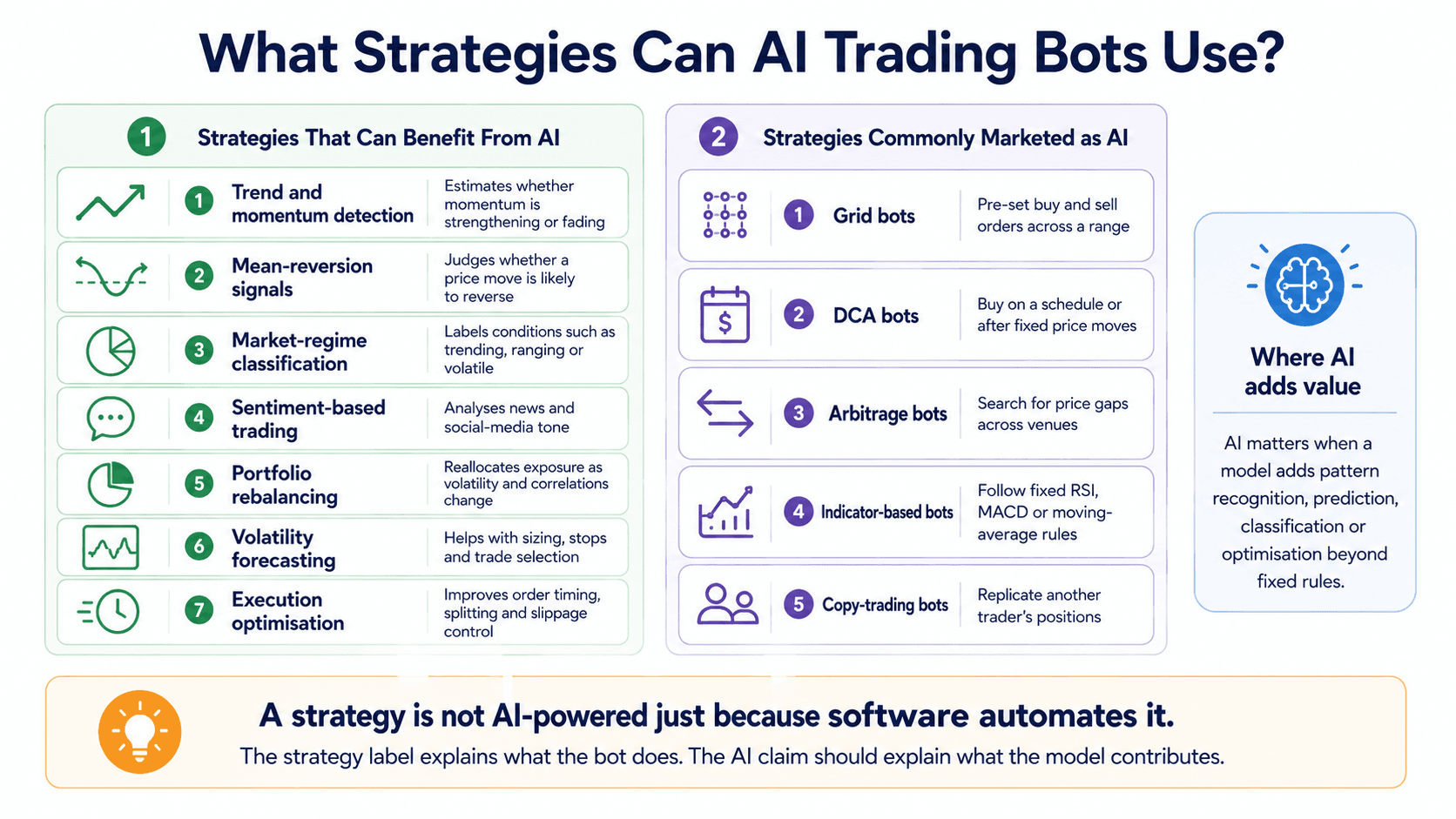 Where AI Adds Real Value Across Trading Strategies
Strategies That Can Benefit From AI
Several strategy categories can use machine learning in a meaningful way:
- Trend and momentum detection: A predictive model can combine price direction, trading volume, cross-asset behavior and volatility to estimate whether momentum is strengthening or fading.
- Mean-reversion signals: AI may estimate whether a price deviation is likely to reverse or whether the market has moved into a new range where the previous average is no longer useful.
- Market-regime classification: The system can label conditions as trending, range-bound, volatile or illiquid, then route trades to a strategy designed for that environment.
- Sentiment-based trading: Natural-language processing can analyze news and social media for changes in tone, although source quality, sarcasm and coordinated promotion remain difficult to handle.
- Portfolio rebalancing: A model may estimate changes in volatility and asset correlations, then recommend how exposure should be redistributed.
- Volatility forecasting: Predicted volatility can guide position sizes, stop-loss distances, options strategies and decisions about whether to trade at all.
- Execution optimization: AI can estimate how to divide a large order, when to use limits and whether the expected edge is large enough to survive slippage.
AI often contributes one layer rather than replacing the entire strategy. A volatility model may improve position sizing while fixed rules determine entries. A regime classifier may select between trend-following and mean-reversion systems while humans define both strategies.
Our guide to crypto trading strategies provides the underlying strategy context. The model should improve a trading thesis that can already be explained without referring to AI.
Strategies Commonly Marketed as AI
Many popular bot categories are useful forms of automation, but they do not inherently require machine learning.
- Grid bots: Place buy and sell orders across a price range. The grid may be fixed by the user even when the platform markets the overall product as AI-powered.
- DCA bots: Buy on a schedule or add to a position after predefined price movements. The timing and amount may remain entirely rule-based.
- Arbitrage bots: Search for price differences across venues. Detecting a spread is ordinary automation unless a model estimates execution probability, transfer delays or whether the gap will survive costs.
- Indicator-based bots: Trade when RSI, moving averages, MACD or other indicators satisfy fixed conditions.
- Copy-trading bots: Replicate another trader’s positions rather than producing an independent market prediction.
Dollar-Cost Averaging is a clear example. A DCA bot may buy a fixed amount of Bitcoin every Monday. The automation removes manual work, but the schedule itself does not involve AI.
A grid bot can also operate through predetermined conditions. AI becomes relevant only when a model selects the range, adjusts grid spacing or decides when the market no longer suits the strategy.
The category label should describe the strategy. The AI claim should identify the model’s specific contribution.
Do AI Trading Bots Actually Work?
AI trading bots can automate a sound strategy, but the AI label alone says nothing about whether that strategy is profitable.
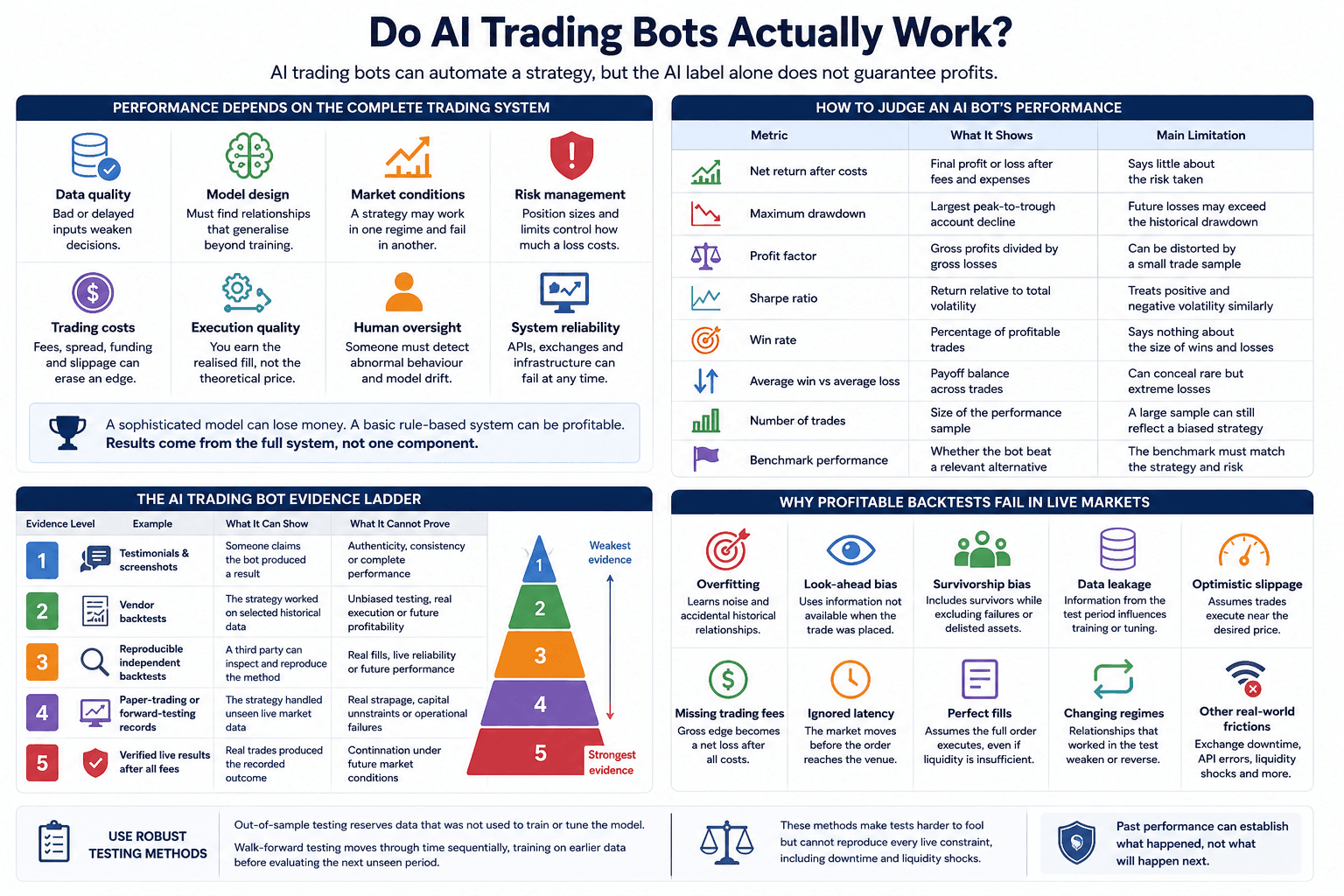 Profitability Depends on Evidence, Costs, and Risk Controls
Performance depends on the complete trading system:
- Data quality: Bad or delayed inputs weaken every decision produced downstream.
- Model design: The model must identify relationships that generalize beyond its training sample.
- Market conditions: A strategy may work in one regime and fail when volatility or liquidity changes.
- Risk management: Position sizes and exposure limits determine how much a wrong prediction can cost.
- Trading costs: Fees, spread, funding and slippage can erase a small statistical edge.
- Execution quality: The account earns the realized fill, not the theoretical price in the model.
- Human oversight: Someone must identify abnormal behavior, model drift and operational failures.
A sophisticated model can lose money. A basic rule-based system can remain profitable. Trading results come from the full system rather than the prestige attached to one component.
How to Judge an AI Bot's Performance
An AI bot should be evaluated through net, risk-aware performance rather than headline returns or isolated winning trades.
| Metric | What It Shows | Main Limitation |
|---|---|---|
| Net return after costs | Final profit or loss after fees and expenses | Says little about the risk taken |
| Maximum drawdown | Largest peak-to-trough account decline | Future losses may exceed the historical drawdown |
| Profit factor | Gross profits divided by gross losses | Can be distorted by a small trade sample |
| Sharpe ratio | Return relative to total volatility | Treats positive and negative volatility similarly |
| Win rate | Percentage of profitable trades | Says nothing about the size of wins and losses |
| Average win vs average loss | Payoff balance across trades | Can conceal rare but extreme losses |
| Number of trades | Size of the performance sample | A large sample can still reflect a biased strategy |
| Benchmark performance | Whether the bot beat a relevant alternative | The benchmark must match the strategy and risk |
Win rate receives far more attention than it deserves.
Consider two bots:
- Bot A wins 90 trades at $1 each and loses 10 trades at $20 each.
- Bot B wins 45 trades at $5 each and loses 55 trades at $2 each.
Bot A has a 90% win rate and loses $110. Bot B wins fewer than half its trades and earns $115.
A useful performance record should answer:
- Were returns calculated after subscription fees, trading commissions, spread, slippage and funding?
- How large was the maximum drawdown?
- How many trades produced the result?
- Which market regimes were included?
- Was leverage used?
- Did the strategy beat a suitable benchmark?
- Could the trade history be independently verified?
- Were deposits and withdrawals separated from trading returns?
For a deeper testing framework, use our guide to backtesting a crypto strategy before accepting a vendor's equity curve.
The AI Trading Bot Evidence Ladder
Performance evidence should be judged by what it can prove, not by how polished it looks.
| Evidence Level | Example | What It Can Show | What It Cannot Prove |
|---|---|---|---|
| 1 | Testimonials and screenshots | Someone claims the bot produced a result | Authenticity, consistency or complete performance |
| 2 | Vendor backtests | The strategy worked on selected historical data | Unbiased testing, real execution or future profitability |
| 3 | Reproducible independent backtests | A third party can inspect and reproduce the method | Real fills, live reliability or future performance |
| 4 | Paper-trading or forward-testing records | The strategy handled unseen live market data | Real slippage, capital constraints or operational failures |
| 5 | Verified live results after all fees | Real trades produced the recorded outcome | Continuation under future market conditions |
Testimonials sit at the bottom because they are selective and difficult to verify. A screenshot may show one profitable day while hiding months of losses, deposits or manual interventions.
Vendor backtests provide more information, but the provider controls the strategy, data, period and execution assumptions. A smooth equity curve may be the result of parameters selected after examining the same market history.
Independent and reproducible backtests are stronger because another researcher can inspect the method. They still simulate execution.
Paper trading or forward testing uses new market data after the strategy has been defined. It reduces the chance that developers merely fitted the model to the past, although simulated fills may remain unrealistically favorable.
Verified live results provide the strongest evidence when they include:
- Full measurement period
- Complete trade history
- Starting and ending equity
- Maximum drawdown
- Benchmark return
- Fees and slippage
- Leverage
- Deposits and withdrawals
- Market conditions
- Independent verification
Even verified live performance remains historical. It can establish what happened, not what will happen next.
Why Profitable Backtests Fail in Live Markets
Profitable backtests often fail because the simulation contains information or execution conditions the trader could not have obtained in real time.
Common causes include:
- Overfitting: The model learns noise and accidental historical relationships rather than a durable signal.
- Look-ahead bias: The test uses information that would not have been available when the trade was placed.
- Survivorship bias: The dataset includes assets or companies that survived while excluding those that failed or disappeared.
- Data leakage: Information from the testing period influences model training, feature creation or parameter selection.
- Optimistic slippage: The simulation assumes trades execute near the desired price despite limited liquidity.
- Missing trading fees: Frequent trading can turn a small gross edge into a net loss.
- Ignored latency: The market moves before the live order reaches the venue.
- Perfect fills: The backtest assumes the full order executes, even when the order book could not support it.
- Changing market regimes: Relationships that held during the test weaken or reverse later.
Out-of-sample testing reserves data that was not used to train or tune the model. Walk-forward testing moves through time sequentially, repeatedly training on earlier data before evaluating the next unseen period.
These methods make a test harder to fool. They cannot reproduce every live constraint, especially exchange downtime, API errors and sudden liquidity shocks.
Benefits and Limitations of AI Trading Bots
AI trading bots can improve monitoring, processing and execution, but every operational advantage has a corresponding limitation.
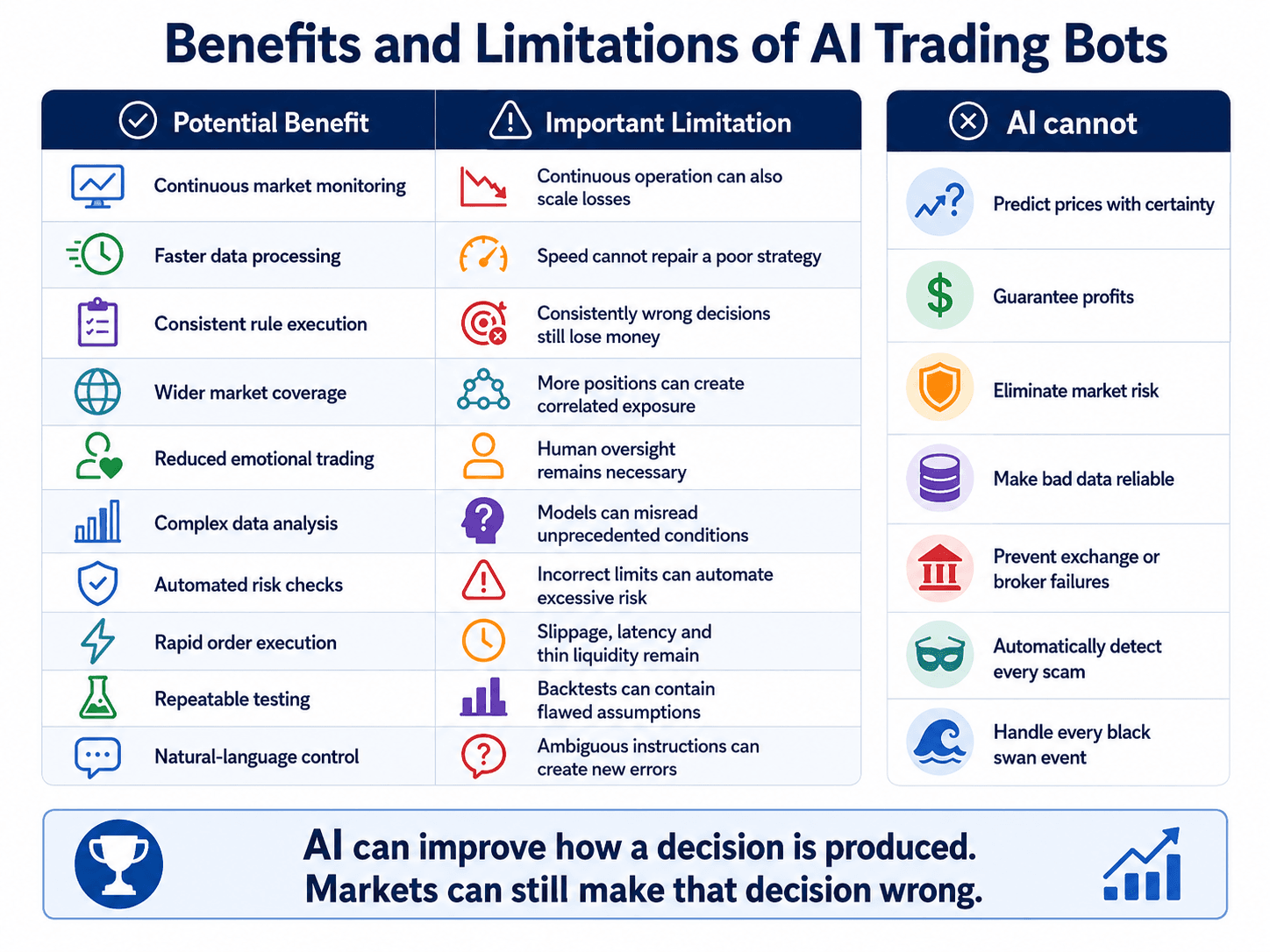 Faster Decisions Bring Efficiency and Larger Failure Risks
| Potential Benefit | Important Limitation |
|---|---|
| Continuous market monitoring | Continuous operation can also scale losses |
| Faster data processing | Speed cannot repair a poor strategy |
| Consistent rule execution | Consistently wrong decisions still lose money |
| Wider market coverage | More positions can create correlated exposure |
| Reduced emotional trading | Human oversight remains necessary |
| Complex data analysis | Models can misread unprecedented conditions |
| Automated risk checks | Incorrect limits can automate excessive risk |
| Rapid order execution | Slippage, latency and thin liquidity remain |
| Repeatable testing | Backtests can contain flawed assumptions |
| Natural-language control | Ambiguous instructions can create new errors |
A bot does not become tired, distracted or frightened by a sudden candle. It can process the same rule at 3 a.m. that it processed at noon.
That consistency helps traders who repeatedly abandon their plans. It cannot turn a weak plan into a profitable one.
Automation may also reduce impulsive entries, revenge trading and hesitation. It can introduce a different psychological trap: blind trust. A user may leave a deteriorating strategy running because intervening feels like overriding an intelligent system.
Crypto trading psychology still applies when a bot submits the order. The trader remains responsible for strategy selection, capital allocation, monitoring and shutdown decisions.
AI cannot:
- Predict prices with certainty: Financial markets contain uncertainty, competing participants and events that no model can know in advance.
- Guarantee profits: A probability-based system will produce losing trades, and market relationships can stop working.
- Eliminate market risk: Volatility, liquidity shocks and correlated sell-offs remain even when execution is automated.
- Make bad data reliable: A more sophisticated model can process flawed inputs faster, but it cannot recover information that was missing or mistimed.
- Prevent exchange or broker failures: Venue outages, frozen accounts and rejected orders sit outside the prediction model.
- Automatically detect every scam: Models can identify patterns, but new fraud methods and manipulated information can still bypass them.
- Handle every black swan event: Unprecedented conditions may fall outside the model’s training data and tested risk range.
Artificial intelligence can improve how a decision is produced. Markets retain the right to make that decision wrong.
What Are the Risks of AI Trading Bots?
AI trading bot risks come from four sources: the model, the market, the execution platform and the permissions granted to the software.
Grouping them by source makes it easier to see where the risk enters and which control can reduce it.
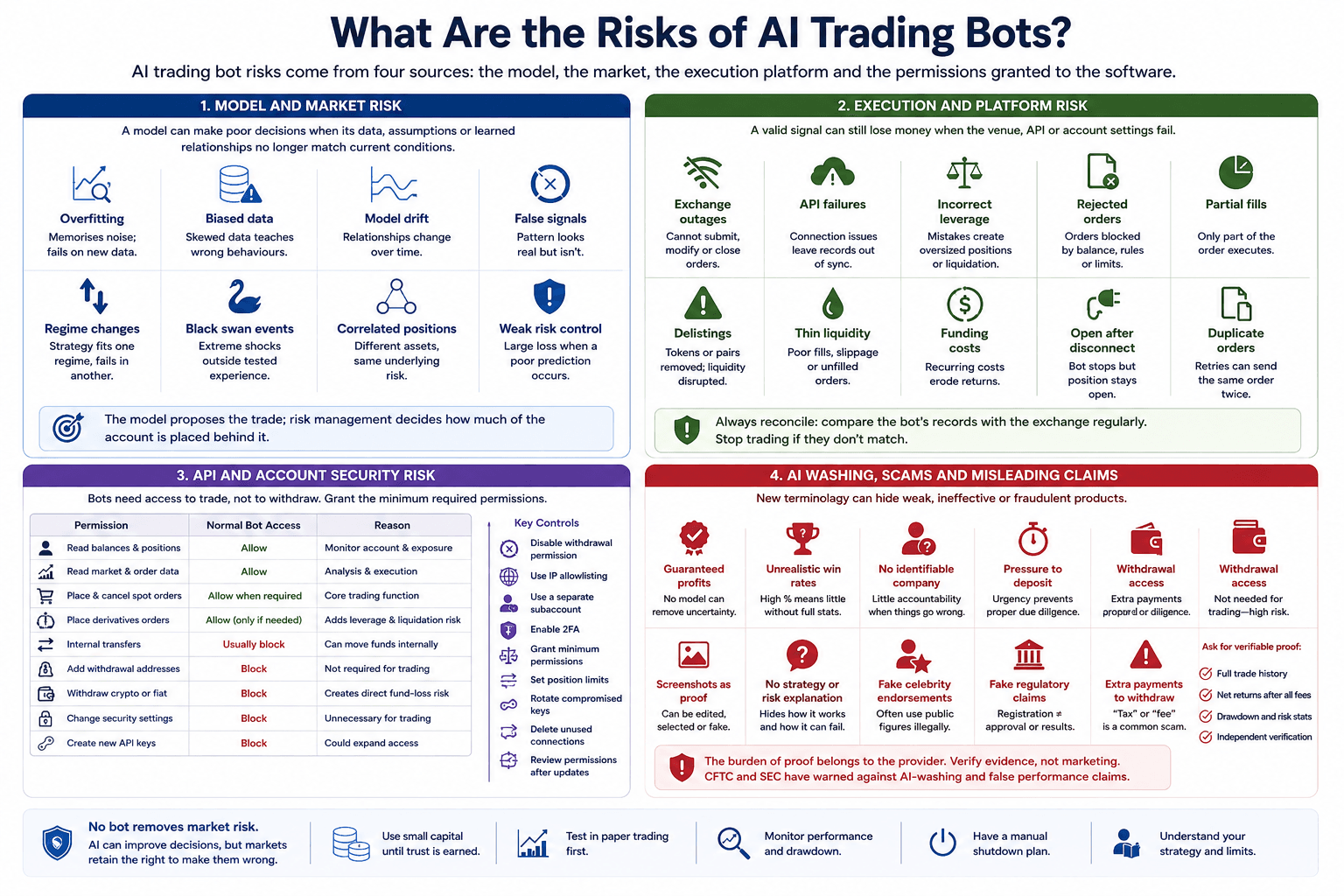 Model, Platform, Security, and Scam Risks Clearly Explained
Model and Market Risk
A model can produce poor decisions because its training data, assumptions or learned relationships no longer match current conditions.
- Overfitting: The model memorizes historical noise and performs poorly when exposed to new data.
- Biased training data: A dataset dominated by rising markets may teach the bot to treat most declines as buying opportunities.
- Model drift: Relationships between inputs and outcomes change, gradually reducing prediction quality.
- False signals: The system identifies a pattern that appears meaningful but carries little real predictive value.
- Regime changes: A trend-following model can struggle in a range, while mean reversion can fail during a sustained breakdown.
- Black swan events: An exceptional shock may sit completely outside the model’s tested experience.
- Correlated positions: Several different trades may depend on the same broad market direction or liquidity source.
A model trained mainly during a bull market may learn that pullbacks usually recover. During a prolonged bear market, the same behavior can repeatedly add exposure to falling assets.
Execution and Platform Risk
A valid trading signal can still lose money when the venue, API connection or account settings fail.
- Exchange outages: The bot may be unable to submit, modify or close orders during a sharp market move.
- API failures: A lost or delayed connection can leave the bot’s internal records out of sync with the exchange account.
- Incorrect leverage: A configuration mistake may create a much larger position or closer liquidation price than intended.
- Rejected orders: Insufficient balance, invalid order sizes or exchange restrictions can prevent an entry or protective exit.
- Partial fills: Only part of an order may execute, leaving the bot with an unintended position or hedge.
- Delistings: An exchange may remove a token or trading pair, disrupting open strategies and reducing available liquidity.
- Thin liquidity: The desired order may move the market, receive a poor fill or remain partly open.
- Funding costs: A perpetual futures strategy can lose money through recurring funding payments even when the price prediction is broadly correct.
- Open positions after disconnection: The bot may stop monitoring while the account remains exposed to the market.
- Duplicate orders: Retries after an uncertain API response can submit the same trade twice unless the system uses reliable order identifiers.
One of the worst failures occurs when an entry executes but its protective stop does not. The bot believes it created a bounded trade while the exchange account holds an unprotected position.
The reverse can also occur. The bot may mark a position as closed internally even though the exchange rejected the exit order.
A reliable system needs reconciliation. It should regularly compare its internal position, balance and order records with the exchange, then stop creating new trades when those records disagree.
API and Account Security Risk
A normal third-party bot usually needs permission to read account information and place trades. It should not need permission to withdraw assets.
| Permission | Normal Bot Access | Reason |
|---|---|---|
| Read balances and positions | Allow | Needed for account and exposure monitoring |
| Read market and order data | Allow | Needed for analysis and execution |
| Place and cancel spot orders | Allow when required | Core trading function |
| Place derivatives orders | Allow only when explicitly needed | Adds leverage and liquidation risk |
| Internal transfers | Usually block | Can move funds between account areas |
| Add withdrawal addresses | Block | Not required for trading |
| Withdraw crypto or fiat | Block | Creates direct fund-loss risk |
| Change security settings | Block | Unnecessary for trading |
| Create new API keys | Block | Could expand access beyond original limits |
Use the following controls:
- Disable withdrawal permission: Trading software does not need the ability to remove funds from the account.
- Use IP allowlisting: Restrict the API key to requests from approved addresses where the provider and exchange support it.
- Create a separate subaccount: Isolate bot capital from the main portfolio and other trading strategies.
- Enable 2FA: Protect account login and security-setting changes, even though API requests use separate credentials.
- Grant minimum permissions: Give the bot only the reading and trading access required by its strategy.
- Set position limits: Restrict how much the bot can place in one asset, strategy or derivatives position.
- Rotate compromised keys: Delete and replace keys immediately after suspected exposure.
- Delete unused connections: Old integrations remain unnecessary attack paths.
- Review permissions after updates: A product upgrade should not quietly gain broader account access.
API keys should never be pasted into unverified browser extensions, chat messages, shared documents or public code repositories.
An AI agent needs tighter controls when it can use wallets or external tools. Its access should be limited by:
- Allowed exchanges
- Approved assets
- Maximum transaction value
- Permitted tools
- Approved smart contracts
- Leverage limits
- Required human confirmations
High-risk actions such as increasing leverage, transferring assets or signing wallet transactions should require explicit approval.
AI Washing, Scams and Misleading Claims
AI washing uses technical language to make an ordinary, ineffective or fraudulent product sound more capable than the evidence supports.
Watch for these red flags:
- Guaranteed profits: No model can remove uncertainty from financial markets.
- Extremely high win rates without records: A headline percentage reveals little without average losses, drawdown and full trade history.
- No identifiable company: Anonymous operators leave users with little accountability when withdrawals or support fail.
- Pressure to deposit quickly: Urgency is used to prevent proper due diligence.
- Requests for withdrawal permission: A normal trading bot does not need direct access to remove funds.
- Screenshots presented as proof: Images can be edited, selectively chosen or taken from demo accounts.
- No explanation of strategy or risk: Proprietary code does not justify hiding the model’s basic function and loss conditions.
- Fake celebrity endorsements: Fraudulent promotions often borrow credibility from public figures who have no connection to the product.
- Fake regulatory claims: Registration in one jurisdiction may be invented or misrepresented as approval of the bot’s profitability.
- Additional payments to unlock withdrawals: Requests for a new “tax,” “verification fee” or “release payment” are a common escalation pattern.
The CFTC has issued a customer advisory on AI trading bot claims, warning against guaranteed and unusually high returns. The SEC has also brought AI-washing enforcement cases involving false or misleading claims about how financial firms used artificial intelligence.
How to Choose an AI Trading Bot
Choose an AI trading bot by inspecting its decision process, security controls, performance evidence and total cost rather than counting how many times its website mentions artificial intelligence.
A brand comparison can narrow the market. Evaluation still has to happen at the individual product and strategy level.
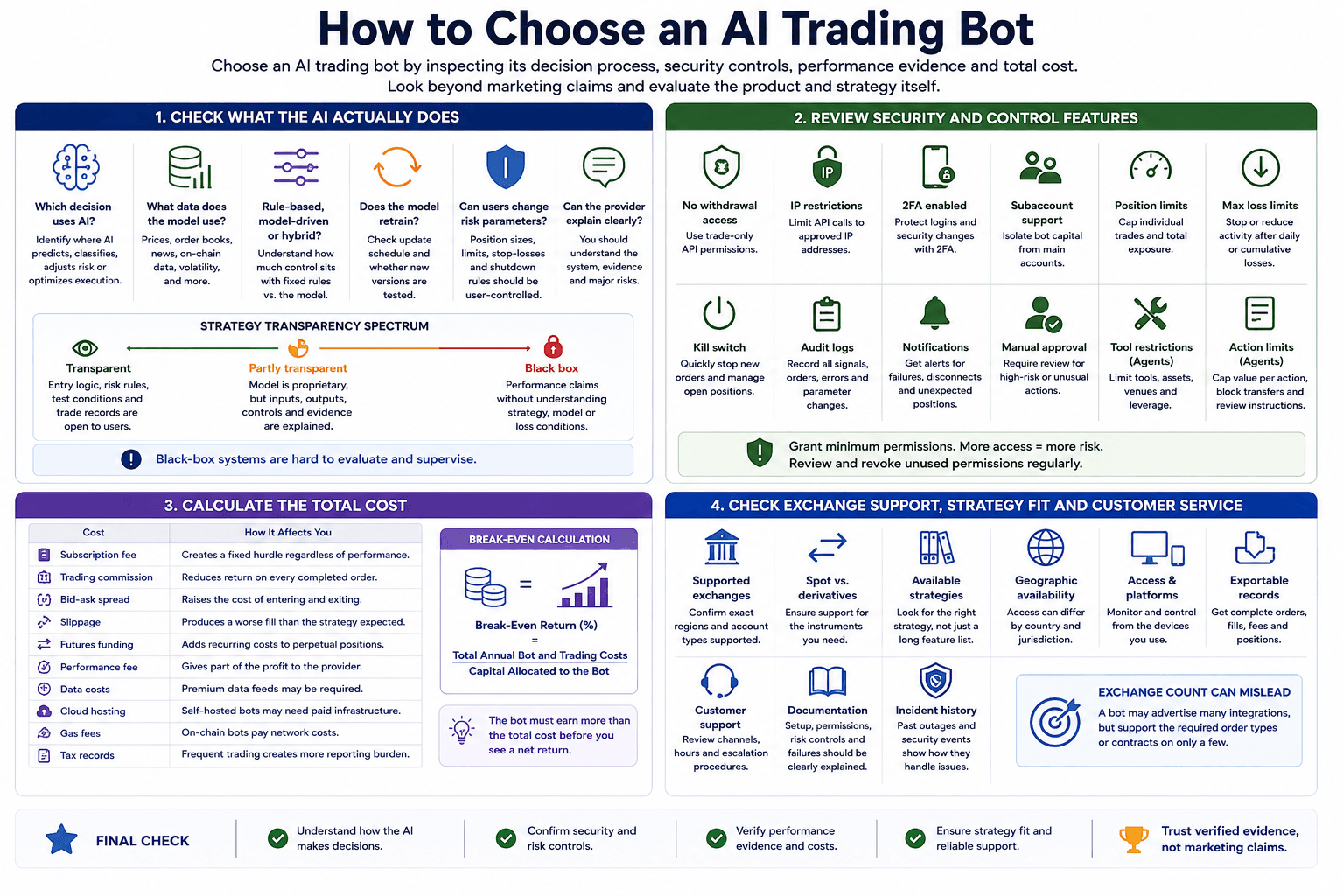 How to Evaluate AI Claims, Costs, and Controls
Check What the AI Actually Does
Begin with one direct question: which meaningful trading decision uses AI?
Ask:
- Which decision uses AI? The provider should identify whether the model predicts direction, classifies regimes, analyses sentiment, adjusts risk or optimizes execution.
- What data does the model analyze? The answer should name relevant inputs such as prices, order books, news, on-chain data or volatility.
- Is the strategy rule-based, model-driven or hybrid? This reveals how much control sits with fixed rules and how much depends on the trained model.
- Does the model retrain? The provider should explain the update schedule and whether new versions undergo controlled testing.
- Can users change risk parameters? Position sizes, exposure limits, stop-losses and shutdown rules should not disappear behind the model.
- Can the provider explain the system clearly? Proprietary methods may remain private, but the function, evidence and major risks should still be understandable.
Strategy transparency exists on a spectrum:
- Transparent: Users can inspect entry logic, risk rules, tested conditions and trade records.
- Partly transparent: The model remains proprietary, but its inputs, outputs, controls and performance evidence are explained.
- Black box: Users receive performance claims without understanding the strategy, model function or loss conditions.
A black-box system is difficult to evaluate and harder to supervise. The user cannot tell whether a losing streak reflects ordinary variance, model drift or an operational failure.
Review Security and Control Features
A safer bot limits what it can do and gives the user several ways to stop it.
Look for:
- No withdrawal access: The provider should support trade-only API permissions.
- IP restrictions: API calls should be limited to approved addresses where technically possible.
- 2FA: Account logins and security changes should require a second authentication factor.
- Subaccount support: Bot capital should be isolated from the main account.
- Position limits: Users should be able to cap individual trades and total portfolio exposure.
- Maximum loss limits: The system should stop or reduce activity after a defined daily or cumulative loss.
- Kill switch: Users need a direct way to stop new orders and manage existing positions.
- Audit logs: Every signal, order, error, parameter change and human intervention should be recorded.
- Notifications: Failed orders, disconnected APIs and unexpected positions should trigger immediate alerts.
- Manual approval: High-risk or unusual actions should be held for review where appropriate.
For newer AI-agent products, also check whether the user can:
- Limit which tools the agent can use
- Restrict approved assets and venues
- Require approval before leveraged trades
- Cap the value of each action
- Block wallet transfers
- Review the agent’s instructions and tool calls
- Prevent the agent from changing its own risk limits
Manual approval reduces autonomy, but that may be the right compromise when the system can sign transactions or interact with derivatives.
Calculate the Total Cost
An AI trading bot’s real cost extends beyond the advertised subscription.
| Cost | How It Affects the User |
|---|---|
| Subscription fee | Creates a fixed hurdle regardless of performance |
| Trading commission | Reduces the return on every completed order |
| Bid-ask spread | Raises the cost of entering and exiting |
| Slippage | Produces a worse fill than the strategy expected |
| Futures funding | Adds recurring costs to perpetual positions |
| Performance fee | Gives part of the profit to the provider |
| Data costs | Premium feeds may be required for advanced models |
| Cloud hosting | Self-hosted systems may need paid infrastructure |
| Gas fees | On-chain bots pay network costs for transactions |
| Tax records | Frequent trading creates a larger reporting burden |
The bot must earn enough to cover all of these expenses before it produces a net return.
Suppose a strategy earns 8% before costs. The subscription consumes 2% of the allocated capital, trading fees and slippage consume 3%, and funding consumes another 2%. The remaining net return is 1%, before tax.
Small accounts face a particular problem. A $50 monthly subscription costs $600 per year. On a $2,000 allocation, the strategy needs a 30% return merely to cover the subscription.
High-frequency systems face a different burden. Their expected profit per trade may be small, making spread, slippage and commissions decisive.
A basic break-even calculation is:
Break-Even Return = Total Annual Bot and Trading Costs ÷ Capital Allocated to the Bot
This does not predict profitability. It shows how much the bot must earn before the user moves above zero.
Check Exchange Support, Strategy Fit and Customer Service
A bot is useful only when its integrations, strategy and operational support fit the trader’s needs.
Evaluate:
- Supported exchanges or brokers: Confirm that the exact regional entity and account type are supported.
- Spot versus derivatives: A platform may support spot bots while offering limited or no futures integration.
- Available strategies: Check whether the bot offers the required strategy rather than a large but irrelevant feature list.
- Geographic availability: Product and exchange access can differ by country.
- Mobile and desktop access: Decide whether monitoring and emergency controls are available on the devices you use.
- Exportable records: The platform should provide complete orders, fills, fees and position history.
- Customer support: Review response channels, operating hours and escalation procedures.
- Documentation: Setup, permissions, risk controls and failures should be explained clearly.
- Incident history: Past outages and security events reveal how the provider communicates under pressure.
Exchange count can mislead. A bot may advertise twenty integrations while supporting the required order type or futures contract on only three.
Customer support becomes most valuable when something breaks. Look beyond routine setup reviews and examine how the provider handles API changes, incorrect orders, outages, security incidents and billing disputes.
How to Test an AI Trading Bot Safely
The safest testing process moves from strategy inspection to historical testing, forward testing and limited live deployment.
Skipping directly to live capital turns the account into the test environment.
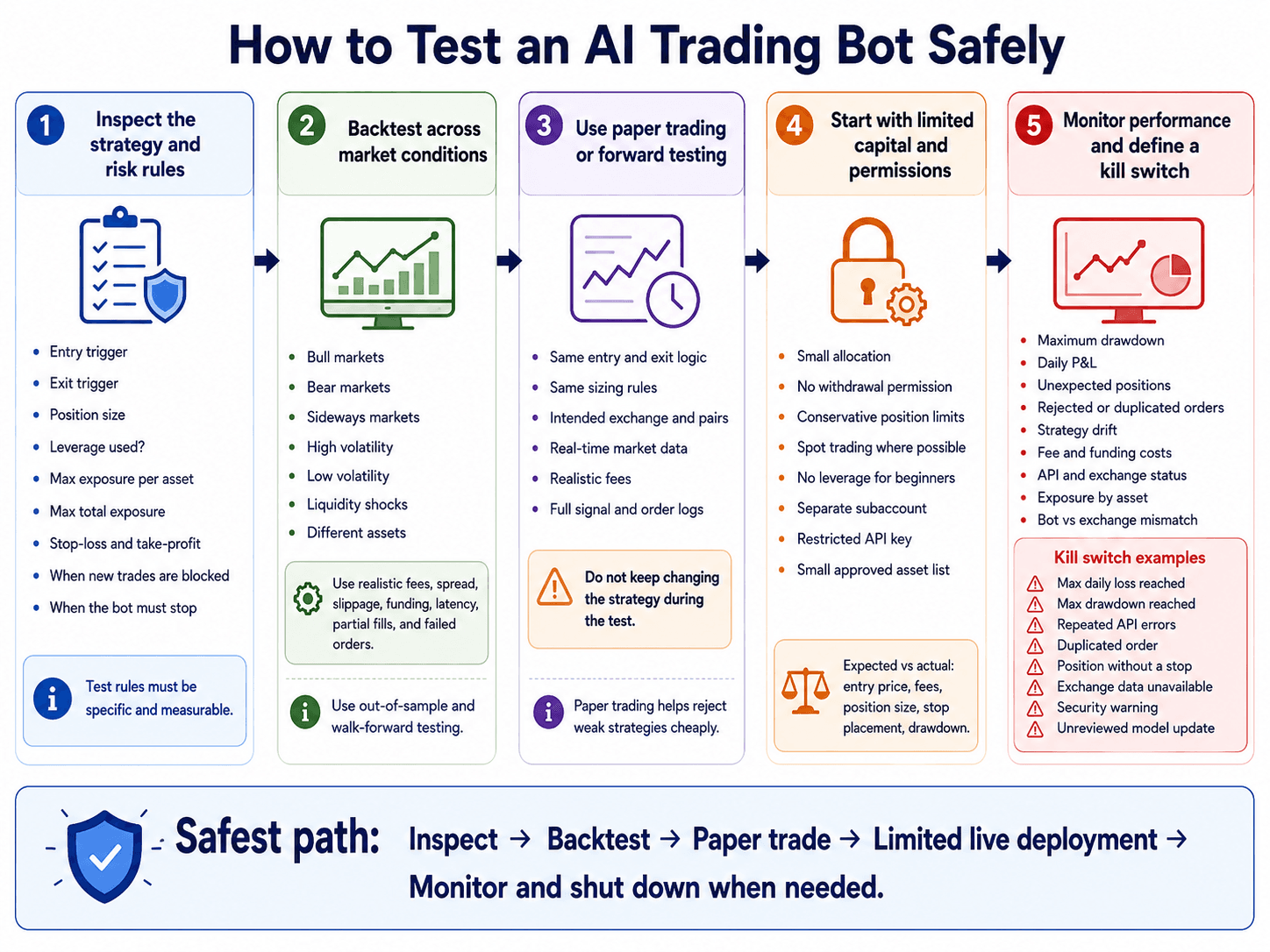 A Five-Step Path From Backtesting to Live Capital
Step 1: Inspect the Strategy and Risk Rules
Understand the bot’s logic before connecting an exchange account.
Document:
- What triggers an entry
- What triggers an exit
- How the position size is calculated
- Whether leverage is used
- Maximum exposure per asset
- Maximum total account exposure
- Stop-loss behavior
- Take-profit behavior
- Conditions that prevent new trades
- Conditions that stop the bot
A testable rule would state that a trade can open only when the model’s confidence exceeds a threshold, liquidity meets the minimum requirement and portfolio exposure remains below a fixed limit.
Step 2: Backtest Across Different Market Conditions
Test the strategy across several environments rather than selecting one favorable period.
Include:
- Bull markets
- Bear markets
- Sideways markets
- High-volatility periods
- Low-volatility periods
- Liquidity shocks
- Different assets where relevant
The test should include realistic:
- Trading commissions
- Bid-ask spread
- Slippage
- Funding rates
- Borrowing costs
- Latency assumptions
- Partial fills
- Failed orders
Separate the data used to design the strategy from the data used to evaluate it. Out-of-sample and walk-forward tests should occur before the result is treated as credible.
A profitable average may hide a strategy that fails catastrophically in one market regime. Review the equity curve, maximum drawdown and distribution of losses rather than stopping at total return.
Step 3: Use Paper Trading or Forward Testing
Paper trading tests the finished strategy on new market data without risking real capital.
A useful forward test should preserve:
- The same entry and exit logic
- The same position-sizing rules
- The intended exchange and pairs
- Real-time market data
- Realistic fees
- Complete signal and order logs
Do not change the strategy whenever the result becomes uncomfortable. Constant adjustments turn the forward test into another form of curve fitting.
Paper trading still has limitations. Simulated orders may fill at the displayed price even when a real market order would experience slippage or receive only a partial fill.
The goal is to reject weak strategies cheaply. Paper performance does not guarantee live execution.
Step 4: Start With Limited Capital and Permissions
Move to live trading with an amount small enough to treat early losses as testing costs.
Use:
- A small account allocation
- No withdrawal permission
- Conservative position limits
- Spot trading where possible
- No leverage for inexperienced users
- A separate subaccount
- A restricted API key
- A small approved asset list
Margin trading magnifies execution errors as well as market losses. A duplicated order, missed stop or incorrect balance becomes more dangerous when the position is leveraged.
The first live phase should compare expected and actual behavior:
- Expected entry price against actual fill
- Expected fees against actual costs
- Expected position size against actual size
- Expected stop placement against exchange records
- Expected drawdown against realized drawdown
Capital should increase only after operational behavior remains stable across a meaningful sample.
Step 5: Monitor Performance and Define a Kill Switch
Automated trading still requires active monitoring.
Track:
- Maximum drawdown
- Daily profit and loss
- Unexpected positions
- Rejected or duplicated orders
- Strategy drift
- Fee accumulation
- Funding costs
- API connection status
- Exchange status
- Exposure by asset
- Correlated exposure
- Differences between bot and exchange records
Define shutdown conditions before the bot goes live.
Examples include:
- Maximum daily loss reached
- Maximum drawdown reached
- Several consecutive API errors
- A duplicated order
- A position left without a stop
- Behavior outside the tested range
- Exchange data becoming unavailable
- Account records no longer matching the bot
- A security warning involving the provider
- An unreviewed model update
The shutdown process should specify whether the bot cancels open orders, closes positions or leaves them for manual review.
Before live deployment, our crypto trading bot mistakes checklist provides a wider pre-launch review of strategy, testing, permissions, fees and monitoring.
How Crypto AI Trading Bots Differ From Stock and Forex Bots
Crypto AI trading bots operate in a market with continuous trading, fragmented liquidity, exchange custody risk and on-chain execution paths that do not appear in the same form across traditional markets.
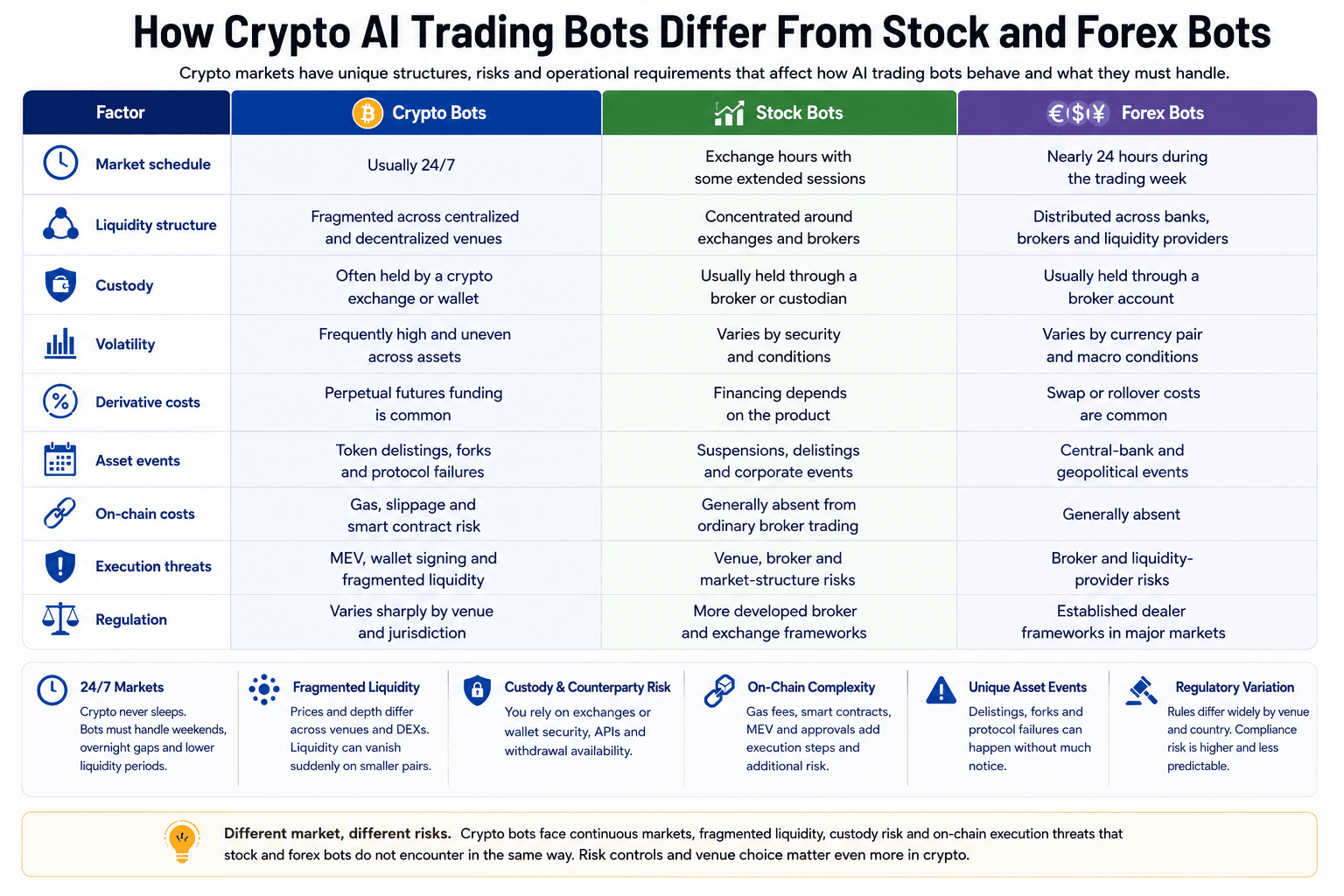 Why Crypto Bots Face Distinct Execution and Custody Risks
| Factor | Crypto Bots | Stock Bots | Forex Bots |
|---|---|---|---|
| Market schedule | Usually 24/7 | Exchange hours with some extended sessions | Nearly 24 hours during the trading week |
| Liquidity structure | Fragmented across centralized and decentralized venues | Concentrated around exchanges and brokers | Distributed across banks, brokers and liquidity providers |
| Custody | Often held by a crypto exchange or wallet | Usually held through a broker or custodian | Usually held through a broker account |
| Volatility | Frequently high and uneven across assets | Varies by security and conditions | Varies by currency pair and macro conditions |
| Derivative costs | Perpetual futures funding is common | Financing depends on the product | Swap or rollover costs are common |
| Asset events | Token delistings, forks and protocol failures | Suspensions, delistings and corporate events | Central-bank and geopolitical events |
| On-chain costs | Gas, slippage and smart contract risk | Generally absent from ordinary broker trading | Generally absent |
| Execution threats | MEV, wallet signing and fragmented liquidity | Venue, broker and market-structure risks | Broker and liquidity-provider risks |
| Regulation | Varies sharply by venue and jurisdiction | More developed broker and exchange frameworks | Established dealer frameworks in major markets |
Crypto trades continuously. A bot may hold positions through weekends, overnight liquidity gaps and periods when banking rails or support teams are less available.
Liquidity is also fragmented. The same token can trade at different prices across exchanges, while smaller assets may have deep liquidity on one venue and poor liquidity elsewhere.
Centralized crypto bots inherit exchange custody and API risk. The trader relies on the exchange to safeguard assets, keep systems online and honor withdrawals.
On-chain systems introduce another layer. A bot or agent may need to:
- Sign wallet transactions
- Pay gas fees
- Interact with smart contracts
- Select liquidity pools
- Set slippage tolerance
- Handle token approvals
- Avoid malicious contracts
- Account for MEV
Smart contract risk becomes relevant when an agent moves beyond centralized exchange APIs and interacts directly with DeFi applications.
MEV can alter the ordering and price of on-chain trades. A visible transaction may be preceded by another trade, placed between two transactions or executed under worse conditions than the bot expected.
Traditional markets have their own failures, leverage risks and manipulation. More developed regulatory and broker infrastructure does not make stock or forex bots safe or predictable. It changes the institutions and protections surrounding them.
Who Should Use an AI Trading Bot?
AI trading bots are most suitable for users who understand the underlying strategy, can interpret performance data and will continue monitoring the account.
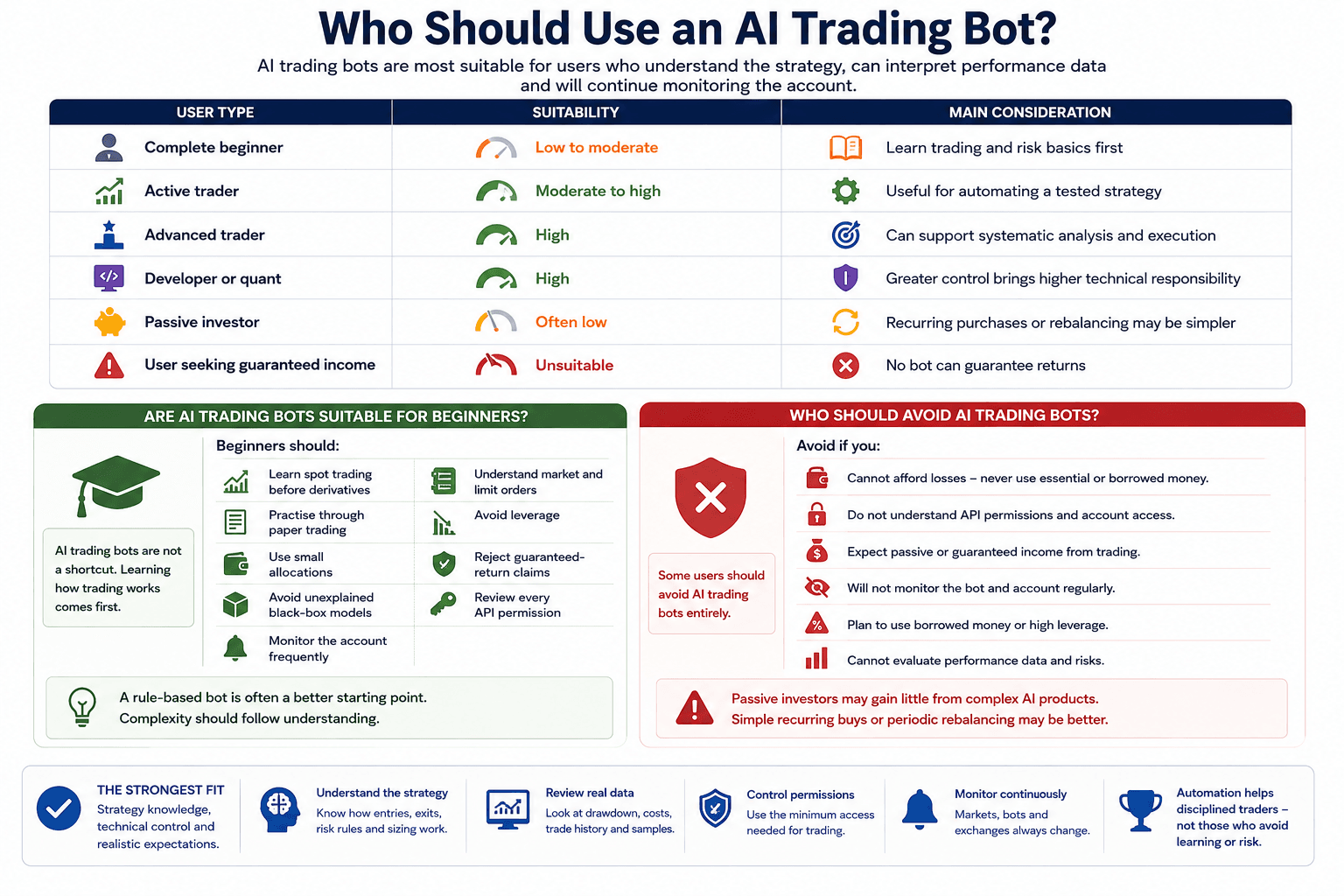 Matching Bot Complexity to Trader Skill and Risk
| User Type | Suitability | Main Consideration |
|---|---|---|
| Complete beginner | Low to moderate | Learn trading and risk basics first |
| Active trader | Moderate to high | Useful for automating a tested strategy |
| Advanced trader | High | Can support systematic analysis and execution |
| Developer or quant | High | Greater control brings higher technical responsibility |
| Passive investor | Often low | Recurring purchases or rebalancing may be simpler |
| User seeking guaranteed income | Unsuitable | No bot can guarantee returns |
Technical sophistication is only one part of suitability. A developer may understand the code while underestimating leverage or market-regime risk. An experienced trader may understand markets while mishandling API permissions.
The strongest fit combines strategy knowledge, technical control and realistic expectations.
Are AI Trading Bots Suitable for Beginners?
AI trading bots are not a shortcut around learning how trading works.
A beginner who cannot explain position sizing, stop-losses, spreads, slippage and leverage cannot properly evaluate what the bot is doing. Software may hide the mechanics without removing their consequences.
Beginners should:
- Learn spot trading before derivatives
- Understand market and limit orders
- Practice through paper trading
- Avoid leverage
- Use small allocations
- Reject guaranteed-return claims
- Avoid unexplained black-box models
- Review every API permission
- Monitor the account frequently
A rule-based bot may be a better starting point because the user can inspect each condition. Complexity should follow understanding rather than substitute for it.
Our beginner’s guide to crypto trading covers the order types, platform mechanics and basic risk concepts users should understand before automating trades.
Who Should Avoid AI Trading Bots?
Some users should avoid AI trading bots entirely.
That includes anyone who:
- Cannot afford losses: Trading capital should not come from rent, emergency savings or essential expenses.
- Does not understand API permissions: A user who cannot distinguish trade access from withdrawal access cannot safely connect a third-party bot.
- Expects passive or guaranteed income: Automated execution still produces losses and requires oversight.
- Will not monitor the bot: Positions, API connections and strategy behavior can change while the user is away.
- Plans to use borrowed money: Interest, funding and liquidation risk can compound ordinary strategy losses.
- Cannot evaluate performance data: Screenshots and win rates are inadequate without drawdown, costs and complete trade history.
Passive investors may also gain little from a complex AI product. A recurring purchase or periodic portfolio rebalance may serve the objective with fewer costs and fewer failure points.
The deciding question is whether automation solves a trading problem the user already understands.

Final Verdict: Should You Use an AI Trading Bot?
AI trading bots can be useful for processing data, monitoring markets and automating a strategy that has already been tested. They are not automatic profit engines. Transparent logic, realistic testing, secure API permissions and disciplined risk management carry more weight than the AI label.
Three recommendations follow:
- Beginners: Start with paper trading and understandable rule-based automation. Avoid leverage and black-box systems.
- Experienced traders: Use AI to support a defined strategy, improve analysis or strengthen execution. Do not let it replace position sizing, exposure limits or human supervision.
- Anyone evaluating a provider: Demand verifiable evidence, restricted permissions, transparent costs and a documented shutdown process.
An AI bot is worth considering when it solves a specific problem: monitoring too many markets, processing information consistently, enforcing a tested strategy or improving execution. It should be rejected when the pitch depends on guaranteed returns, unexplained intelligence or a belief that the model knows where prices will go.
A bot can automate discipline. It can automate confusion just as efficiently.