Binance is the broader all-in-one platform, while Bybit is more focused on active traders, derivatives and copy trading.
In this guide, we compare Binance vs Bybit across fees, security, products, usability and regional access to help you decide which exchange fits you best.
Editor's Note (June 10, 2026): We fully updated this Binance vs Bybit comparison in June 2026 to to reflect the latest Binance and Bybit fees, product changes, proof-of-reserves information, security developments, regional restrictions and platform features. We also rewrote the comparison structure to make the verdict clearer for different user types, including beginners, active traders, copy trading users, Earn users and Web3 users.
Quick Verdict: Binance or Bybit?
Binance is best overall, while Bybit is best for copy trading and derivatives-focused users.
The best choice depends on how you trade. Binance wins if you want a full-service crypto exchange with deeper liquidity, broader market coverage, lower effective spot fees through BNB discounts, stronger Earn products and wider ecosystem access. Bybit wins if you want a cleaner trading-first exchange built around perpetual futures, copy trading, trading competitions, bots, rewards campaigns and TradeGPT.
Who Should Choose Which?
Choose Binance if you want:
- The stronger all-in-one crypto exchange for most users
- Deeper liquidity, higher trading volume and wider market coverage
- Lower effective spot fees through eligible BNB fee discounts
- A broader product suite, including Binance Earn, Launchpool, Megadrop, Binance Wallet, Binance Pay and BNB Chain tools where supported
- Stronger security-reserve visibility through SAFU and longer proof-of-reserves visibility
Choose Bybit if you want:
- A stronger copy trading suite
- A cleaner trading interface for futures and perpetual contracts
- Trading competitions, rewards campaigns and trader-focused tools
- TradeGPT as an AI assistant for market information and platform support
- A sharper trading-first platform instead of a larger all-in-one exchange ecosystem
Binance vs Bybit Winner by Category
| Category | Winner | Why It Matters |
|---|---|---|
| Overall exchange | Binance | Binance has the stronger overall score because it combines liquidity, trading volume, product range, Earn products, fiat access and ecosystem reach. |
| Spot trading depth | Binance | Binance is better for users who trade major coins often or need stronger order book depth across more markets. |
| Base spot fees | Tie | Both platforms start at 0.10% maker and taker for regular spot users, though Binance can be cheaper for eligible users paying fees with BNB. |
| Futures trading | Tie | Both are strong for derivatives, but Binance has deeper breadth while Bybit has a cleaner trading-first futures experience. |
| Max leverage | Binance | Binance offers up to 125x leverage on selected contracts, while Bybit offers up to 100x on selected contracts. |
| Copy trading | Bybit | Bybit has stronger association with master traders, follower tools, trader rankings, performance history and copy trading dashboards. |
| Trading bots | Tie | Both exchanges offer trading bots, including grid and futures bots, but users still need to manage volatility and strategy risk. |
| Earn products | Binance | Binance Earn is broader, with flexible products, locked products, staking, Dual Investment, Launchpool, Megadrop and on-chain yield products where supported. |
| AI tools | Bybit | Bybit has TradeGPT, which is useful as an assistant for market information and platform navigation, not as a guaranteed trading signal. |
| Web3 access | Binance | Binance has stronger ecosystem reach through Binance Wallet, BNB Chain and Binance Pay, while Bybit Web3 is useful inside a trading-first account flow. |
| Crypto cards and payments | Binance | Binance Pay gives Binance a stronger payments edge, though Binance Card and Bybit Card availability both depend on region and eligibility. |
| Mobile app simplicity | Bybit | Bybit feels cleaner and more focused for active traders, while Binance has more menus because it supports more products. |
| Beginner support | Binance | Binance has more learning resources, simple buy tools, convert features and a larger support ecosystem for users moving beyond basic buying. |
| US availability | Binance | Bybit does not support US users, while Binance.US exists as a separate and more limited platform. |
| Security reserve visibility | Binance | Binance has SAFU, longer public reserve visibility and a cleaner recent exchange-security record, while Bybit still carries post-2025 hack risk. |
Data should be checked against live exchange pages before depositing funds, as fees, leverage limits, supported products, proof-of-reserves data, withdrawal fees, KYC rules and country access can change.
Disclosure
Some links in this guide may be affiliate links. If you choose to use a service through these links, we may earn a commission at no additional cost to you.
Disclaimer
This guide is educational only and is not financial advice. The comparison is based on platform features, public fee schedules, exchange documentation, security information, proof-of-reserves pages, regulatory notices and product availability at the time of writing.

How This Binance vs Bybit Comparison Was Built (Methodology)
This comparison checks the areas users should review before choosing an exchange:
- Trading fees
- Spot and futures markets
- Liquidity and market depth
- Copy trading tools
- Trading bots
- Earn products
- Web3 wallets
- Crypto cards
- Proof of reserves
- Security reserves
- Known security incidents
- KYC requirements
- Regional restrictions
- Beginner fit
- Long-term trust signals
For fees, we used official Binance and Bybit fee pages for spot and futures pricing. Fee schedules can change, so the figures should be treated as a dated snapshot rather than permanent numbers.
For security and reserves, we used official Binance and Bybit proof-of-reserves pages, Binance SAFU information, account security guides and public incident reports. Binance has SAFU and says user assets are backed 1:1 plus reserves. Bybit says it maintains 1:1 reserves on user assets.
For product comparisons, we checked official exchange pages for Earn, copy trading, trading bots, Web3 wallets, cards, fiat services and regional availability. Availability can vary by country, account status and KYC level.
Binance vs Bybit: At-a-Glance Comparison
| Feature | Binance | Bybit |
|---|---|---|
| Founded | 2017 | 2018 |
| Best for | All-in-one crypto exchange | Copy trading and derivatives |
| Registered users | Over 270M registered users | Over 80M users |
| Spot trading | Yes | Yes |
| Futures trading | Yes | Yes |
| Max leverage | Up to 125x on selected contracts | Up to 100x on selected contracts |
| Base spot fee | 0.100% maker / 0.100% taker | 0.1000% maker / 0.1000% taker |
| Base futures fee | 0.020% maker / 0.050% taker for regular-user futures examples | 0.0200% maker / 0.0550% taker for VIP 0 perpetual and futures contracts |
| Fee discount | BNB fee discount | VIP tiers and campaigns |
| Copy trading | Available | Stronger suite |
| Trading bots | Yes | Yes |
| AI tools | Available where supported | TradeGPT |
| Earn products | Binance Earn is broader | Bybit Earn is useful but narrower |
| Web3 wallet | Binance Wallet | Bybit Web3 |
| Crypto card | Region-dependent | Bybit Card, region-dependent |
| Security reserve | SAFU | Protection and reserve mechanisms |
| US availability | Binance.US, limited | Not supported |
| Best overall for | Most users | Active traders and copy trading users |
Note: Data is current as of June 10, 2026.
Binance or Bybit: Which One Should You Choose?
The choice is straightforward: use Binance when you want a full crypto platform, and use Bybit when you want a cleaner trading-first exchange.
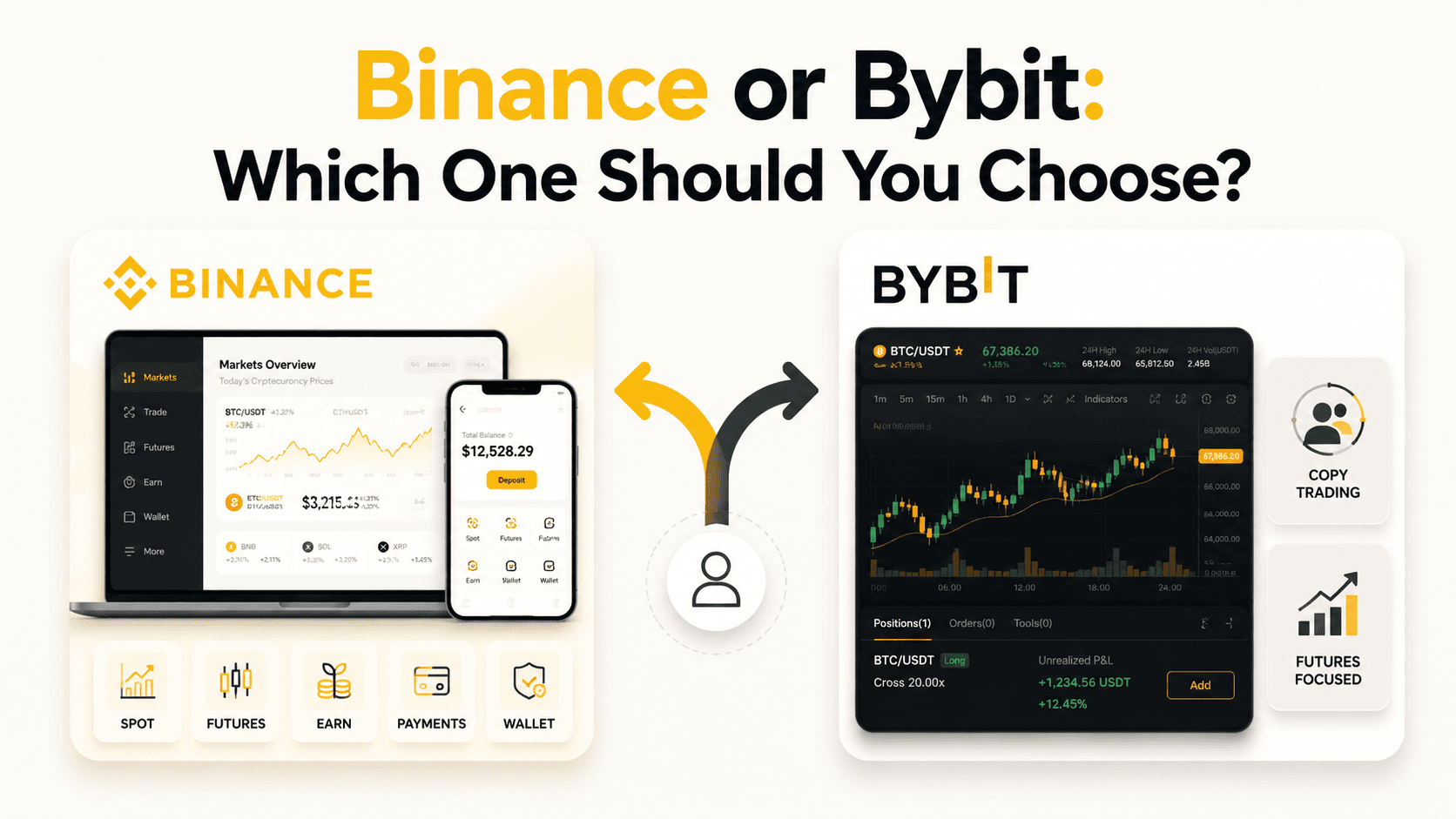 Simple Visual Guide to Choosing Binance for Breadth or Bybit for Trading Focus
Choose Binance If
- You want one main exchange for trading, earning, payments, Web3 access and fiat services.
- You want deep liquidity, high trading volume and wide market coverage.
- You want lower effective trading fees through BNB discounts.
- You want access to a wider product range, including Binance Earn, Launchpool, Megadrop, Binance Wallet, Binance Pay and BNB Chain tools where supported.
- Security-reserve visibility is important to you.
Read our full Binance review.
Also Read
- How to Sign Up on Binance: A Step-by-Step Guide
- Binance App Review: Mobile Trading on the Go
- Is Binance Safe?
- BNB Review
- Binance NFT Marketplace Review
- Top Binance Alternatives
- How to Buy Bitcoin on Binance
- A Guide to Trading on Binance
- Binance Earn Review
- Binance Wallet Review
- Binance Sharia Earn
Choose Bybit If
- You want stronger copy trading tools.
- You mainly trade futures or perpetual contracts.
- You prefer a cleaner trading interface than Binance.
- You want access to trading competitions, rewards campaigns and derivatives-focused tools.
Read our full Bybit review.
Also Read
- Is Bybit Safe?
- Bybit Earn Review
- Bybit Card Review
- Bybit's Products and Features
- Bybit Copy Trading Review
- Bybit Trading Guide
- How Sign up on Bybit
Neither Exchange Is Best If
- You are a complete beginner who wants the simplest app to buy Bitcoin and hold it
You are a US user looking for full derivatives access. Binance.US has a smaller product set than global Binance, while Bybit’s restricted countries page says it does not offer services or products to users in the United States.
Binance vs Bybit Fees
Fees look similar at the base spot level, but the real cost depends on product, region, trading pair, VIP tier, BNB discounts, funding rates and withdrawal networks. Always check live fee pages before trading or moving funds.
Spot Trading Fees
Both exchanges use maker and taker fees. A maker order adds liquidity to the order book. A taker order removes liquidity by matching an existing order.
| Spot Fee Item | Binance | Bybit |
|---|---|---|
| Standard spot maker fee | 0.100% | 0.1000% |
| Standard spot taker fee | 0.100% | 0.1000% |
| Discount route | BNB fee discount | VIP tiers and campaigns |
| Discounted standard spot fee | 0.07500% maker / 0.07500% taker with BNB fee payment | Region and VIP dependent |
For regular spot users, both exchanges start at 0.10% maker and taker, as of June 10, 2026. Binance can be cheaper for eligible users who pay fees with BNB. Bybit can be competitive through VIP tiers and high-volume discounts.
Futures Fees and Leverage
Both platforms support advanced futures trading.
| Futures Item | Binance | Bybit |
|---|---|---|
| Standard futures maker fee | 0.020% in regular-user futures fee examples | 0.0200% for VIP 0 perpetual and futures contracts |
| Standard futures taker fee | 0.050% in regular-user futures fee examples | 0.0550% for VIP 0 perpetual and futures contracts |
| Max leverage | Up to 125x on selected contracts | Up to 100x on selected contracts |
| Main risk | Liquidation, funding rates and margin risk | Liquidation, funding rates and margin risk |
Binance offers USDT-M futures and COIN-M futures, with leverage up to 125x on selected contracts. Bybit offers perpetual futures and other derivatives products, with leverage up to 100x on selected contracts.
Higher leverage is not automatically better. Leverage increases profit and loss exposure, and liquidation can happen quickly during volatile markets. Futures traders need to watch funding rates, margin mode, maintenance margin, mark price, index price and liquidation rules.
Funding rate risk shouldn't be ignore. A profitable-looking position can become expensive if funding costs move against the trader. This is especially important for high-leverage perpetual futures.
Deposit, Withdrawal and Fiat Costs
Binance generally has broader fiat access, but availability varies by country. It supports payment methods such as card purchases, cash balances and third-party routes where available.
Bybit also supports fiat options, card purchases, third-party payment routes and P2P access in eligible regions. The Bybit fiat deposit FAQ explains that fiat deposits move fiat currency into a Bybit Funding Account, but supported currencies and methods vary.
Crypto withdrawal fees depend on the asset and network. A USDT withdrawal on Ethereum can cost more than a USDT withdrawal on a cheaper network. Sending funds on the wrong network can lead to permanent loss.
| Cost Type | What To Check |
|---|---|
| Fiat deposit | Payment method, bank support, country rules |
| Card purchase | Card fee, spread, verification level |
| Crypto withdrawal | Asset, network, minimum withdrawal, network fee |
| Fiat off-ramp | Bank route, supported currency, processing time |
| Limits | KYC level, account status, region |
Binance And Bybit Security Comparison
Exchange security is not one feature. It includes custody systems, hot wallet limits, cold wallet controls, internal approvals, proof of reserves, withdrawal rules, account security and incident response.
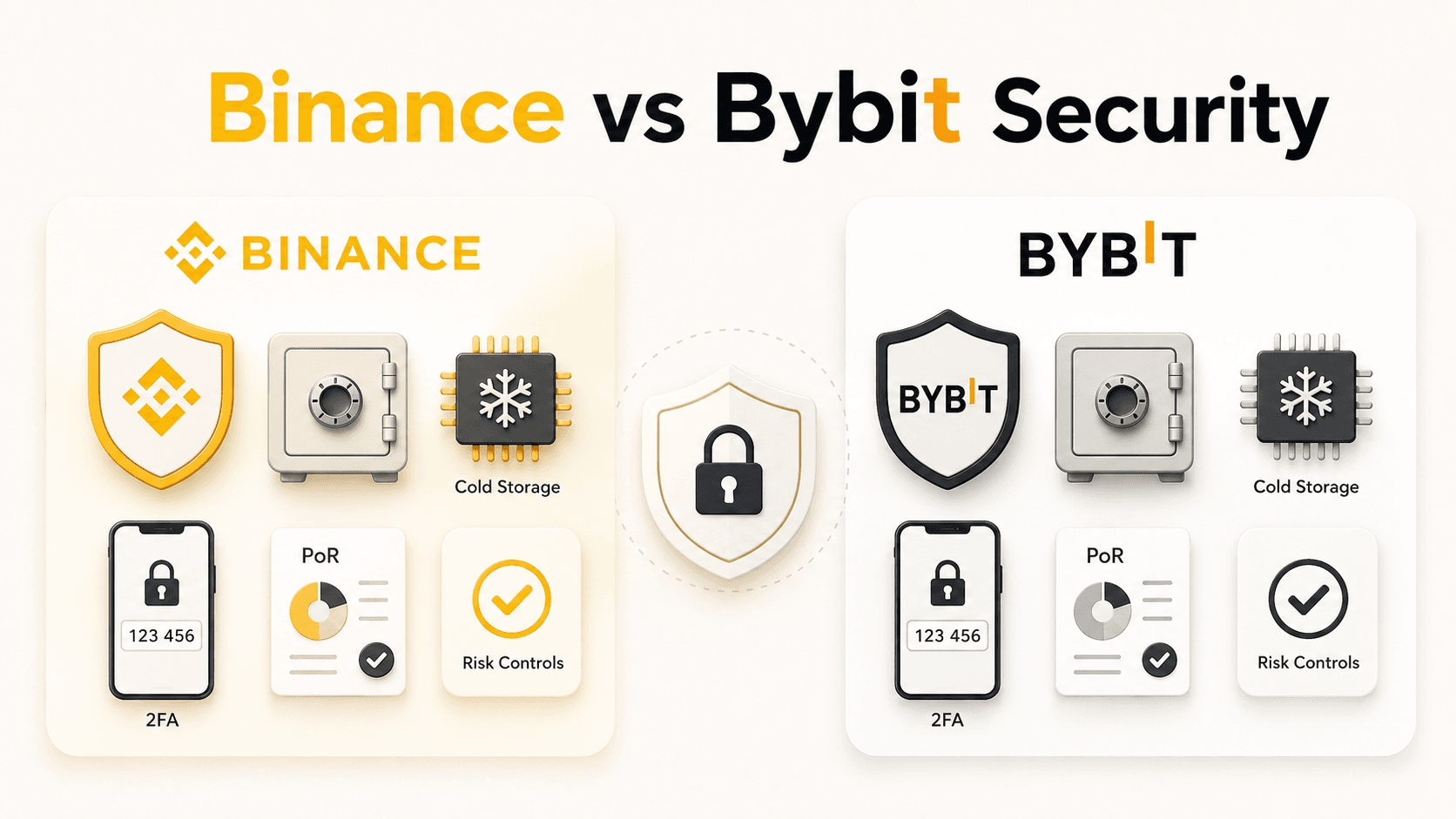 Exchange Security Compared Through Reserves, Cold Storage, Account Controls, and Incident Risk
Fund Storage and Platform Security
Both exchanges use cold storage, wallet controls and internal approval processes. Cold storage keeps assets offline. Hot wallets hold funds needed for active withdrawals and operations.
Binance has a long-running public emergency reserve through SAFU. The exchange also publishes Binance proof of reserves, where it says user assets are backed 1:1 plus reserves and uses Merkle Tree and zk-SNARK-based verification methods.
Bybit uses cold wallet infrastructure and post-2025 reserve reporting. The Bybit proof of reserves page says the exchange maintains 1:1 reserves on user assets.
Account Security Features
Binance account protections include 2FA, withdrawal address whitelists, anti-phishing codes, device management, passkeys where available and withdrawal confirmation. Binance’s account security tips recommend stronger login, email and withdrawal protections.
Bybit account protections include 2FA, anti-phishing codes, Secure Transaction Approval, passkeys, device controls, fund passwords, biometric login where available and API controls. Bybit’s account security guide also recommends anti-phishing codes to verify official messages.
Users must enable these tools. A strong exchange security setup is weaker if the user reuses passwords, ignores withdrawal whitelists, approves phishing links or gives trading bots unnecessary API permissions.
Security Track Record and Risk Profile
Binance had a major 2019 hack. Attackers withdrew 7,000 BTC from a hot wallet after obtaining user API keys, 2FA codes and other data. Binance said the loss would be covered by SAFU in its 2019 security breach announcement.
Bybit suffered a major 2025 hack. The FBI said North Korea-linked TraderTraitor actors were responsible for the theft of about $1.5 billion in virtual assets from Bybit on or around February 21, 2025, in its public notice on the Bybit hack. TRM Labs described the incident as the largest exploit on record and tracked laundering through intermediary wallets, decentralized exchanges and cross-chain bridges in its Bybit hack analysis.
Which Exchange Is Safer?
Binance gets the edge for most users. The reasons are SAFU, scale, longer public reserve visibility and a cleaner recent exchange-security record.
Bybit remains a serious exchange. Its proof of reserves, incident response and user-protection mechanisms help.
The safer choice also depends on user behavior. Use 2FA, passkeys, withdrawal whitelists, anti-phishing codes, secure devices and separate email security. Do not store all funds on any centralized exchange.
Products and Features Compared
Binance offers the broader product range. Bybit offers a sharper trading experience, especially for perpetual contracts, copy trading and trader-focused tools.
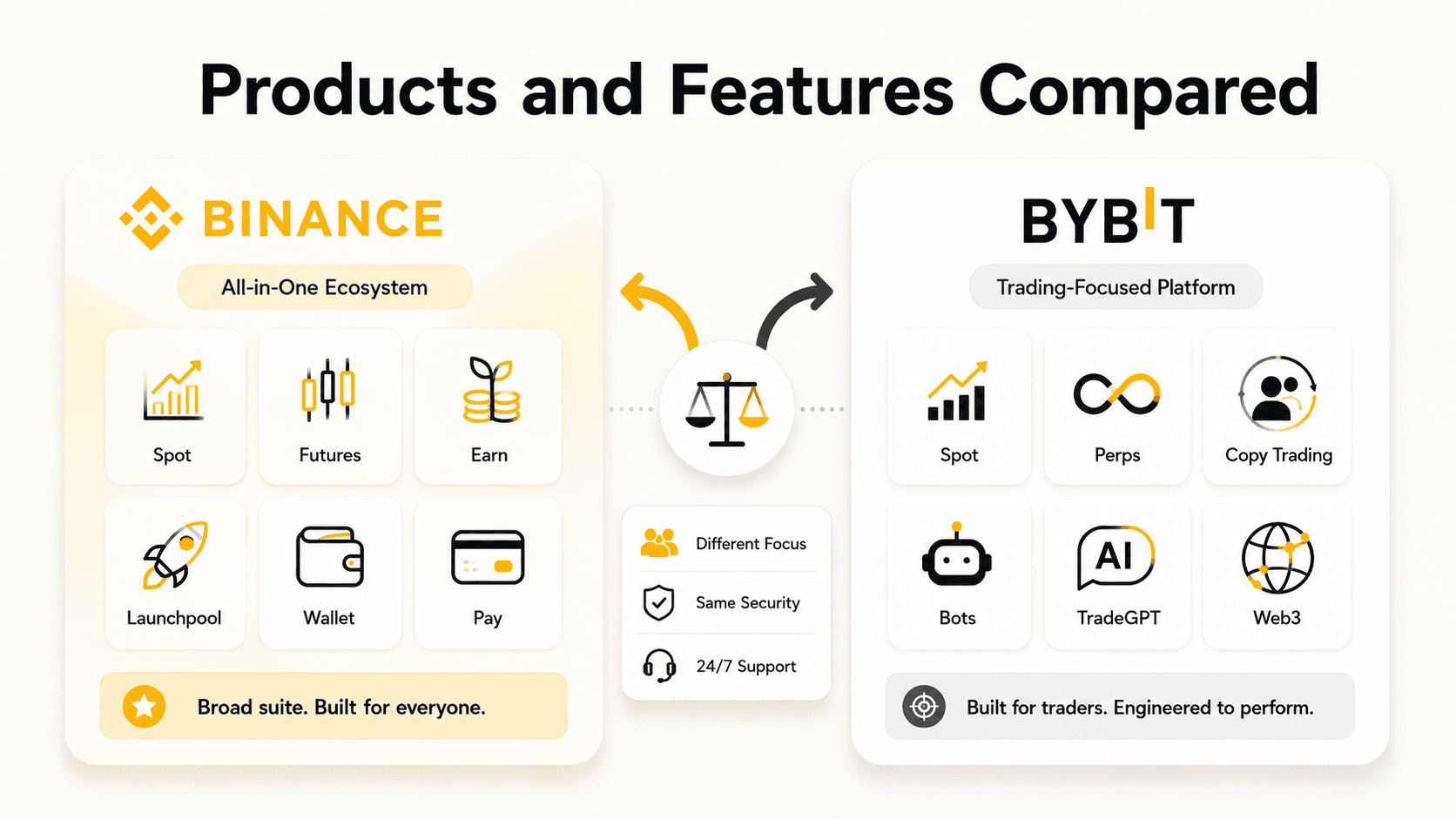 Binance Shows Broader Products, While Bybit Highlights Perps, Copy Trading, Bots, and Web3
Spot, Margin and Futures Trading
Both exchanges support spot trading and derivatives trading.
Binance has broader market depth and product coverage. It supports spot, margin, futures, options, P2P and trading bots on the global platform where allowed.
Bybit is highly competitive for perpetual futures and active traders. Its derivatives interface is clean, fast and built around trading activity rather than the wider exchange ecosystem.
Both exchanges offer TradingView-style charting, advanced order types, order book views, market depth tools and API access.
Earn Products and Passive Income
Binance has the stronger Earn suite overall. Binance Earn includes Simple Earn, Flexible Products, Locked Products, ETH staking, SOL staking, Dual Investment and on-chain yield products.
Binance also has Launchpool and Megadrop. These can give users access to new token distribution campaigns, but they should not be treated as guaranteed income.
Bybit Earn is useful but narrower. It supports products such as flexible savings, staking, structured products and on-chain yield options depending on region, asset and account eligibility.
Copy Trading, Bots and AI Tools
Bybit wins copy trading.
Bybit has stronger brand association with master traders, followers, trader rankings, performance history, drawdowns and trading competitions. Binance Copy Trading exists, but Binance is not defined by copy trading in the same way.
Copy trading risk is serious. A trader’s past performance can hide high leverage, open losses, unstable position sizing or one lucky market period. Followers should check maximum drawdown, average leverage, trade frequency, open positions and risk controls.
Both exchanges offer trading bots, including grid bots and futures bots. Bots can automate execution, but they can also amplify losses when volatility breaks the strategy.
Bybit's TradeGPT should be treated as an AI trading assistant, not a profit engine. It can help users explore market information, but it does not replace risk management, position sizing or independent research.
Web3 Wallets, DApps and On-Chain Access
Binance Wallet gives users access to DApps, swaps and BNB Chain activity. The official Binance Wallet page describes it as a self-custody wallet using multi-party computation, or MPC, though the setup differs from a traditional seed phrase wallet.
Bybit Web3 gives users wallet, DApp and on-chain features inside the Bybit environment. The Bybit Web3 product is useful for users who want exchange access plus Web3 tools in one account flow.
Cards, Payments and Rewards
Binance Card and Bybit Card availability varies by region. Crypto card products change often because they depend on payment partners, local rules and issuer support.
Binance Pay is a strong payment product in the Binance ecosystem. It is more relevant for users who want crypto payments, transfers and merchant-related tools.
Bybit Card has become a bigger part of Bybit’s product suite. The Bybit Card official page highlights crypto spending, rewards, fraud monitoring, 2FA and instant card controls, but availability depends on country and user eligibility.
User Experience and Mobile Apps
Binance is powerful but crowded. Bybit is cleaner and more trading-focused.
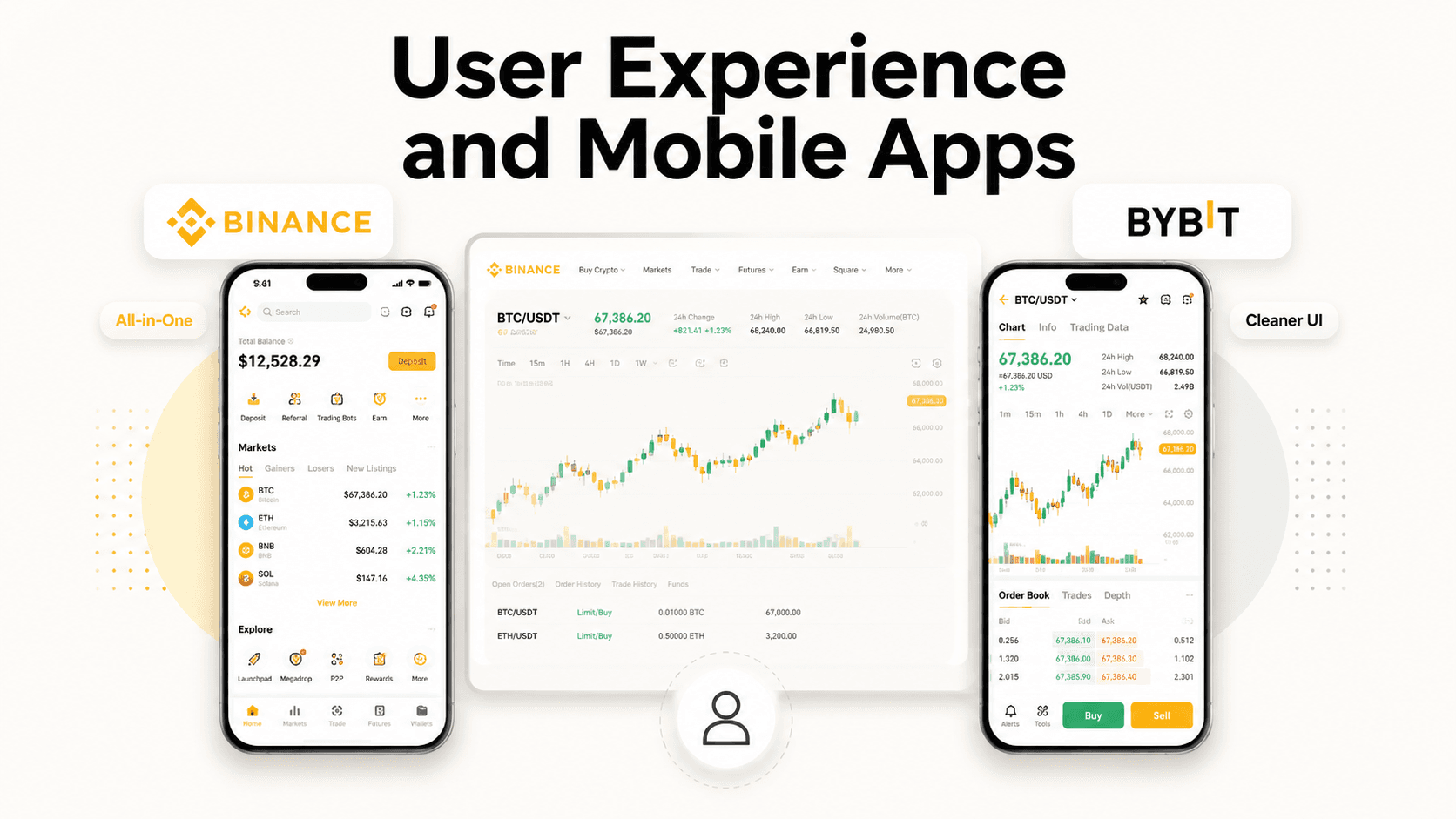 Binance Feels Feature-Rich, While Bybit Presents a Cleaner Mobile Trading Interface
Desktop Experience
Binance has more tools, menus and product paths. That helps users who want one dashboard for spot trading, futures trading, Binance Earn, Launchpool, Binance Wallet, Binance Pay, P2P and account tools.
The trade-off is clutter. Binance can overwhelm users who only want basic trading, a simple convert feature or a place to buy Bitcoin.
Bybit’s desktop interface is cleaner. It feels closer to a trading terminal, with less all-in-one platform noise.
Active traders can use both comfortably. Binance works well for users who want market depth and many products. Bybit works well for users who want a tighter derivatives and copy trading layout.
Mobile App Experience
Both exchanges have full-featured mobile apps.
The Binance app has more features and more menus, including trading, price alerts, order management, wallet tools, Earn products, fiat routes and security settings.
The Bybit app feels more trading-focused. It puts spot, derivatives, copy trading, rewards and Web3 tools closer to the trading workflow.
Mobile users should focus on app security. Use biometric login, 2FA, price alerts, withdrawal controls and order confirmations. Download exchange apps only from official app stores or official websites.
Which Is Easier for Beginners?
Neither is the best first crypto app for complete beginners.
Binance has more learning resources and simple buy tools. Binance Academy, convert tools and fiat onboarding make it easier to grow from basic buying into advanced features.
Bybit is cleaner, but it is still trader-first. Bybit Learn helps with education, yet the platform still points users toward derivatives, copy trading, rewards and active trading.
Regulation, KYC and Country Availability
Country availability can decide the comparison before fees or features matter. A product can look attractive and still be unavailable, restricted or different in your jurisdiction.
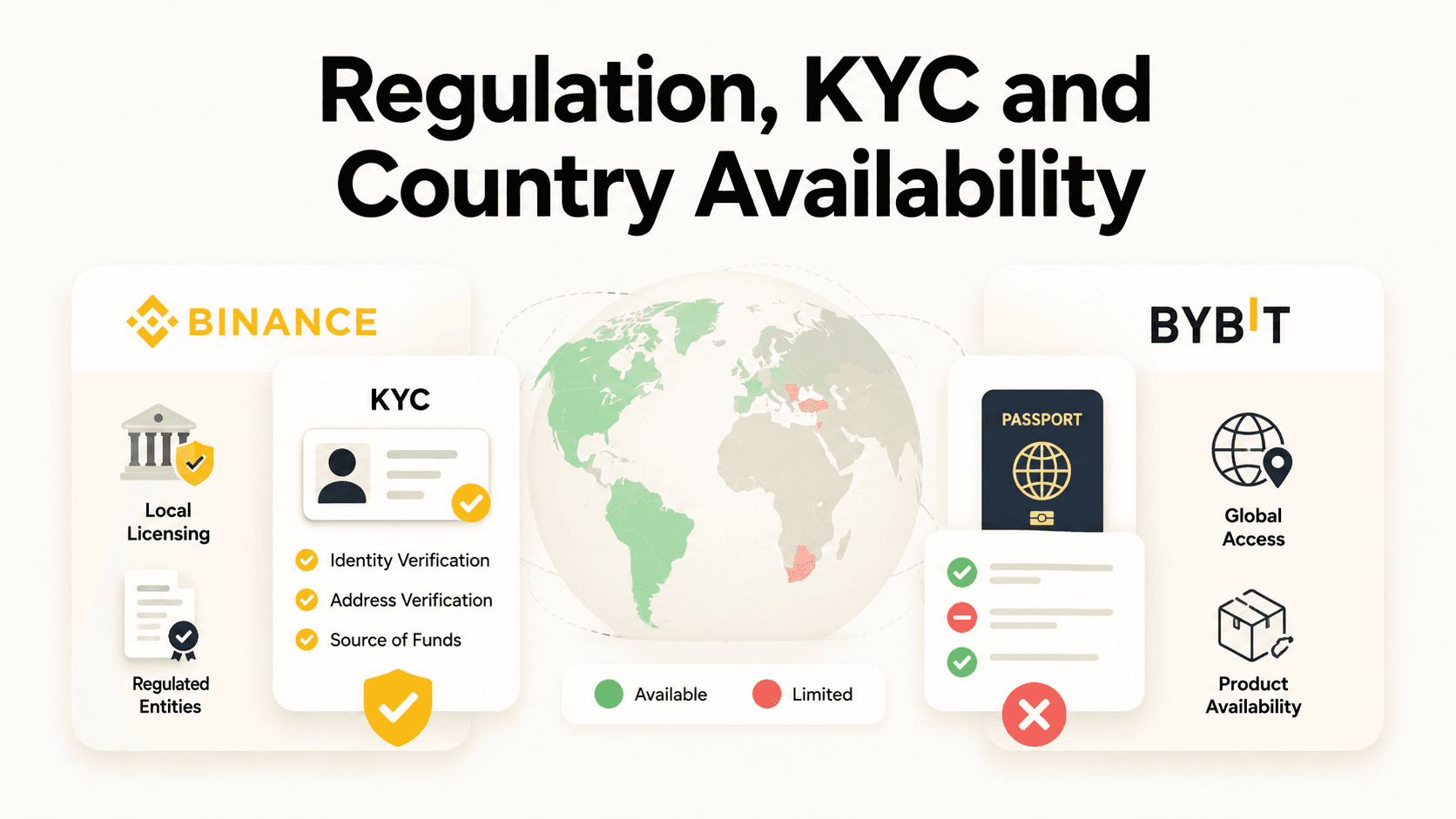 KYC, Licensing, and Regional Access Shape Which Exchange Users Can Actually Use
KYC Requirements
Both platforms require KYC for full access.
KYC affects deposits, withdrawals, fiat access, cards, limits, derivatives, copy trading, Earn products and product eligibility. Binance says users should complete identity verification before buying crypto on the global platform.
Bybit’s KYC levels page shows that verification affects crypto deposits, fiat deposits, fiat withdrawals, card purchases, P2P, spot trading, margin trading, bots, perpetual contracts, futures contracts, options, copy trading, Bybit Card and Earn products.
Do not present Binance or Bybit as no-KYC exchanges. Users who want full exchange functionality should expect identity verification.
KYC also creates privacy and compliance trade-offs. Exchanges can request more information, review transactions, freeze withdrawals, restrict products or close accounts when required by policy or regulation.
Country Availability
Binance availability varies by country. Binance.US is separate from global Binance and has fewer products. Binance.US says it supports 200+ digital assets, which is much smaller than the global platform.
As of June 10, 2026, Bybit does not support US users. Its restricted countries page includes jurisdictions including the United States, Chinese Mainland, Hong Kong, Singapore, Canada, North Korea, Cuba, Iran, Uzbekistan, Russian-controlled regions of Ukraine, Sevastopol, Sudan, Syria and Dubai.
Meanwhile, Binance is unavailable in United States, Canada, the Netherlands, Cuba, North Korea, Iran and Crimea, as of June 10, 2026.
| Region | Binance | Bybit |
|---|---|---|
| United States | Binance.US, limited | Not supported |
| United Kingdom | Restrictions apply | Restrictions apply |
| European Union | Availability varies by local entity and MiCA rollout | Bybit EU has MiCAR authorization in Austria |
| UAE / Dubai | Binance FZE has a VARA license | Global Bybit lists Dubai as excluded |
| India | Access has changed with FIU rules | Bybit access has changed with compliance status |
| Canada | Binance exited Canada | Bybit lists Canada as excluded |
| Singapore | Restrictions apply | Bybit lists Singapore as excluded |
For Europe, Austria’s Financial Market Authority said Bybit EU GmbH was granted authorization as a crypto-asset service provider under MiCAR in May 2025. For Dubai, VARA’s public register lists Binance FZE as holding an active VASP license.
UK users should be careful. As per the FCA's Binance Markets Limited warning, Binance is not permitted to undertake regulated activity in the UK.
For the UAE, the Binance Dubai page says Binance FZE is licensed by VARA for Exchange Services, Broker-Dealer Services, Lending and Borrowing Services, and VA Management and Investment Services. Regional product access should still be checked inside the account before depositing funds.
Regulatory Risk
Binance has faced major regulatory action. In November 2023, the US Department of Justice said Binance pleaded guilty and agreed to pay more than $4 billion to resolve violations related to the Bank Secrecy Act, failure to register as a money transmitting business and sanctions laws. Changpeng Zhao also pleaded guilty and resigned as CEO, according to the DOJ’s Binance settlement announcement.
Binance vs Bybit by User Type
Different users should weigh different features. A casual buyer, futures trader, copy trading user, passive-income user and Web3 user do not need the same exchange.
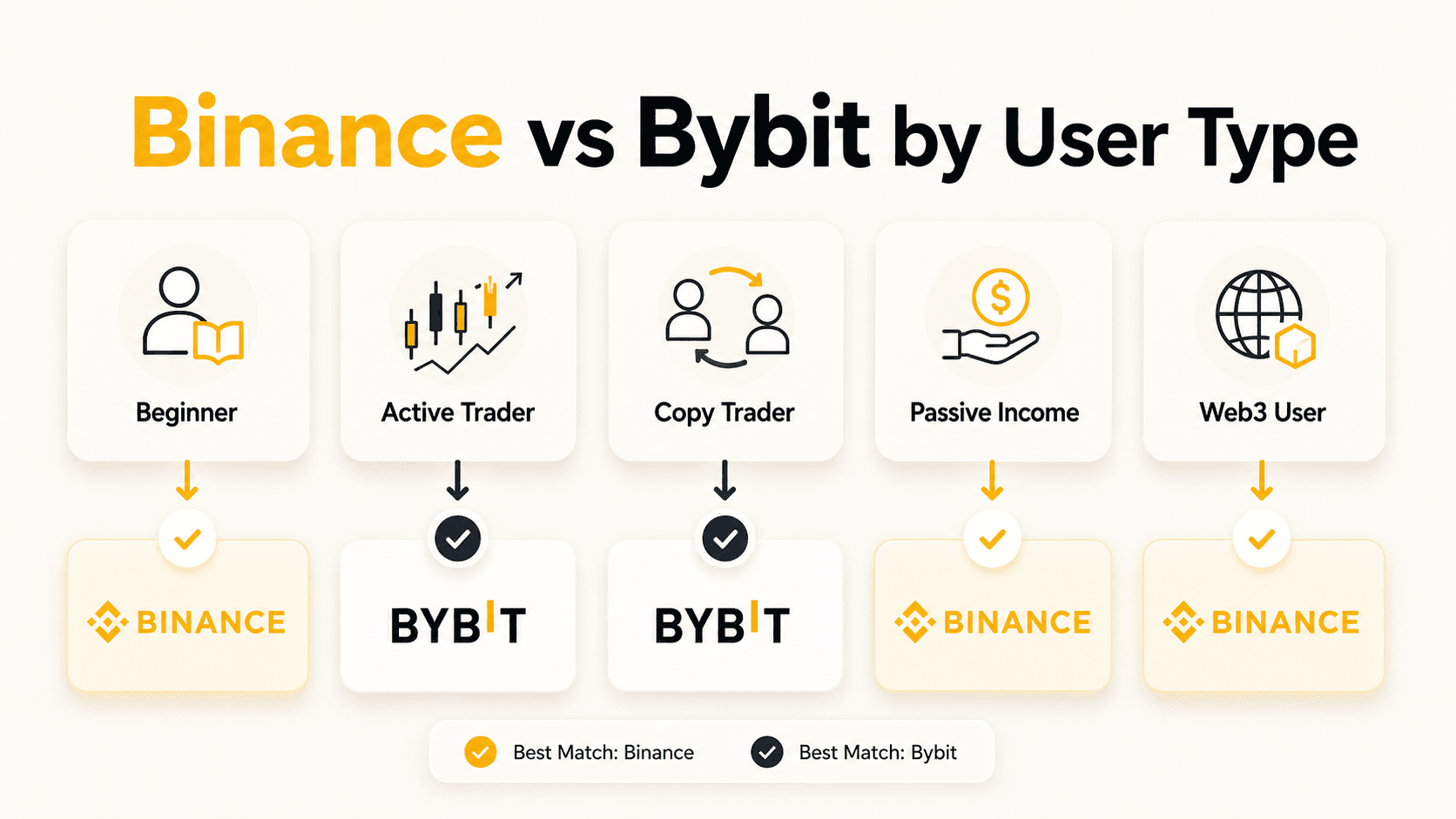 Different Crypto Users Match Better With Binance or Bybit Based on Trading Need
Best for Beginners
Binance is stronger if you want more education, more simple tools and a larger support ecosystem.
Bybit has cleaner navigation, but it is still trader-first. Beginners can use it, but the platform is built around active trading, copy trading and derivatives.
Verdict: Binance if you want more support and a bigger exchange ecosystem.
Best for Active Traders
Both are strong for active traders.
Binance wins on liquidity, trading volume and market range. It is the stronger choice for users who want deep order books, broad spot coverage, many trading pairs and access to many products from one account.
Bybit wins on focused derivatives UX. It feels sharper for users who spend most of their time in perpetual futures, funding rates, trading competitions and copy trading dashboards.
Verdict: Binance for market depth. Bybit for a trading-first feel.
Best for Copy Trading
Bybit wins copy trading.
Bybit has stronger association with master traders, followers, trader rankings, performance history and drawdown controls. Binance Copy Trading is available, but Binance does not define the category as strongly.
Verdict: Bybit.
Best for Passive Income
Binance wins passive income because Binance Earn is broader.
Binance has flexible products, locked products, staking, Launchpool, Megadrop, Dual Investment and on-chain yield products. Bybit Earn is fine for simpler savings, staking and structured products, but its Earn ecosystem is narrower.
Verdict: Binance.
Best for Web3 and DApp Users
Binance has stronger ecosystem reach through Binance Wallet, BNB Chain and Binance Pay.
Bybit Web3 is useful for users who want exchange plus wallet tools in the same environment. It is more convenient than managing everything separately, but convenience should not be confused with lower risk.
Verdict: Binance for ecosystem reach. Bybit for users who want Web3 tools inside a cleaner trading platform.
Binance vs Bybit Strengths and Weaknesses
Binance is broader and deeper. Bybit is cleaner and more trader-focused.
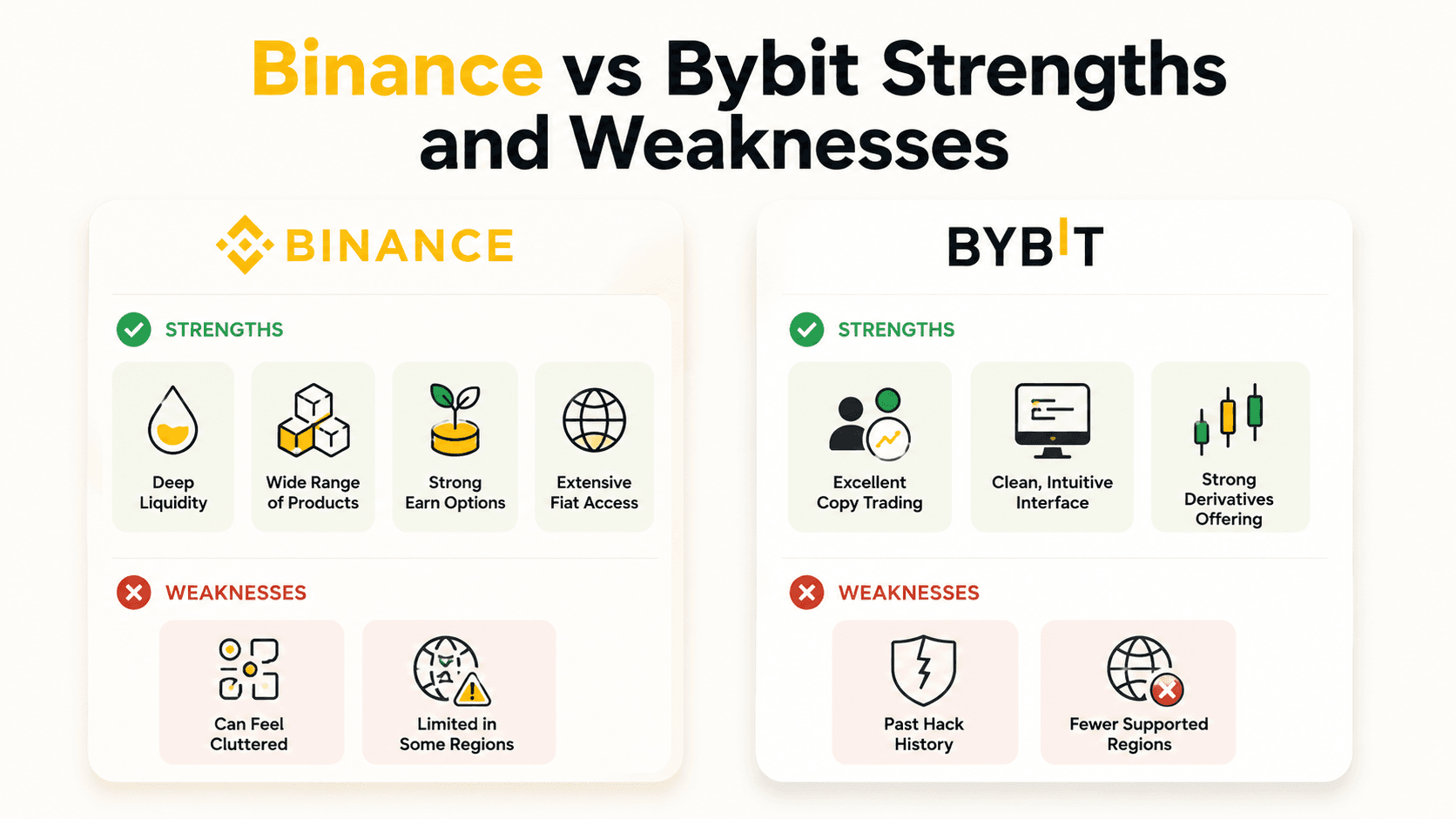 Binance Leads on Breadth, While Bybit Stands Out for Copy Trading and Derivatives
Where Binance Is Stronger
Binance is stronger on liquidity, trading volume and market range. It is also stronger on product range, effective fee discounts, Earn products, launch products, fiat access and ecosystem reach.
| Binance Strength | Why It Matters |
|---|---|
| Liquidity | Better execution on many major markets |
| Trading volume | Stronger depth across major pairs |
| BNB discount | Lower effective fees for eligible users |
| Binance Earn | Broader passive-income suite |
| Launchpool and Megadrop | More launch-style product access |
| Fiat access | More useful as a main exchange |
| SAFU | Longer-running public emergency fund |
| Ecosystem | Binance Wallet, Binance Pay and BNB Chain |
Binance is the stronger all-in-one crypto exchange.
Where Bybit Is Stronger
Bybit is stronger on copy trading, derivatives-focused trading experience, cleaner interface, trading competitions, rewards campaigns and TradeGPT.
| Bybit Strength | Why It Matters |
|---|---|
| Copy trading | Stronger master trader and follower ecosystem |
| Derivatives UX | Cleaner for perpetual futures users |
| Interface | Easier to navigate than Binance |
| Competitions | More trader-focused campaigns |
| TradeGPT | Useful AI assistant, not a guaranteed edge |
| Rewards hub | More trading-campaign focus |
| Trader identity | Clearer focus on active traders |
Bybit is the stronger trading-first platform.
Where Binance Falls Short
Binance can feel crowded. The same product range that helps advanced users can overwhelm casual buyers.
Regulatory restrictions vary by country. Users may not get the global Binance product set in their jurisdiction, and Binance.US is much more limited than global Binance.
Binance is also not the simplest exchange for someone who only wants to buy crypto and hold it for years. Those users may be better served by a simpler exchange and a self-custody wallet.
Where Bybit Falls Short
The 2025 Bybit hack remains part of its risk profile. Bybit remained solvent, processed withdrawals and closed the ETH gap, but the incident still counts.
Bybit also has no US support and lists several major excluded jurisdictions.
Its all-in-one product range is smaller than Binance’s. Bybit Earn and fiat access are useful, but they are not as broad as Binance Earn and Binance’s wider fiat and ecosystem coverage.
Bybit is better for traders than casual long-term holders. Users who plan to hold crypto for years should take self-custody seriously.

Binance vs Bybit: Final Verdict
Binance is the better overall exchange for most users.
Bybit is the better pick for copy trading and derivatives-focused users.
Binance wins on liquidity, products, fees, Earn, fiat support and security reserve visibility. Bybit wins on copy trading, cleaner trading UX, trading competitions, TradeGPT and trader-focused tools.
The security verdict also favors Binance overall. Binance has SAFU, longer proof-of-reserves visibility and a cleaner recent exchange-security record. Bybit remains a serious platform, but the 2025 hack gives it an important post-incident risk profile.
Use Binance if you want the biggest all-in-one crypto exchange. Go for Bybit if you want a sharper trading platform built around copy trading, derivatives and active trading tools.