Chainlink began with a fairly contained problem: smart contracts needed trustworthy information from outside their blockchains. That problem remains central to the network, but Chainlink in 2026 reaches into cross-chain messaging, token interoperability, offchain computation, institutional workflows and infrastructure for tokenized assets.
That expansion changes the question for LINK holders. Chainlink can gain infrastructure adoption without every dollar of activity generating equivalent demand for LINK. Staking, Payment Abstraction and the Chainlink Reserve create clearer routes from network usage to the token, but those flows still have to be compared with token releases, incentives and actual fee generation.
Editor's Note (Oct. 4, 2026): We fully updated this article in October 2026 to reflect Chainlink's evolution beyond decentralized oracles. The review now covers CCIP 2.0, Cross-Chain Tokens, CRE, Data Streams, staking v0.2, Payment Abstraction, the Chainlink Reserve, current LINK tokenomics, updated DeFi adoption metrics, institutional and RWA activity, security risks, and Chainlink's position against competing oracle and interoperability networks.
Chainlink Review 2026: Quick Verdict
Chainlink has evolved from a decentralized oracle network into broader blockchain infrastructure spanning market data, cross-chain interoperability and institutional workflows. Its adoption remains extensive, but LINK's investment case depends on how effectively service usage translates into fees, LINK purchases, staking demand and Reserve accumulation.
Key Takeaways on Chainlink
-
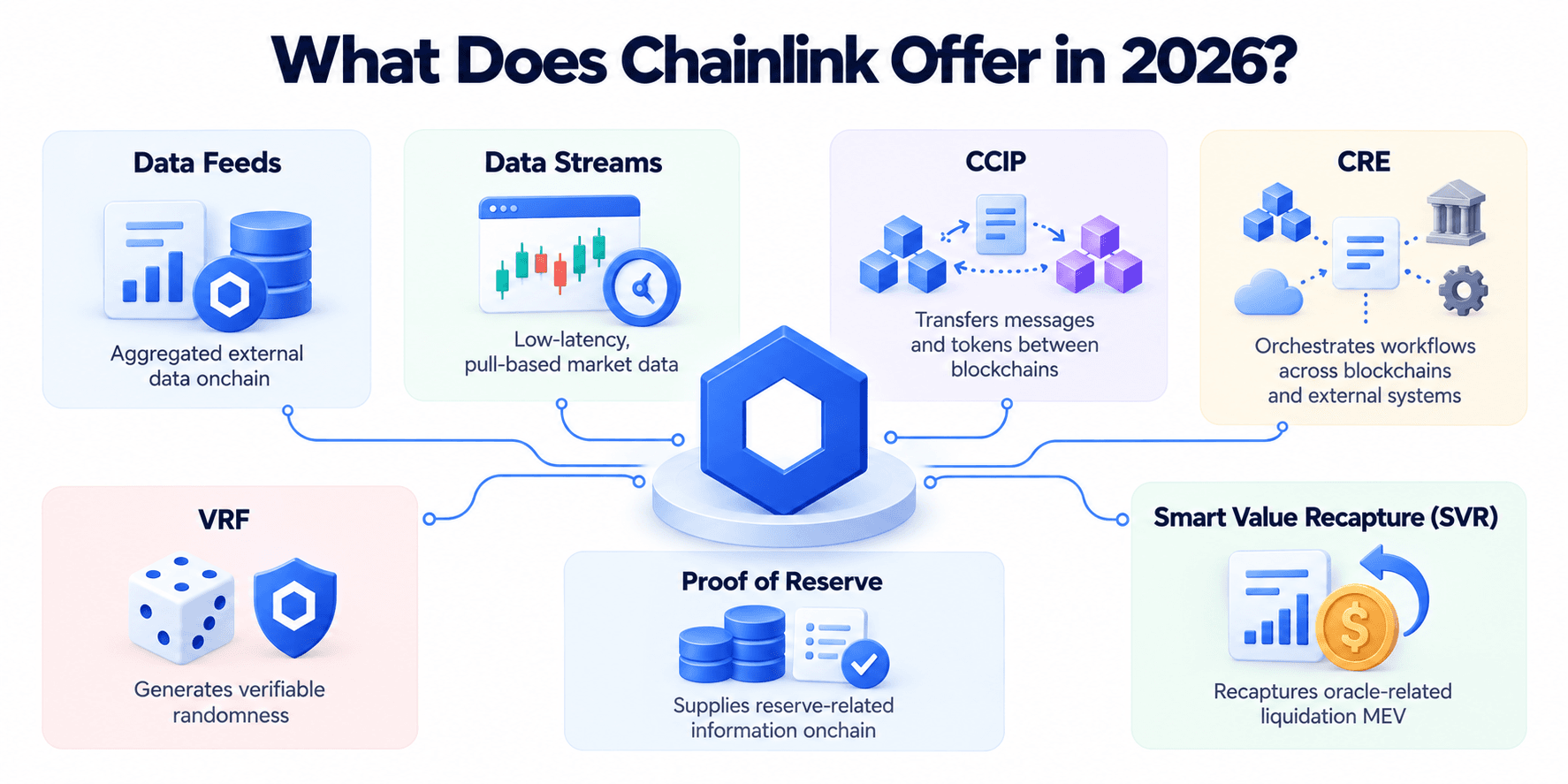
Chainlink has expanded well beyond price oracles Its 2026 stack includes Data Feeds, Data Streams, CCIP, CRE, VRF, Proof of Reserve and Smart Value Recapture.
-
Decentralized Oracle Networks remain the foundation Independent nodes aggregate external information through DONs, while Offchain Reporting reduces the cost of reaching consensus before verified reports are published onchain.
-
Data Feeds and Data Streams serve different applications Data Feeds provide push-based reference data, while Data Streams supply lower-latency pull-based reports for trading and derivatives applications.
-
CCIP turns Chainlink into cross-chain infrastructure CCIP supports generalized messaging and token transfers, while Cross-Chain Tokens give issuers standardized control over how assets move between networks.
-
CCIP 2.0 introduces modular verification Developers can combine Chainlink's DON-based Committee Verifier with additional Cross-Chain Verifiers, alongside rate limits and emergency controls.
-
CRE is becoming Chainlink's orchestration layer The Chainlink Runtime Environment coordinates blockchains, APIs, computation and Chainlink services inside programmable workflows, including institutional and tokenized-asset use cases.
-
Chainlink has significant DeFi adoption As of Oct. 4, 2026, DefiLlama attributed roughly $37.5 billion in oracle TVS across 534 protocols to Chainlink, well ahead of other major oracle networks by independent TVS.
-
Institutional adoption ranges from tests to production UBS and DigiFT have completed a production tokenized-fund workflow, while projects involving J.P. Morgan's Kinexys, Ondo and Swift remain at different stages of testing and deployment.
-
LINK has a fixed 1 billion token maximum supply More than 748 million LINK was circulating as of Oct. 4, 2026, while Chainlink's current release schedule can add the equivalent of 7% of total supply annually to circulation.
-
Payment Abstraction creates a direct LINK demand pathway Qualifying Chainlink service fees paid in supported assets can be converted into LINK, reducing the need for customers to hold LINK before paying for services.
-
The Chainlink Reserve provides visible evidence of revenue conversion The Reserve held roughly 6 million LINK around publication, but that remains small compared with both circulating supply and potential annual token releases.
-
Staking does not currently secure the entire Chainlink Network Staking v0.2 has a 45 million LINK capacity and currently focuses its public alerting and slashing mechanism on the ETH/USD Data Feed on Ethereum.
-
Chainlink adoption does not automatically equal LINK demand The investment thesis depends on service fees, Payment Abstraction, Reserve growth, fee-funded staking and other mechanisms converting infrastructure usage into recurring token demand.
Disclaimer
This guide is for educational purposes only and is not financial advice. LINK, staking, oracle infrastructure, cross-chain protocols, smart contracts and digital assets can involve significant risks.
Disclosure
Some links in this guide may be affiliate links. If you choose to use a service through these links, we may earn a commission at no additional cost to you.

What Is Chainlink and How Does It Work?
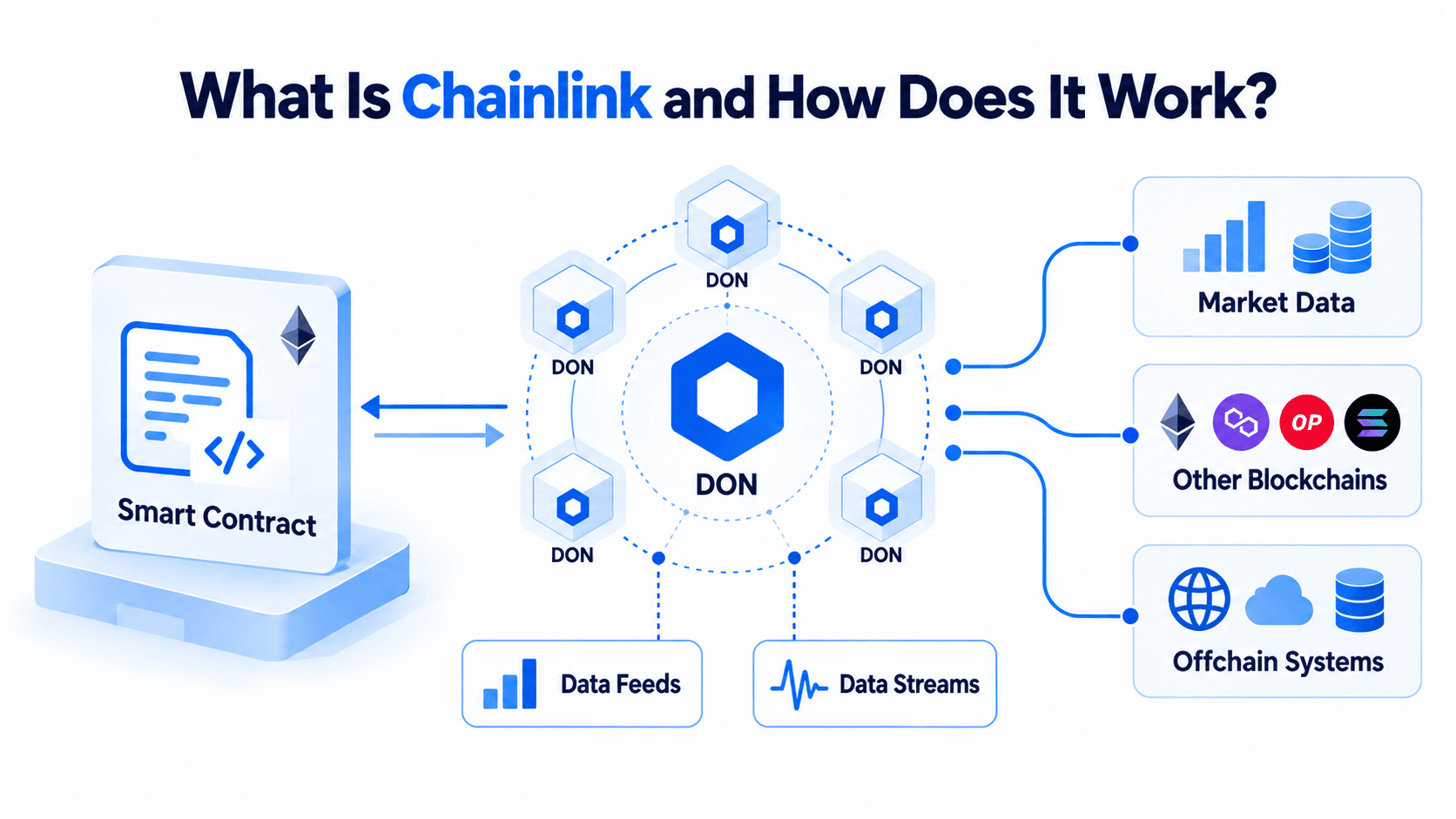
Chainlink is a decentralized oracle and interoperability platform that connects smart contracts to external data, other blockchains and offchain systems. It works through decentralized oracle networks, or DONs, where independent node operators collect, validate and aggregate information before delivering results to blockchains.
A lending protocol provides a simple example. Suppose a protocol needs the ETH/USD price before deciding whether a borrower's collateral should be liquidated. The blockchain cannot independently open an exchange API and check ETH's market price. Chainlink nodes retrieve market data from multiple sources, reconcile their observations through an oracle network and publish an aggregated answer that the application's smart contract can consume.
Blockchain oracles perform this connection between onchain applications and information that originates elsewhere.
 Chainlink Connects Smart Contracts With Reliable External Data
Why Smart Contracts Need Oracles
Blockchains can reach agreement over information already contained in their own state. They cannot independently determine an equity price, weather event, sports result, bank balance or API response.
An oracle brings that external information into an environment a contract can use.
Trusting one external provider would create a single point of failure. If that provider returned an incorrect price, went offline or was compromised, the smart contract could execute correctly against bad information.
Oracle design therefore has two jobs: retrieve useful external data and reduce the amount of trust placed in any single source or operator.
This problem appears throughout DeFi, where lending markets, derivatives, stablecoins and other applications depend on information that their host blockchains cannot generate themselves.
Decentralized Oracle Networks, Nodes and OCR
Chainlink handles this through DONs made up of independent oracle nodes.
For many market feeds, individual nodes collect observations from several professional data providers. The nodes then compare their observations using Offchain Reporting, or OCR.
Instead of every node submitting its own onchain transaction, OCR lets nodes communicate and reach consensus offchain. An aggregated report is signed by a quorum and submitted onchain, where the receiving contract verifies it.
The data can therefore be diversified twice. Multiple data sources reduce reliance on any individual market-data provider, while multiple nodes reduce reliance on a single oracle operator.
Neither prevents every failure. Several providers can still rely on overlapping exchange inputs, markets can become disorderly and applications can configure feeds incorrectly.
Data Feeds vs Data Streams
Chainlink uses different delivery models depending on how quickly an application needs fresh data.
Chainlink Data Feeds are primarily push-based. New oracle reports are published onchain when predefined conditions are met, commonly a price-deviation threshold or heartbeat interval.
That model works well for lending markets, stablecoins and other applications where dependable onchain reference prices matter more than receiving every market tick.
Chainlink Data Streams target applications that need faster information. Reports are generated offchain at high frequency and retrieved on demand, then cryptographically verified when an application uses them. Chainlink describes the service as supporting sub-second market data.
A perpetual-futures platform may need a fresh price whenever a trader opens or closes a position, which favors the pull-based Data Streams model. A lending market checking collateral health can often work with Data Feeds whose updates follow deviation and heartbeat parameters.
The application therefore chooses between persistent onchain updates and lower-latency data requested when needed.
What Does Chainlink Offer in 2026?
Chainlink now supplies data, computation, interoperability and workflow infrastructure. Each service solves a separate technical problem, and several can operate together inside the same application.
| Product | What It Does | Primary User | Main Use Case |
|---|---|---|---|
| Chainlink Data Feeds | Publishes aggregated external data onchain | DeFi protocols, asset issuers | Reference prices and verified external data |
| Chainlink Data Streams | Provides low-latency, pull-based market data | Derivatives and trading applications | High-frequency pricing |
| CCIP | Transfers messages and tokens between blockchains | Developers, protocols, asset issuers | Cross-chain applications and token movement |
| CRE | Orchestrates workflows across blockchains and external systems | Developers and institutions | Multi-system blockchain workflows |
| VRF | Generates verifiable randomness | Games, NFT and onchain applications | Random selections and outcomes |
| Proof of Reserve | Supplies reserve-related information onchain | Asset issuers and DeFi protocols | Monitoring asset backing |
| Smart Value Recapture | Recaptures oracle-related liquidation MEV | DeFi protocols | Redirecting part of liquidation value |
Proof of Reserve, for example, can supply reserve information for tokenized assets or stablecoins. VRF produces verifiable randomness. SVR attempts to recover value that would otherwise be extracted around oracle-triggered liquidations.
These products can also feed one another. Market data can trigger application logic, CCIP can carry instructions to another chain, and CRE can coordinate the workflow across several systems.
 Chainlink Expands Beyond Oracles Into Broader Blockchain Infrastructure
From Oracle Network to Infrastructure Platform
Chainlink's product progression can be traced through the functions it has added.
Price and data feeds brought external information into smart contracts. VRF, Automation, Functions and Proof of Reserve extended the network into randomness, triggering, computation and reserve verification.
CCIP introduced cross-chain communication. CRE now lets developers combine blockchains, Chainlink services, APIs and external systems inside programmable workflows.
That puts Chainlink into several competitive markets at once. It competes with Pyth, RedStone and Chronicle for oracle workloads. CCIP overlaps with interoperability protocols such as LayerZero, Wormhole and Axelar. CRE is designed for workflows that may touch blockchains, bank infrastructure, external APIs and compliance systems in one process.
Chainlink CCIP Explained
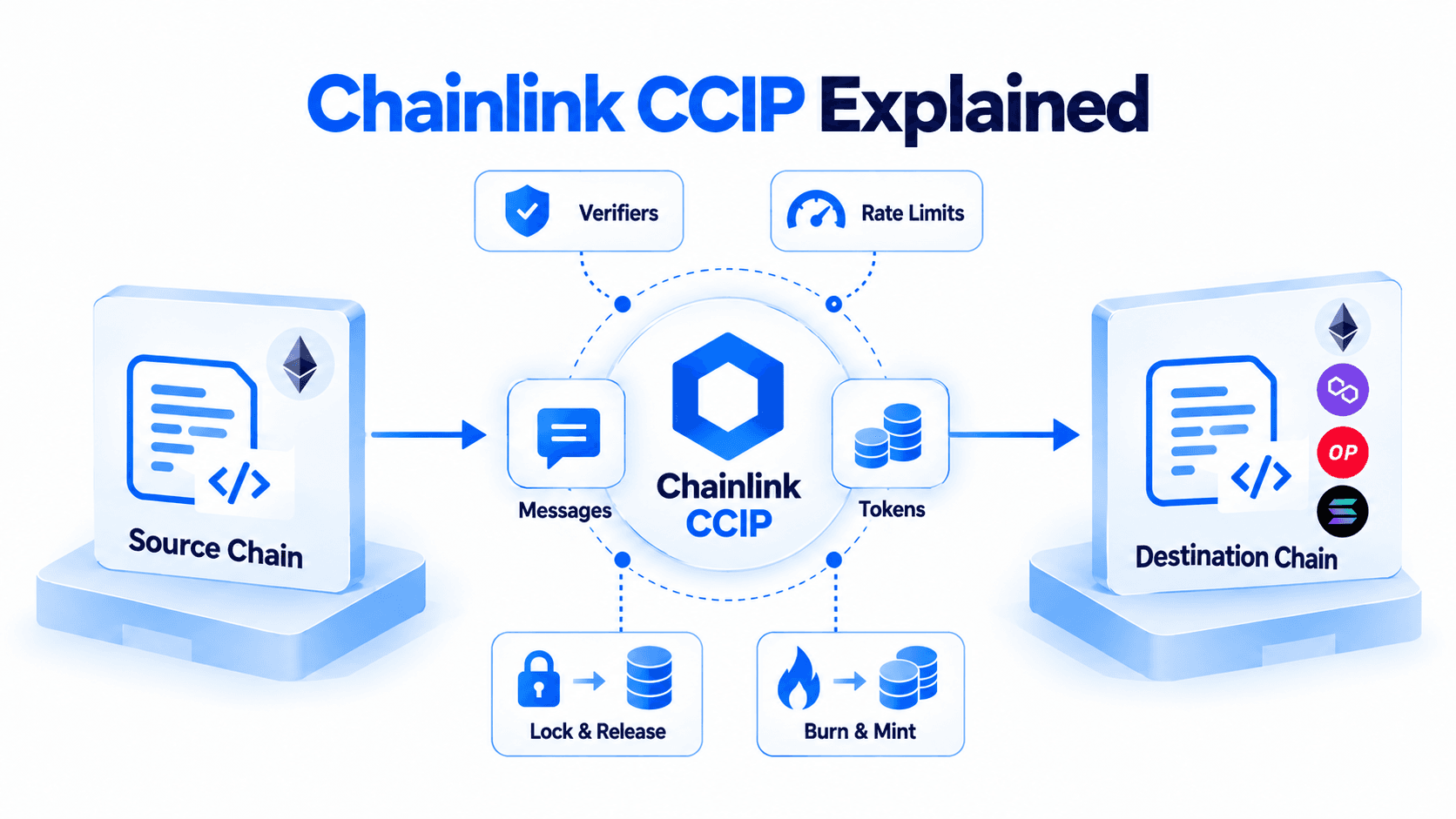
The Cross-Chain Interoperability Protocol, or CCIP, is Chainlink's infrastructure for sending messages and tokens between blockchains. Applications can use it to trigger actions across networks without maintaining a separate communication system for every chain pair.
CCIP sits within blockchain interoperability, where independent networks exchange assets, data and instructions.
 CCIP Moves Messages And Tokens Across Blockchain Networks
How CCIP Transfers Tokens and Messages Between Blockchains
A cross-chain application generally has logic on a source chain and another contract or account on the destination chain. The sender submits instructions through CCIP, Chainlink's infrastructure verifies the message, and destination-side contracts execute the approved instruction.
That instruction can carry data alone. A governance application might send a command from one chain to another. A lending protocol could synchronize state. An asset issuer could combine a token transfer with instructions describing what should happen after settlement.
Token transfers introduce supply mechanics. Depending on the token, a pool can lock assets on the source chain and release them elsewhere, or burn supply on one network and mint the corresponding amount on another.
A conventional cross-chain bridge may focus mainly on asset movement. CCIP also transports arbitrary messages, allowing a destination smart contract to execute logic based on an event elsewhere.
CCIP supports ecosystems including Ethereum, Arbitrum, Avalanche, Base and Solana, among others. Supported networks and lanes change, so developers need to confirm the live CCIP directory for the route they intend to use.
The Cross-Chain Token Standard
Cross-Chain Tokens, or CCTs, give issuers a standardized way to make assets transferable through CCIP while retaining control over the token's supply mechanics.
With the Cross-Chain Token standard, an issuer can connect an existing or new token to CCIP through token pools. Those pools determine how supply moves across networks, including lock-and-release and burn-and-mint models.
Without a common framework, an issuer expanding across several networks may have to maintain separate bridge integrations, security assumptions and liquidity arrangements.
CCT reduces those separate integrations while letting the issuer define how its token moves.
For tokenized securities and other real-world assets, issuers may also need restrictions around who can hold or transfer an asset. CCIP's newer architecture allows verification and compliance components to be incorporated into cross-chain flows.
How CCIP Approaches Cross-Chain Security
A cross-chain message asks one blockchain to act on something that happened somewhere else. If the verification process accepts a false message, the destination contract may execute it as though it were legitimate.
CCIP 2.0, introduced on Sept. 28, 2026, uses a modular verification system built around Cross-Chain Verifiers, or CCVs. A default Committee Verifier uses a Chainlink DON to attest to messages, while developers and token issuers can require other verifiers.
Several required CCVs can be combined so that a message has to satisfy all selected verification conditions before execution.
Rate limits can restrict how much value moves through a route during a defined period. If abnormal activity occurs, the amount that can leave before intervention is therefore capped.
Current deployments also differ from older CCIP descriptions. Earlier versions centered an automated offchain Risk Management Network. Current documentation says the offchain RMN is no longer active in current deployments, while an onchain Risk Management Network contract remains available for emergency controls.
Developers can also choose confirmation settings according to the transaction. A high-value transfer can wait for stronger finality, while another application may accept faster execution with different risk assumptions.
These mechanisms reduce specific failure paths. They cannot remove the additional contracts, verification logic and chain dependencies created by cross-chain execution.
Is CCIP Just Another Bridge?
A traditional token bridge primarily moves an asset from one chain to another. It may lock tokens and issue a representation elsewhere, burn and mint native supply, or use liquidity pools.
A generalized messaging protocol carries instructions between chains. Token movement can sit on top of that messaging layer, but applications can also trigger contracts, synchronize state or coordinate actions across networks.
CCIP combines both. It provides generalized messaging alongside token-transfer infrastructure, CCTs and configurable verification.
A user transferring a token may experience CCIP like a bridge. A developer can use the same network to create an application whose logic spans several chains.
Chainlink CRE and the New Chainlink Architecture
The Chainlink Runtime Environment, or CRE, is an orchestration environment for workflows that combine blockchains, Chainlink services, APIs, external systems and computation.
Developers define the workflow once and use CRE to coordinate the systems involved instead of connecting every component separately.
What Is the Chainlink Runtime Environment?
A CRE workflow can read blockchain state, call an API, perform offchain computation, use Chainlink services, obtain consensus through a DON and write a result back to one or more blockchains.
Consider a tokenized investment fund. A transaction may require NAV data, investor eligibility checks, an instruction from existing financial infrastructure, an onchain transfer and synchronized records in another system.
Those steps may operate across entirely different software environments.
CRE coordinates those steps inside one workflow. Chainlink is also developing privacy and compliance components for cases where institutions cannot expose every data point or transaction detail publicly.
Tokenization makes these multi-system workflows common because the asset may exist onchain while identity, payments, compliance and accounting remain partly offchain.
How CRE Changes Chainlink Automation and Functions
Chainlink's earlier developer stack exposed Automation and Functions as separate products.
That model changed during 2026.
Chainlink sunset Functions on June 30, 2026, directing new development toward CRE. Legacy Automation versions have also been deprecated as Chainlink moves event-driven execution into the CRE environment.
The capabilities remain available in a different architecture. Developers can combine triggers, API calls, computation and Chainlink services inside one workflow rather than integrating each as an isolated product.
CRE therefore becomes the coordination layer, while services such as Data Feeds and CCIP provide data and connectivity that workflows can call.
Why CRE Is Important for Institutional Applications
A tokenized security may depend on a bank's internal systems, identity checks, an asset-servicing platform, market data, one or more blockchains and a payment network.
Institutions cannot simply discard those systems when they begin using blockchain infrastructure. A practical implementation needs to connect them.
Chainlink announced on Sept. 28, 2026, that financial institutions would be able to connect to SWIFT's blockchain ledger through CRE. The model allows institutions to retain their transaction-signing keys while CRE coordinates workflows between bank systems and Swift's ledger.
A bank can therefore keep parts of its existing operating environment while a CRE workflow handles blockchain connectivity, data and execution across the other systems involved.
LINK Tokenomics: What Gives the Token Value?
LINK gains economic utility from service payments, node incentives, staking and mechanisms that convert qualifying Chainlink revenue into LINK. Network usage only benefits the token directly when activity reaches one of those economic pathways.
LINK uses the ERC-677 token standard on Ethereum. It remains compatible with standard token transfers while supporting additional contract interactions.
What Is LINK Used For?
LINK performs several jobs in the Chainlink Network.
Oracle and infrastructure services can generate fees that compensate service providers. Node operators perform work across DONs and receive economic rewards. Staking lets eligible node operators and community participants commit LINK to selected security functions.
Payment Abstraction allows supported service revenue received in other assets to be converted into LINK. Part of that LINK can enter the Chainlink Reserve.
LINK remains a network token rather than conventional equity. Holding it does not provide ownership of Chainlink Labs or a contractual claim on the company's assets or profits.
That leaves the token thesis dependent on how much Chainlink usage produces LINK payments, conversions, staking demand or Reserve accumulation.
LINK Supply and Circulating Supply
LINK has a fixed maximum supply of 1 billion tokens.
Its circulating supply can still increase until that maximum is reached.
As of Oct. 4, 2026, Chainlink reports more than 748 million LINK in circulation. The remaining supply sits in identified non-circulating wallets.
Chainlink states a release schedule equal to 7% of total supply per year. With a maximum supply of 1 billion LINK, 7% corresponds to 70 million LINK.
A fixed maximum prevents issuance above 1 billion under the current token design. It does not prevent dilution among existing circulating holders while previously non-circulating LINK continues to enter the market.
Payment Abstraction Explained
Enterprises and protocols may want Chainlink services without holding LINK before every payment.
A company may prefer fiat or stablecoins. A DeFi protocol may earn revenue in ETH or another asset. Requiring every customer to source LINK first would add payment friction.
Payment Abstraction went live on mainnet in March 2025. It allows qualifying Chainlink service fees paid in supported assets to be consolidated and converted into LINK.
In its initial implementation, fees are collected, moved to the relevant payment environment when necessary, converted into LINK through decentralized liquidity and allocated according to the economics of the service.
The customer can therefore pay using another asset while the Chainlink economic system still creates LINK purchases.
The size of that effect depends on revenue. A $1 million service integration does not create $1 million of LINK demand simply because Chainlink powers it. Fees have to be generated, collected and routed through the conversion mechanism.
What Is the Chainlink Reserve?
The Chainlink Reserve is an onchain reserve that accumulates LINK using revenue generated by Chainlink's enterprise and onchain services.
Chainlink introduced the Reserve in August 2025. Payment Abstraction can convert qualifying revenue into LINK, which is then accumulated in the Reserve.
At the latest available snapshot around publication, the Reserve held roughly 6 million LINK.
The LINK is held rather than burned. Reserve accumulation therefore does not reduce LINK's 1 billion maximum supply.
It can still affect the market in two ways. Acquiring LINK creates demand during conversion, and LINK held in the Reserve remains outside normal market circulation while it stays there.
The scale can be compared with the rest of the token system. Roughly 6 million LINK in the Reserve represents less than 1% of the approximately 748 million LINK circulating. The current annual release schedule corresponds to as much as 70 million LINK.
Reserve balance and annual releases measure different things, but tracking both shows whether fee-driven accumulation is growing fast enough to become material beside new circulating supply.
Does Chainlink Adoption Automatically Create LINK Demand?
No. The economic connection depends on how the service is monetized.
A simplified path looks like this:
Service usage → fees or revenue → Payment Abstraction or direct LINK payment → LINK distributed to service providers, stakers and/or the Reserve
SVR provides one concrete example. It captures part of the MEV associated with oracle-triggered liquidations and allocates revenue between participating applications and the Chainlink ecosystem. Payment Abstraction can convert Chainlink's share into LINK.
An institutional pilot can behave differently. It may demonstrate that CRE works with existing financial infrastructure and make future commercial deployments easier without generating a large amount of LINK demand during the pilot itself.
LINK holders can therefore track conversion rather than treating integration counts as a proxy for token demand. Reserve accumulation, Payment Abstraction volumes, service fees, staking revenue and circulating-supply growth provide more direct evidence.
Chainlink Staking Explained
Chainlink Staking lets node operators and community members commit LINK to selected oracle-security functions. The current v0.2 system does not secure every Chainlink service.
It also differs from blockchain Proof-of-Stake. Chainlink staking operates around oracle services rather than selecting validators to produce blocks for a Layer 1 blockchain.
| Participant | Role | Pool Capacity | Rewards | Withdrawal | Slashing Exposure |
|---|---|---|---|---|---|
| Community staker | Backs the service and participates in alerting | 40.875M LINK | Variable rewards, currently around 4.32% | 28-day cooldown followed by 7-day claim window | No community-staker slashing in v0.2 |
| Node operator | Operates oracle infrastructure and supplies stake | 4.125M LINK | Base rewards plus delegation rewards | Subject to v0.2 withdrawal mechanics | Selected operators can be slashed under defined conditions |
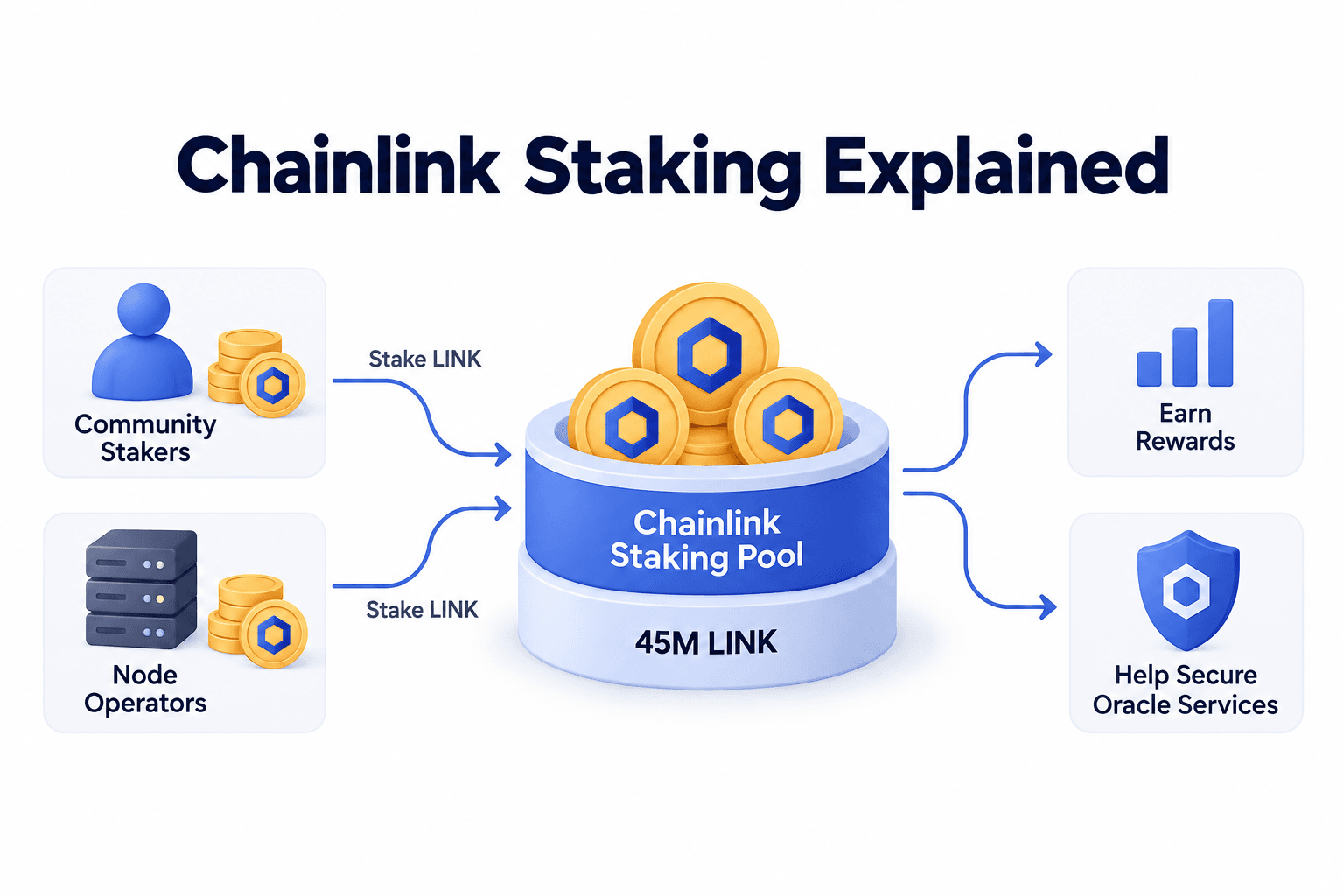 Chainlink Staking Adds Economic Security To Selected Services
How Chainlink Staking v0.2 Works
Staking v0.2 has a maximum pool capacity of 45 million LINK. Community stakers receive 40.875 million LINK of that capacity, while node operators receive 4.125 million.
The community pool is currently full at 40.875 million LINK. Chainlink's economics dashboard reports more than 42 million LINK staked when node-operator participation is included.
Community stakers currently see a variable reward rate around 4.32%. The underlying v0.2 design uses a 4.5% base floor rate for a full community pool, with 4% of community rewards directed to node operators as delegation rewards. That leaves an effective community rate of 4.32%.
Rewards also use a 90-day ramp-up period.
A staker who wants to exit begins a 28-day cooldown. That is followed by a seven-day claim window. If the withdrawal is not completed during that window, the position returns to staking.
Pool capacity also affects entry. When the community allocation is full, another holder cannot simply stake more LINK until capacity becomes available.
What Does Staked LINK Actually Secure?
The 45 million LINK pool does not currently secure every Chainlink product.
The public v0.2 system still focuses its alerting and slashing mechanism on the ETH/USD Data Feed on Ethereum.
Community stakers can raise an alert when the feed experiences a defined period of downtime. Node operators serving the feed can face a 700 LINK slash each when the relevant conditions are met, while the successful alerter can receive a reward.
Community stakers are not subject to slashing under v0.2.
Chainlink can extend staking to additional oracle services in later versions. Until that happens, describing the current pool as economic security for CCIP, CRE, every Data Feed and the rest of the Chainlink Network would overstate what the deployed staking system does.
Chainlink Staking Risks and Limitations
A full community pool restricts access. New participants can only enter when capacity opens or Chainlink changes the pool.
Rewards still rely substantially on emissions-based funding. Chainlink's economic design calls for external service fees to fund a larger share of staking rewards over time, with emissions eventually declining. Current staking has not reached that endpoint.
Slashing also differs by participant. Selected node operators can lose LINK under defined v0.2 conditions, while community stakers currently cannot.
Staking introduces smart contract risk because LINK sits inside non-custodial contracts whose behavior depends on deployed code and upgrade controls.
The withdrawal process creates opportunity cost as well. A 28-day cooldown can prevent a holder from immediately using or selling the staked LINK when market conditions change.
How Widely Is Chainlink Actually Used?
Chainlink has extensive DeFi adoption and a growing set of institutional deployments. Its adoption metrics use different denominators, so TVS, transaction value enabled and CCIP transfer volume cannot be compared as though they measure the same activity.
As of Oct. 4, 2026:
| Metric | Current Figure | What It Measures | Source |
|---|---|---|---|
| Third-party Chainlink oracle TVS | ~$37.5B | Value associated with protocols DefiLlama attributes to Chainlink oracles | DefiLlama |
| Protocols tracked using Chainlink | 534 | DefiLlama protocol count attributed to Chainlink oracle usage | DefiLlama |
| Chainlink-reported TVS | ~$56.6B | Chainlink's point-in-time value-secured metric | Chainlink Metrics |
| Transaction Value Enabled | ~$34.18T | Cumulative transaction value facilitated by Chainlink services | Chainlink Metrics |
| Cumulative CCIP transfer volume | ~$24.12B | Value transferred through CCIP | Chainlink Metrics |
Chainlink's Position in DeFi and Onchain Finance
DefiLlama currently attributes approximately $37.5 billion across 534 protocols to Chainlink.
The same oracle dashboard puts Chronicle at roughly $5.1 billion, RedStone around $4.3 billion and Pyth around $3.4 billion at the time of writing.
That gives Chainlink considerably more third-party oracle TVS than the other networks in the comparison.
Protocol distribution also affects those numbers. Aave, one of DeFi's largest lending markets, contributes a large amount of value to Chainlink's oracle TVS because its collateral and liquidation systems rely on external pricing.
Heavy exposure to large protocols can move the aggregate number quickly. If Aave deposits fall while Chainlink adds several smaller integrations, total Chainlink TVS can still decline.
The metric therefore shows the value dependent on Chainlink within DefiLlama's methodology, not simply the number of integrations the oracle network has signed.
TVS vs Transaction Value Enabled: Why Chainlink Metrics Differ
Chainlink figures that appear contradictory can describe entirely separate datasets.
DefiLlama recently showed Chainlink oracle TVS near $39.9 billion and currently reports roughly $37.5 billion. That is a third-party point-in-time figure based on protocols included in DefiLlama's oracle methodology.
Chainlink reported roughly $110 billion in TVS during its Q2 2026 review. Its own live metrics later showed approximately $56.6 billion.
Those first-party and third-party TVS figures use different coverage and can also be measured on different dates.
The much larger $34.18 trillion Transaction Value Enabled figure is cumulative. It measures transaction value facilitated by Chainlink services over time rather than the value dependent on Chainlink at one moment.
CCIP uses another measurement. Its roughly $24.12 billion cumulative transfer volume tracks value moved through CCIP.
The figures therefore answer separate questions:
- TVS: How much value is currently associated with applications using the infrastructure?
- Transaction Value Enabled: How much qualifying transaction value has flowed through Chainlink-enabled activity over time?
- CCIP transfer volume: How much value has moved through the cross-chain protocol?
Institutional and RWA Adoption
Chainlink's institutional projects sit at different stages, ranging from tests to production transactions.
| Example | Status | What Actually Happened |
|---|---|---|
| UBS and DigiFT | Production deployment | UBS Tokenize and DigiFT completed a live tokenized fund subscription and redemption workflow using Chainlink infrastructure. |
| Kinexys by J.P. Morgan and Ondo | Completed test transaction | The firms completed a cross-chain delivery-versus-payment test involving Kinexys Digital Payments and Ondo Chain testnet, with CRE coordinating the workflow. |
| Swift | Announced infrastructure and upcoming pilots | Chainlink announced in September 2026 that CRE would enable institutions to connect to Swift's blockchain ledger. |
The UBS transaction used a live production workflow for tokenized fund subscription and redemption. It therefore demonstrates production use rather than a proof of concept.
The J.P. Morgan Kinexys and Ondo transaction connected a permissioned payment system with an asset on Ondo Chain testnet. The transaction was completed, but the use of a testnet means it should not be described as a full production deployment.
The SWIFT work is at another stage. The announced infrastructure would connect institutions to Swift's blockchain ledger through CRE, while participating banks prepare to pilot tokenized-deposit transactions.
Chainlink also supplies infrastructure such as DataLink and its Digital Transfer Agent standard for tokenized securities and funds.
Separating tests, completed transactions and recurring production deployments prevents a long partnership list from overstating actual usage.
Chainlink Security, Decentralization and Risks
Chainlink's security depends on several layers: the quality of external data, the nodes reporting it, the contracts consuming it, product-specific controls and the economic incentives around the network.
CCIP introduces additional cross-chain dependencies that ordinary price feeds do not have.
| Risk Layer | Main Failure Path |
|---|---|
| Data risk | External information is wrong, stale or correlated |
| Oracle-network risk | Nodes disagree, fail or coordinate incorrectly |
| Protocol risk | Contracts or configurations contain errors |
| Cross-chain risk | A false or compromised message causes execution on another chain |
| Governance/control risk | Administrative or upgrade authority is compromised or misused |
| Economic risk | Chainlink usage grows without equivalent LINK value capture |
For users interacting with complex DeFi or cross-chain systems, crypto security extends beyond wallet protection. Oracle dependencies, upgrade keys, bridge design and emergency controls can affect an application even when the user's wallet is secure.
Oracle and Data-Source Risk
Five oracle nodes reading the same faulty market source do not provide meaningful source diversity.
Chainlink market feeds typically use data providers that aggregate prices from several venues, while multiple nodes independently obtain and report observations.
Correlated inputs can still occur. Several vendors may ultimately rely on overlapping exchanges. During extreme volatility, exchange prices can diverge and individual markets can temporarily lose liquidity.
Stale data creates a separate failure path. Data Feeds publish according to heartbeat and deviation parameters rather than updating every time a market price moves.
Chainlink's integration guidance tells applications to inspect timestamps and account for stale data.
The integrating protocol therefore remains responsible for how it consumes the feed. Reading the wrong contract, ignoring timestamps, mishandling decimals or using unsuitable liquidation parameters can produce losses even when the oracle itself operates as designed.
CCIP and Cross-Chain Risk
Cross-chain communication turns a verified message into an action on another blockchain.
If that verification fails, the destination contract may transfer assets or execute logic based on a false event.
CCIP 2.0 uses DON-based verification by default and allows additional CCVs. Developers can require several verification systems before a message is accepted.
Rate limits reduce how much value can move during a defined period. Emergency controls can stop affected routes.
Those defenses reduce the amount of trust concentrated in one mechanism, but cross-chain applications still depend on source-chain finality, message verification, destination contracts, token pools and configuration.
Each dependency can fail independently or interact with another failure.
Users comparing cross-chain protocols should therefore examine the verification threshold, upgrade authority, rate limits and emergency controls rather than assuming that a protocol's branding or network size determines its security.
Governance and Operational Control
Chainlink decentralization varies by service.
A DON can contain independent node operators. Market data can come from several independent providers. Those characteristics distribute data collection and reporting.
Deployment and upgrade authority is separate.
Data Feeds use upgrade mechanisms and multisig controls. Staking v0.2 uses timelocked controls for security-sensitive upgrades. CCIP includes administrative and emergency functions needed to operate cross-chain deployments.
LINK ownership does not grant general governance rights over these controls.
A widely distributed token therefore does not prove that every Chainlink product is decentralized to the same degree.
A service-level assessment asks how many independent nodes participate, which sources they use, what quorum is required, who can modify contracts, whether changes are timelocked and which emergency powers remain available.
Economic Risks for LINK Holders
LINK holders can face weak token economics even while Chainlink services gain users.
Circulating supply is still increasing under the current release schedule. New demand from Payment Abstraction, staking and the Reserve has to absorb part of that additional supply if those mechanisms are to tighten LINK's market economics.
Fee conversion creates another variable. Payment Abstraction can turn qualifying revenue into LINK demand, but the effect depends on how much revenue the services generate.
Competition can affect that revenue at several layers. Pyth, RedStone and Chronicle compete for data workloads. LayerZero, Wormhole and Axelar compete in interoperability. Institutional deployments can also involve traditional financial technology providers and proprietary bank infrastructure.
Staking rewards remain partly dependent on emissions rather than entirely on customer fees.
The risk for holders is therefore specific: Chainlink's infrastructure usage could grow faster than the mechanisms converting that usage into LINK demand.
Chainlink vs Other Oracle and Interoperability Networks
Chainlink faces one competitive set in oracle data and another in cross-chain messaging. Comparing all of them in one ranking would mix protocols solving different problems.
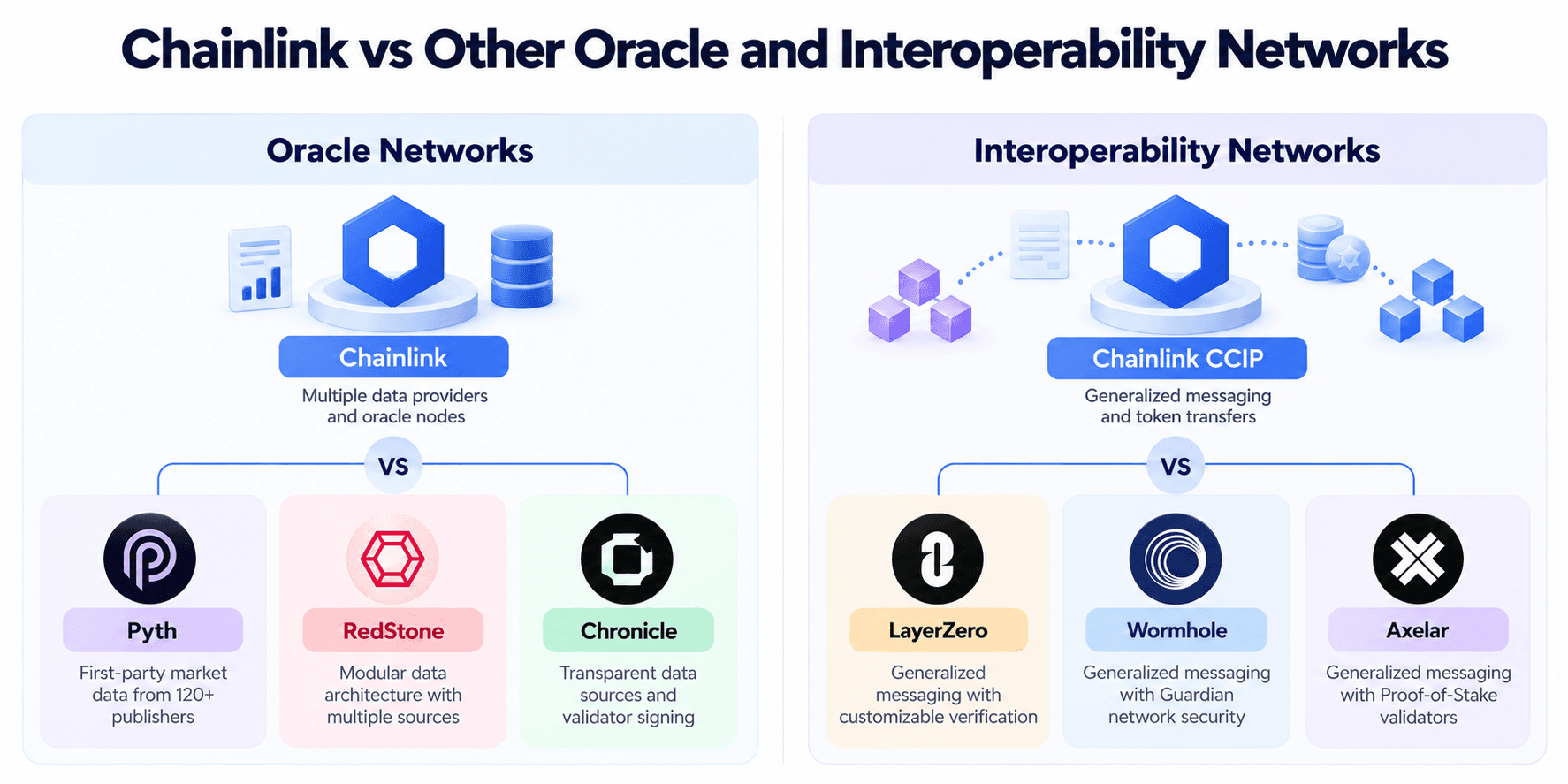 Chainlink Competes Across Oracle And Interoperability Infrastructure Markets
Chainlink vs Pyth, RedStone and Chronicle
Oracle networks differ in data provenance, delivery speed, update model, validator or node structure and where their integrations are concentrated.
| Network | Data Delivery | Data and Security Model | Independent DeFi Footprint | Main Position |
|---|---|---|---|---|
| Chainlink | Push-based Data Feeds plus pull-based Data Streams | Multiple data providers and independent oracle nodes using DON consensus | ~534 protocols, ~$37.5B TVS | Large DeFi footprint with separate high-speed data product |
| Pyth | Push and pull models with high-frequency market data | 120+ first-party data providers publish financial-market data | ~320 protocols, ~$3.4B TVS | Strong derivatives and trading focus |
| RedStone | Push, pull and streaming models | Modular signed-data architecture using multiple sources | ~90 protocols, ~$4.3B TVS | Flexible delivery across DeFi and newer assets |
| Chronicle | Onchain feeds using Scribe | Transparent data sources and validator-based signing | ~13 protocols, ~$5.1B TVS | Concentrated deployment with source transparency |
The adoption figures come from DefiLlama's oracle rankings and change with protocol balances and asset prices.
Pyth emphasizes first-party publishers such as exchanges, trading firms and market makers. Its architecture can suit applications that prioritize low-latency financial data originating close to the trading venues producing it.
RedStone offers push, pull and streaming formats, allowing applications to choose between persistent onchain data and reports supplied only when needed.
Chronicle's Scribe system uses validator agreement and exposes information about its data sources and validators. Its protocol count is smaller, while several large integrations give it comparatively high TVS.
Chainlink combines a large existing DeFi footprint with both push and pull data products.
The choice depends on what an application requires. A lending protocol may prioritize battle-tested integrations and reference prices, while a derivatives platform may put more weight on latency and first-party market data.
CCIP vs LayerZero, Wormhole and Axelar
CCIP competes with protocols whose primary job is transporting messages and tokens across blockchains.
| Protocol | Messaging Model | Token Interoperability | Security / Trust Model | Developer Model |
|---|---|---|---|---|
| CCIP | Generalized messaging | CCTs and token pools | Default DON-based Committee Verifier, optional CCVs, rate limits and emergency controls | Issuers can configure verification and token-pool rules |
| LayerZero | Generalized messaging | Omnichain Fungible Token standard | Applications select Decentralized Verifier Networks and execution configuration | Developers choose parts of the verification stack |
| Wormhole | Generalized messaging | Native Token Transfers and token frameworks | Guardian network signs verified messages | Applications consume Guardian-verified messages |
| Axelar | Generalized message passing | Interchain token infrastructure | Proof-of-Stake validator network and multiparty signing | Apps communicate through Axelar gateways and validator infrastructure |
- LayerZero separates message verification from execution and lets applications select the Decentralized Verifier Networks that must approve messages.
- Wormhole uses a Guardian network that observes connected chains and signs Verifiable Action Approvals. Destination applications execute after the required signature threshold is reached.
- Axelar uses a Proof-of-Stake validator network for cross-chain verification and consensus, with General Message Passing carrying application instructions.
- CCIP uses a Chainlink DON-based verifier by default and can combine additional CCVs. CCT supplies a standardized token-interoperability system on top.
LINK Investment Thesis: Strengths, Risks and What to Watch
The LINK investment thesis can now be tested against observable economic variables. Oracle adoption shows how widely Chainlink is used. Payment Abstraction, staking, the Reserve and service revenue show how much of that activity can reach LINK.
The Case for LINK
Chainlink already has a large oracle footprint. Existing integrations can also create distribution for other products. A protocol already using Data Feeds has an established Chainlink relationship when evaluating Data Streams, SVR or CCIP.
CCIP creates fee opportunities around cross-chain messaging and token transfers. CRE targets workflows involving blockchains and external financial systems. SVR monetizes value generated around oracle-triggered liquidations.
Payment Abstraction can convert qualifying service revenue into LINK even when customers pay using other assets.
The Reserve then provides a visible record of part of that conversion, while staking currently removes more than 42 million LINK from immediate liquid circulation and gives the token a security function.
If CCIP fees, SVR revenue, enterprise payments and other Chainlink service revenue increase, more economic activity could flow through these mechanisms.
That outcome depends on actual revenue rather than integration counts.
The Case Against LINK
Chainlink usage and LINK demand can diverge.
A bank can complete a CRE pilot without buying an economically meaningful amount of LINK. A protocol can integrate a Data Feed while node rewards still depend partly on token incentives.
Transaction Value Enabled, TVS and partnership counts therefore cannot substitute for token revenue.
The Reserve balance of roughly 6 million LINK remains small compared with both circulating supply and the current potential annual release amount.
Staking locks more LINK, but the tokens remain owned by stakers and can return to liquid circulation after withdrawal.
Competition can also limit fee growth. Pyth has built a large first-party data network. RedStone supports several data-delivery models. Chronicle remains established in specific DeFi markets. CCIP competes with LayerZero, Wormhole and Axelar for cross-chain applications.
Fee-funded staking has also not fully replaced emission-funded rewards.
LINK therefore needs more than Chainlink adoption. It needs a growing share of that adoption to generate fees that either buy LINK, compensate LINK stakers or accumulate LINK in mechanisms such as the Reserve.
What to Watch
These variables show whether Chainlink's product growth is translating into stronger LINK economics:
| Variable | What to Track | What It Shows |
|---|---|---|
| Chainlink Reserve | LINK accumulated over time | Whether enterprise and onchain revenue is creating recurring LINK acquisition |
| Circulating supply | Net growth and token releases | How quickly previously non-circulating LINK enters the market |
| Payment Abstraction | Revenue converted into LINK | Strength of the direct service-usage-to-LINK pathway |
| Staking revenue | Share funded by external fees | Whether staking becomes less dependent on emissions |
| CCIP | Transfer volume, messages and fees | Whether interoperability generates meaningful usage and revenue |
| CRE | Production workflows | Whether institutional orchestration moves beyond tests and pilots |
| SVR | Value recaptured and Chainlink revenue | How much additional monetization comes from existing oracle usage |
| Institutional deployments | Recurring production activity | Whether announced integrations turn into commercial infrastructure |
| Oracle market share | Independent TVS and protocol counts | Whether Chainlink retains its core data position |
| Staked LINK | Share of supply and services secured | Whether staking expands beyond its current security scope |
Reserve growth should be read beside circulating-supply growth. One tracks LINK accumulated through revenue conversion; the other tracks LINK becoming available to the market.
Staking also needs two measurements. The number of LINK tokens deposited shows capital commitment, while the number of services secured and the fees supporting rewards show how useful that stake has become economically.
CCIP requires similar separation. Transfer volume shows usage. Fees show monetization.
CRE announcements indicate distribution, while recurring production workflows indicate that institutions are actually using the infrastructure.
None of those measurements requires a LINK price prediction.

Chainlink Review: Conclusion
Chainlink already occupies a major position in blockchain infrastructure. It leads the oracle market by independent TVS, supplies data to hundreds of DeFi protocols and now operates products for low-latency data, cross-chain communication, token interoperability and multi-system workflows through CCIP and CRE.
Staking, Payment Abstraction and the Chainlink Reserve create identifiable routes between Chainlink services and token demand. Around 748 million LINK is already circulating, however, and the current release schedule continues to increase supply. The Reserve remains small relative to those flows, while staking rewards have yet to become predominantly fee-funded.
For LINK holders, the question is now measurable: how much revenue do CCIP, CRE, SVR and the existing oracle business generate, how much of that revenue is converted into LINK, and how quickly does that demand grow relative to token releases?
Chainlink has already shown infrastructure adoption. LINK's investment case depends on how much of that infrastructure usage becomes recurring token demand.