Choosing between crypto and stocks sounds simple until you realize the question hides three different ones underneath. Which one can grow faster? Which one is safer to hold? And which one actually makes sense for the kind of investor you are.
This comparison breaks that down in plain English. It looks at performance, volatility, regulation, ETFs, taxes, income, and beginner fit, so the answer is not just theoretical. By the end, you should have a much clearer view of where stocks win, where crypto earns its place, and how the two can fit together without muddying the portfolio.
Editor's Note (April 9, 2026): We fully updated this guide in April 2026 to make it more useful for today’s investor. The update includes new sections on spot crypto ETFs, post-2024 halving market structure, portfolio allocation, taxes, staking, beginner suitability, and the practical differences between using stocks as a core holding and crypto as a higher-risk satellite position.
Crypto vs Stocks in 30 Seconds
Crypto and stocks are both investable assets, but they do different jobs in a portfolio. Bitcoin and other crypto assets can offer higher upside, but they also come with much higher volatility, less consistent regulation, and bigger drawdown risk. Stocks, especially broad S&P 500 funds, have a longer history of compounding and fit more naturally with long-term investing. The right mix depends on risk tolerance, time horizon, and whether the goal is growth, stability, or better diversification through thoughtful portfolio allocation.
Quick Verdict
- CryptoHigher upside potential, higher volatility, less predictable return path
- StocksLower volatility, stronger regulation, longer compounding track record
- Best crypto benchmarkBitcoin first, then Ethereum for most mainstream comparisons
- Best stock benchmarkS&P 500 funds, total-market ETFs, and diversified equity exposure
- Best portfolio role Depends on risk tolerance and time horizon
Key Takeaways
- Crypto offers a different kind of upside than stocks, with Bitcoin and Ethereum giving investors exposure to scarce and programmable digital assets.
- Bitcoin’s fixed supply and Ethereum’s network utility are the clearest reasons crypto remains attractive in a modern portfolio.
- Spot ETFs and easier brokerage access have made crypto much more investable for mainstream users.
- Crypto can strengthen a portfolio for investors who want higher-growth exposure and can handle sharper volatility.
- The best crypto use case is usually as a focused, high-conviction allocation, not as a replacement for every other asset class.

Crypto vs Stocks at a Glance
For most investors, broad stock ETFs linked to indices like the S&P 500 remain the simplest starting point. Crypto, on the other hand, has become easier to access through exchanges, apps, and now spot Bitcoin and Ethereum ETFs, but that shift in access has not changed how the asset behaves.
Quick Comparison Table
| Factor | Crypto | Stocks |
|---|---|---|
| Return Potential | Higher upside potential, especially through Bitcoin and Ethereum, but far less predictable | Lower peak upside, but stronger long-term compounding through diversified equity markets like the S&P 500 |
| Volatility | Very high, with deeper and faster drawdowns | Lower, especially through diversified index funds |
| Regulation | More mature than before, but still uneven across assets and jurisdictions | Built inside a mature securities framework |
| Trading Hours | 24/7 global trading | Regular market hours, with limited after-hours access |
| Income Generation | Can generate yield through staking, mainly on Ethereum | Can return capital through dividends and buybacks |
| Valuation Basis | Driven by network effects, adoption, liquidity, and sentiment | Driven by earnings, cash flow, and valuation multiples |
| Custody Risk | May require exchange trust or self-custody | Usually held through brokerages and custodians |
| Tax Treatment | Often more complex across wallets, venues, and onchain activity | Usually more standardized through brokerage reporting |
| Beginner Friendliness | Harder learning curve | Easier entry point |
| Best Access Routes | Coinbase, Robinhood, wallets, and spot crypto ETFs | Vanguard, Fidelity, Robinhood, ETFs, and index funds |
| Best Role in a Portfolio | Higher-risk satellite allocation | Core long-term allocation |
The biggest change is access. Investors can now buy spot Bitcoin ETF exposure through products such as IBIT from BlackRock and FBTC from Fidelity through a regular brokerage account, instead of buying coins directly and managing wallets themselves. That closes part of the usability gap, but it does not remove the underlying volatility of crypto or turn it into the same kind of asset as stocks
What Is the Difference Between Crypto and Stocks?
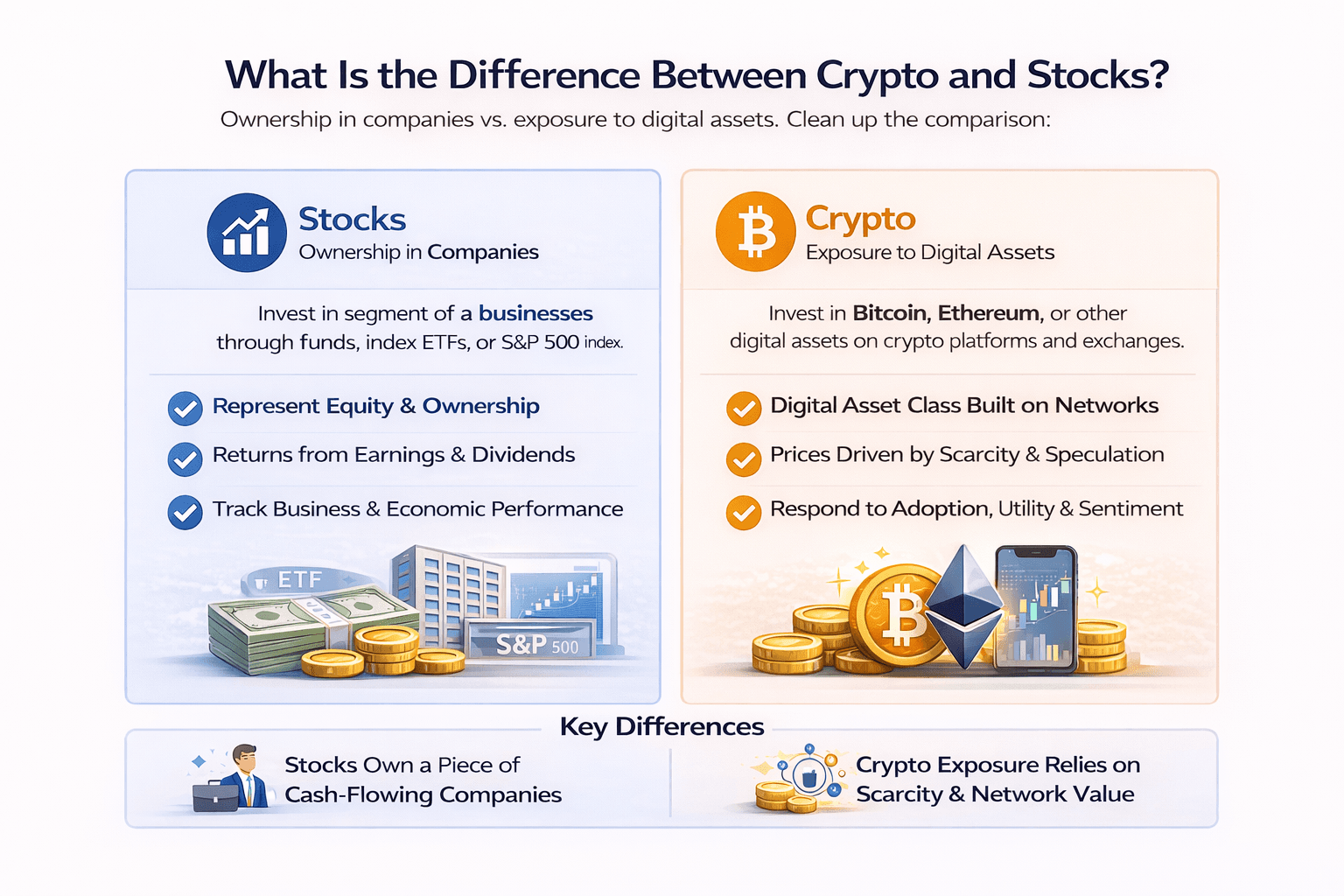
Stocks give you ownership in businesses, while crypto gives you exposure to digital assets whose value comes from a very different set of drivers.
That difference gives shape to how returns are built, how risk shows up, and why the two assets belong in different parts of a portfolio. For most readers, this is really a comparison between broad stock exposure through index funds, ETFs, or an S&P 500 fund on one side, and Bitcoin first, then maybe Ethereum on the other.
 Two Asset Classes, Two Very Different Return Engines
Stocks Represent Ownership in Companies
When you buy a stock, you own a slice of a business, and your return usually comes from some mix of earnings growth, valuation expansion, dividends, and buybacks. Most people do not build wealth by picking random single names. They do it through brokerages and diversified funds that track large parts of the market, such as the S&P 500 or other broad indexes. That setup is a big reason stocks have stayed central to long-term investing for decades.
Crypto Is a Digital Asset Class With Different Drivers
Crypto is much larger and less uniform. Bitcoin does not behave like Ethereum, and neither of them behaves like stablecoins or memecoins. Bitcoin is usually discussed through scarcity, liquidity, and store-of-value demand. Ethereum adds smart contracts, staking, and application infrastructure.
Stablecoins aim for price stability, while memecoins sit in a far more speculative tier driven heavily by attention and market mood. Unlike stocks, most crypto does not represent ownership in cash-flowing firms, so prices tend to respond more to adoption, utility, network effects, liquidity, and sentiment.
What You’re Really Comparing
“Stocks” usually means diversified exposure through S&P 500 funds, total-market ETFs, or standard brokerage investing, not a pile of concentrated bets on single companies. “Crypto” usually means Bitcoin first and, in some cases, Ethereum after that. That is a much narrower and more sensible comparison than throwing in low-liquidity altcoins or memecoins, which belong in a higher-risk category altogether. Put simply, comparing a broad Vanguard or Fidelity fund to Bitcoin is one conversation. Comparing it to speculative altcoins is a different one.
Historical Performance Which Has Delivered Better Returns?
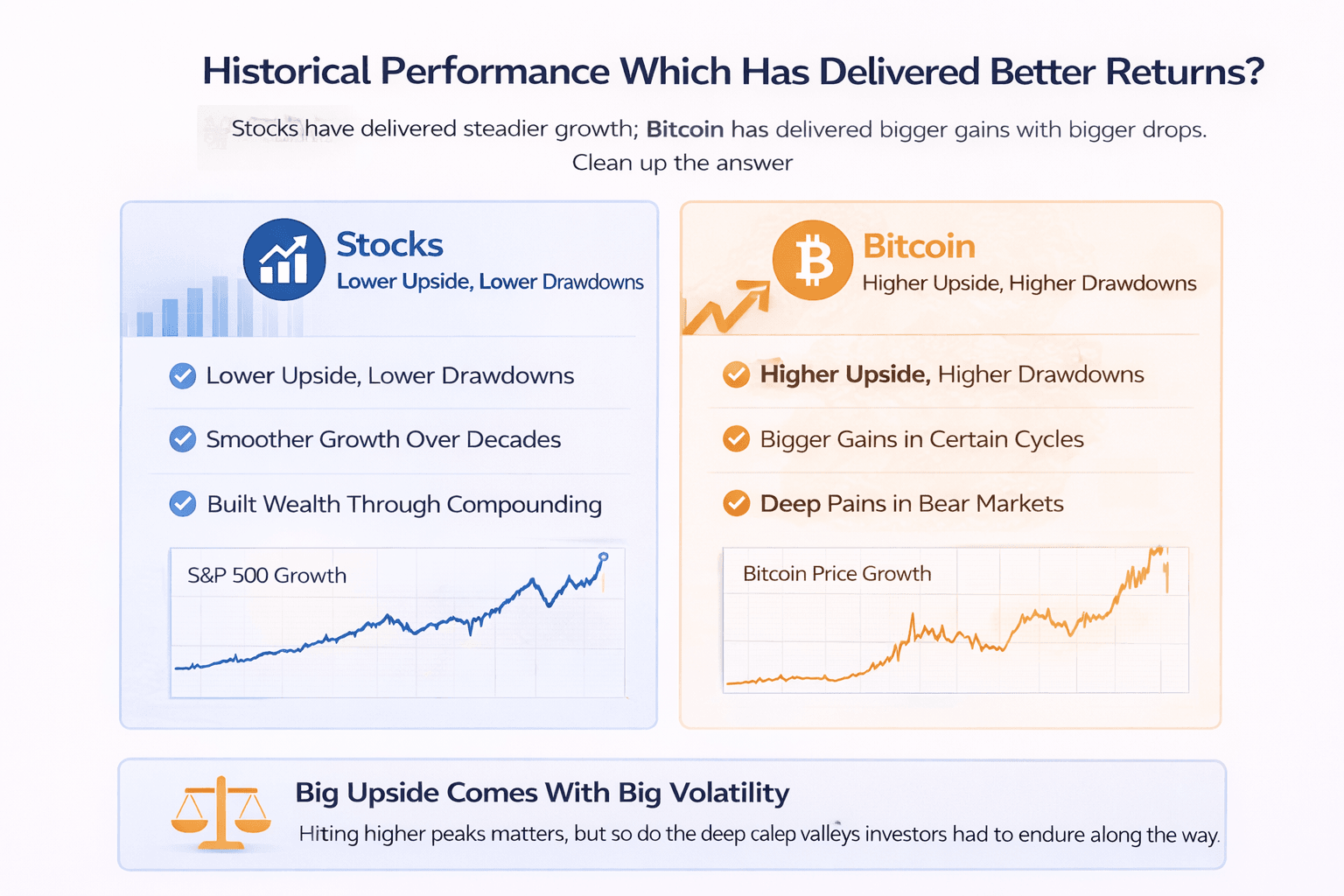
Over long stretches, stocks have built wealth in a steadier and more repeatable way. Crypto, especially Bitcoin, has delivered much bigger upside in certain cycles, but it has also come with much deeper drawdowns. That is why simple return comparisons can mislead. A portfolio is not judged only by how high it climbed in the best year. It is also judged by how much pain an investor had to absorb to stay in the trade.
 Big Gains Matter Less Without Surviving The Ride
Stocks Build Wealth Through Long-Term Compounding
Stocks have a long record of compounding wealth through business growth, dividends, and reinvestment. For most people, that means owning broad market funds tied to the S&P 500 rather than trying to outpick the market one company at a time. That consistency matters.
It is less exciting than a parabolic crypto run, but it is easier to hold through different market conditions, which is one reason stock investing remains the default core for long-term portfolios. Research from SPIVA keeps showing how hard it is for active managers to beat their benchmarks over time, which strengthens the case for low-cost index exposure.
Bitcoin Delivers Higher Upside With Far Deeper Drawdowns
Bitcoin has been the stronger asset if you measure upside alone. Its long-term gains have dwarfed stock market returns from the same starting periods. The catch is that those gains came with violent drawdowns that stocks usually do not match. Bitcoin has repeatedly fallen hard enough to shake out investors who liked the story but could not handle the path.
That is why saying crypto “performed better” without mentioning drawdowns leaves out the hardest part of owning it. Ethereum has had similar boom and bust behavior, and lower-quality altcoins have often been even more fragile. The payoff can be huge, but the ride is rough.
What Changed After the Spot ETF Era and the 2024 Bitcoin Halving
The comparison changed in a real way after the approval of spot Bitcoin ETFs in January 2024 and spot Ethereum ETF products later in 2024. Those approvals gave investors a regulated wrapper through traditional brokerages, which made crypto easier to access and easier to place next to stocks in the same portfolio.
Understand how Bitcoin Spot ETFs work before going any further on the spot ETF era.
Around the same period, the Bitcoin halving cut the block reward from 6.25 BTC to 3.125 BTC in April 2024. That did not guarantee higher prices, and it should not be treated as automatic causality, but it did reinforce Bitcoin’s supply narrative at a time when institutional access was opening up. Put together, those changes made crypto feel less fringe and more integrated into mainstream portfolio conversations, even though the asset itself stayed highly volatile.
Crypto or Stocks: Which Is Safer?
If safety is the question, stocks usually come out ahead for most investors.
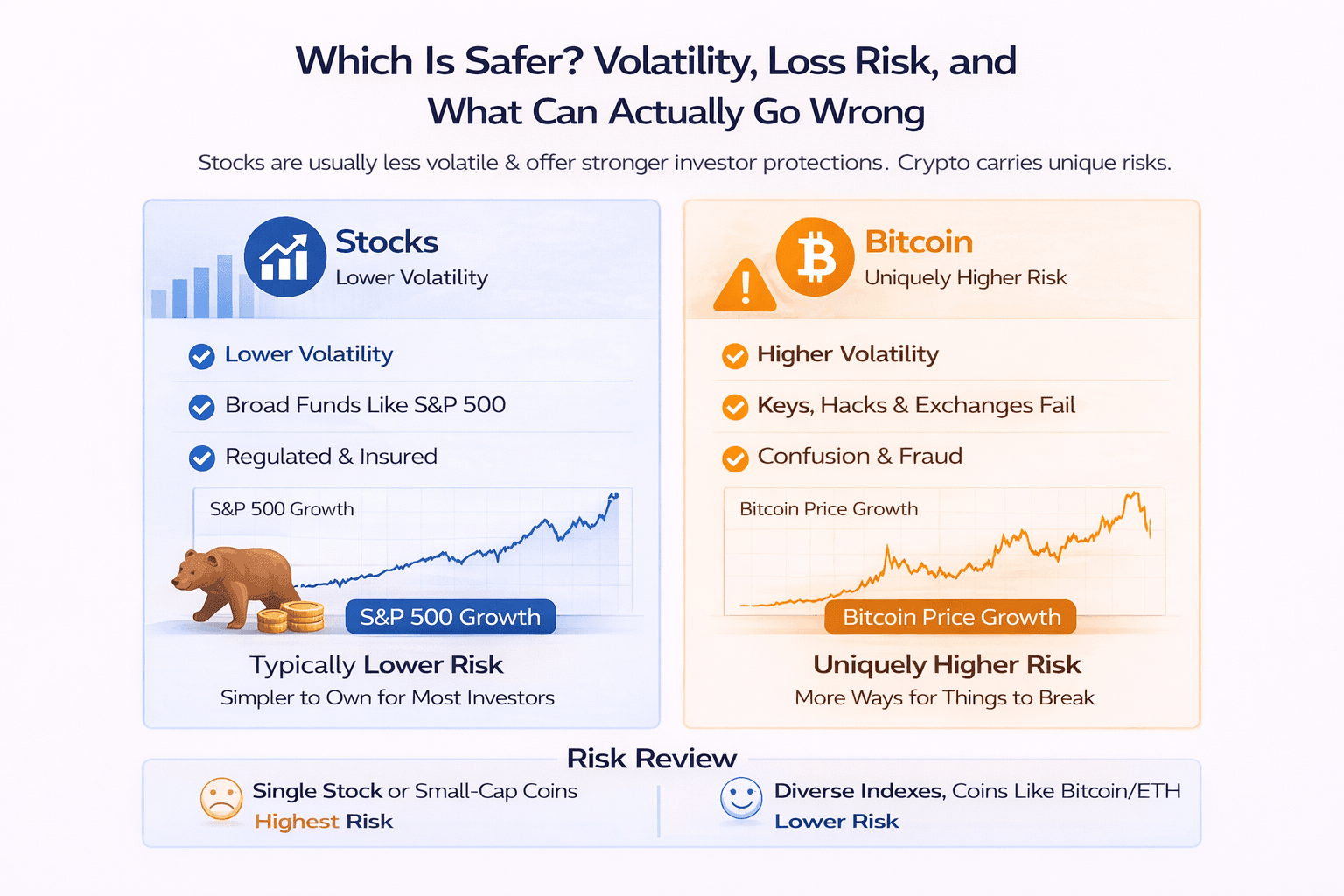
That does not mean stocks are risk-free. It means the usual way people buy them, especially through an S&P 500 ETF or index fund, tends to bring lower volatility, stronger investor protections, and fewer ways to lose money through user error. Crypto can offer a stronger upside, but it adds more moving parts and more ways for things to break.
 Safer Usually Means Fewer Ways To Blow Up
Stocks Usually Carry Lower Volatility
Stocks can fall hard. Bear markets happen, and even the S&P 500 can go through ugly stretches.
Still, broad stock funds are usually less volatile than crypto. That matters because volatility is not just a number on a chart. It affects behavior. The deeper and faster an asset drops, the more likely investors are to sell at the wrong time and lock in losses.
Crypto Adds Unique Risks Stocks Do Not Have
Crypto brings risks that stocks usually do not. If you use self-custody, you are responsible for your private keys, wallet backup, and basic security. If you lose access, there is often no recovery path. If you leave assets on an exchange, you take on platform and custody risk instead.
That is only part of it. Crypto investors can also face exchange failures, smart contract risk, token blowups, and sudden liquidity drops in smaller assets. FINRA warns that crypto assets can be exceptionally risky and volatile, and that they often do not come with the same regulatory protections investors get in stocks and bonds.
Hardware wallets such as Ledger and Trezor can reduce exchange risk, but they do not remove user responsibility.
Safety Depends on What You Actually Buy
Buying a diversified index fund is very different from buying a single stock. In the same way, buying Bitcoin is very different from buying thinly traded altcoins. This logic gets missed all the time.
So the better comparison is vehicle against vehicle. A multi-stock ETF is usually safer than a single stock. Bitcoin is usually less fragile than small-cap tokens. Once you compare at that level, the picture gets much clearer. For most people, the safer path still sits on the stock side.
Regulation and Investor Protection
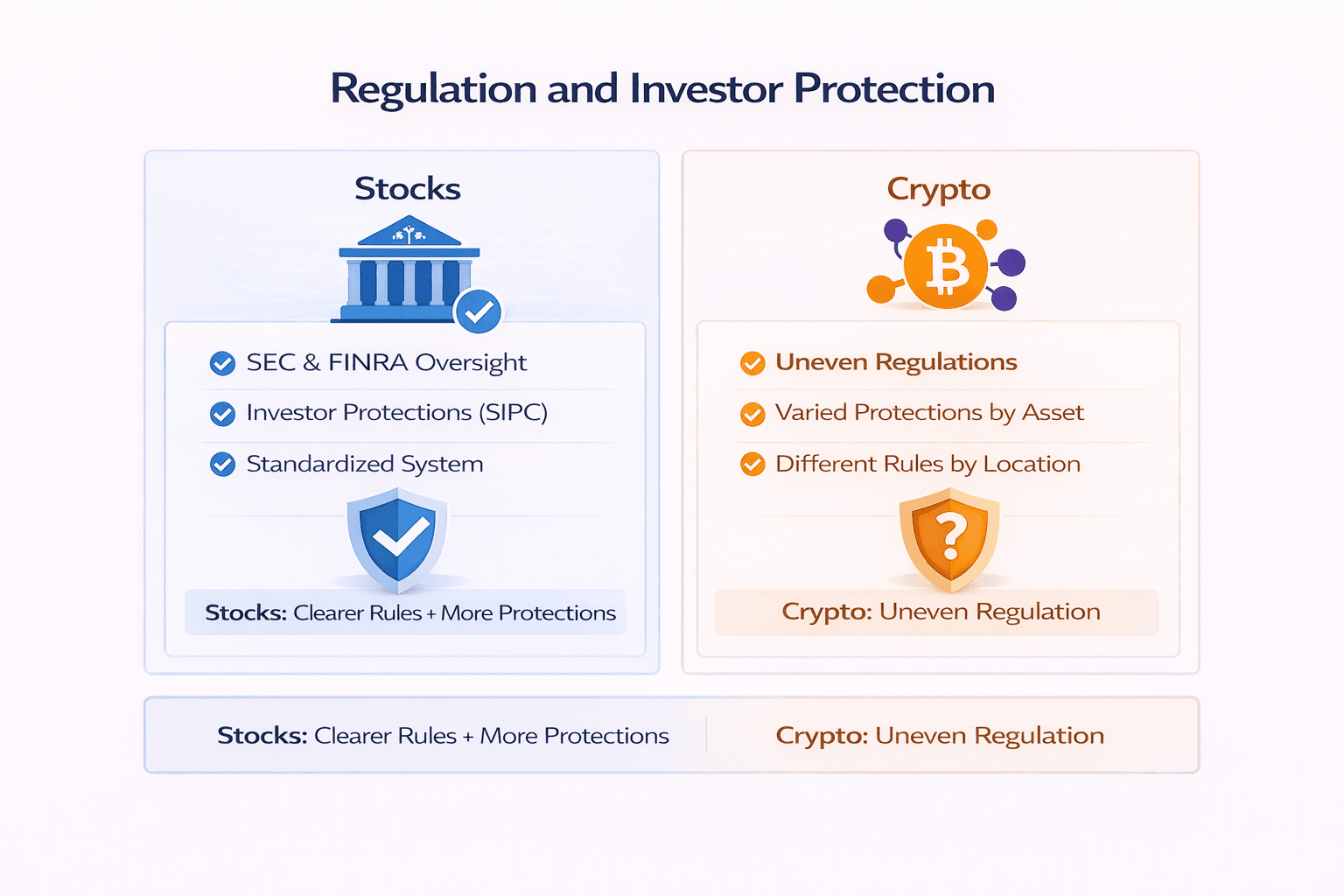
Stocks still have the cleaner edge on regulation and investor protection. They sit inside a long-established system built around disclosure, market oversight, brokerage rules, and customer protection. Crypto has moved closer to that world than it was a few years ago, especially after the arrival of spot Bitcoin ETFs and spot Ethereum ETF products, but it is still less uniform and much more dependent on the asset, the platform, and the jurisdiction.
 Rules Affect Risk More Than Most Investors Realize
Stocks Operate Inside a Mature Regulatory Framework
Stocks trade inside a structure shaped by the SEC, FINRA, exchange rules, and brokerage standards. Public companies follow disclosure requirements, broker-dealers follow conduct and custody rules, and investors usually hold assets through regulated brokerage accounts rather than managing keys or wallets themselves. That does not remove market risk, but it does make the system more standardized and easier to understand.
There is also a clearer protection layer when a brokerage firm fails. SIPC can protect customer securities and cash within set limits if a member brokerage collapses, even though it does not protect against normal market losses. That kind of backstop shapes the investor experience in a way that crypto still does not fully match.
Crypto Regulation Has Matured, But It Is Still Uneven
Crypto is more regulated than it was in the early days, but the rulebook is still uneven. Some activity now sits inside clearer wrappers, especially through BlackRock and Fidelity spot ETF products held in brokerage accounts. That helped bring crypto exposure into a more familiar investment channel and gave many investors a way to avoid direct self-custody.
Even so, crypto regulation still depends heavily on what the asset is and how it is being offered. FINRA makes this plain. Federal securities laws and FINRA rules apply when a crypto asset is treated as a security, but not every token or service fits neatly into the same bucket. That leaves investors with a market that is more mature than before, though still less standardized than stocks.
Why Regulation Changes the Investor Experience
This difference matters most for beginners and for people building retirement-style portfolios. On the stock side, stronger reporting standards, clearer custody arrangements, and a more familiar brokerage workflow reduce friction and the chance of making a costly operational mistake.
On the crypto side, investors often carry more responsibility. They may need to think about exchange selection, wallet security, custody setup, and product-specific risks on top of price volatility. ETF access has made crypto easier to buy, but it has not made crypto risk feel like stock risk. That gap is still real, and it is one reason stocks remain the easier default for most people.
Crypto ETFs vs Stock ETFs: The New Middle Ground
Crypto ETFs changed the comparison in a big way. Investors can now get Bitcoin and Ethereum exposure through a regular brokerage account, which makes crypto much easier to place next to stocks in the same portfolio. That is a real shift in access. It lowers the friction around wallets, private keys, and direct self-custody. It does not change the fact that the underlying asset is still crypto.
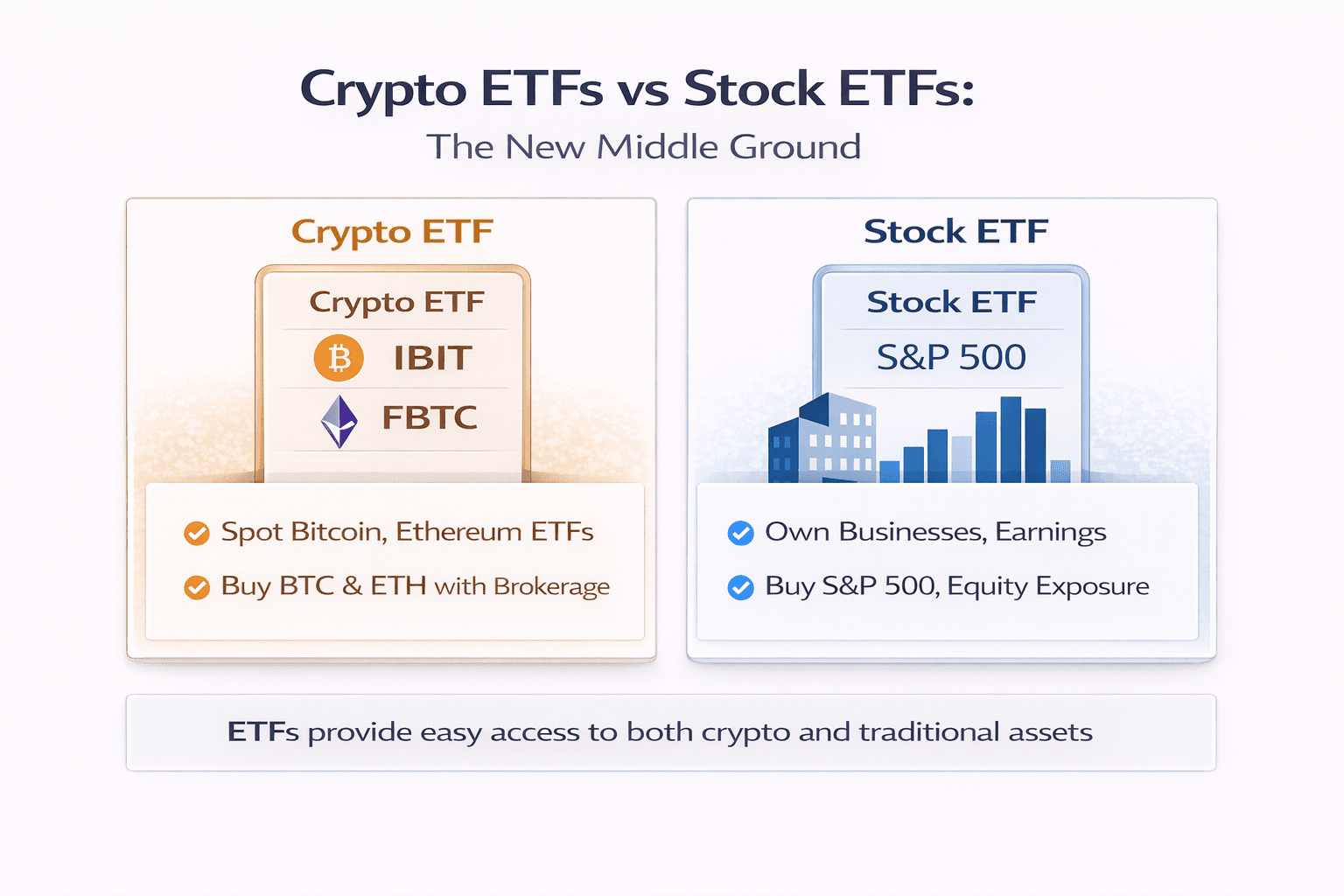 ETFs are Same Wrapper, Very Different Assets Underneath
Spot Bitcoin and Ethereum ETFs Changed Access
The biggest change is convenience. Products like IBIT, FBTC, and Fidelity’s crypto fund lineup let investors buy crypto exposure through the same kind of brokerage setup they already use for stocks and ETFs. For many people, that removes the need to open a crypto exchange account or manage coins directly.
That matters because access shapes behavior. Once crypto sits inside a standard brokerage workflow, it becomes easier to compare it directly with stocks, easier to track, and easier to size as part of a normal portfolio allocation. The SEC’s 2024 approvals did not turn crypto into a stock-like asset, but they did give it a more familiar wrapper.
Why Stock ETFs Still Work Differently
Stock ETFs still do a different job. A plain index fund or equity ETF usually holds productive assets tied to real companies, earnings, and cash flows. When you buy an S&P 500 fund, you are buying exposure to businesses that generate revenue, report earnings, and in many cases return cash through dividends or buybacks.
A spot Bitcoin ETF does not do that. IBIT is designed to track the price of bitcoin, and FBTC is built for the same basic purpose. These funds give price exposure, not ownership in operating businesses. That is the core difference, and it matters more than the shared ETF label.
ETF Access Is Easier, But It Does Not Erase Risk
The ETF wrapper makes crypto easier to buy. It does not make crypto less volatile. BlackRock’s own IBIT page says the fund seeks to reflect the price of bitcoin, and Fidelity says FBTC is meant for investors with a high risk tolerance and warns that bitcoin is highly volatile and could become illiquid. That is the key point. Regulated access is easier access, not safer price behavior.
There is also a distinction in custody worth keeping in mind. With a crypto ETF, investors usually avoid direct self-custody because the fund handles the asset storage through institutional custody arrangements. That reduces one kind of operational risk.
It does not remove market risk, and it does not turn bitcoin or ether into the same kind of holding as a stock ETF from Vanguard, BlackRock, or Fidelity. For most investors, crypto ETFs are best understood as a cleaner access point to a volatile asset class, not a replacement for core stock exposure.
Income Generation Dividends vs Staking
If you want income that is easier to understand, measure, and hold over time, stocks have the stronger case. If you want yield from crypto, you need to be more careful about where that yield comes from and what risks sit behind it.
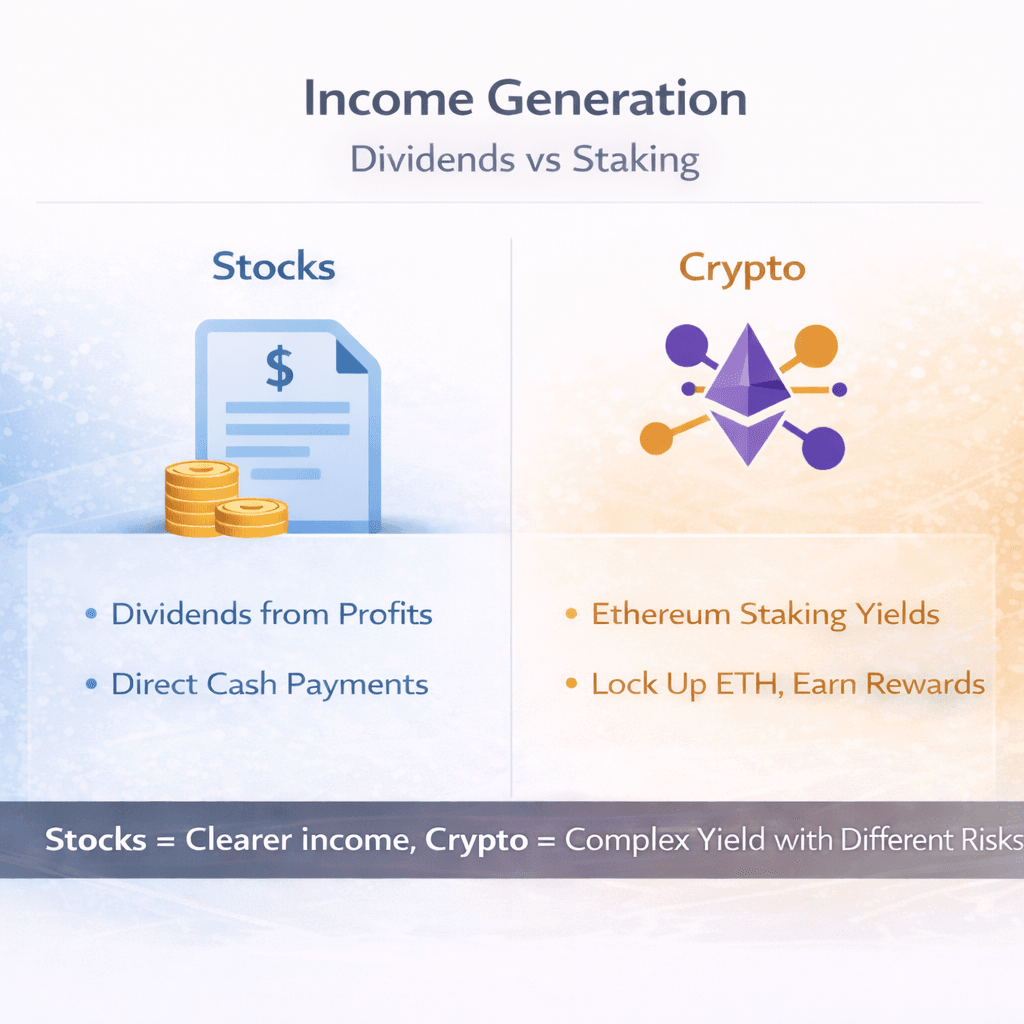 Yield Means Different Things On Each Side
Stocks Can Produce Cash Flow Through Dividends
Stocks can return value through dividends and buybacks. Dividends are direct cash payments to shareholders, while buybacks reduce the share count and can support per-share value over time.
Not every stock pays dividends, so this is not a universal feature. Still, income investing is a real stock-side advantage because the source of return is easier to trace back to business earnings, cash flow, and capital allocation decisions. That makes the income stream more familiar and usually easier for regular investors to evaluate.
Crypto Income Exists, But It Works Differently
Crypto income exists, but it is not the same kind of thing. On Ethereum, staking means locking up ETH to help validate the network and earn rewards in return. Validators stake ETH, run validator software, process transactions, and can earn new ETH for doing that work.
That means staking yields are tied to protocol rules and validator participation, not to business profits in the way dividends are. It can still be useful for long-term holders, but it comes with extra layers such as validator setup, lockup or withdrawal mechanics, and platform risk if the investor uses a third party instead of staking directly.
Why Yield Quality Matters More Than Yield Size
A higher yield number does not automatically mean a better income asset.
Stock income is usually easier to analyze because it sits inside a more familiar reporting system. Crypto yield often brings extra operational, protocol, or counterparty risk, especially when the yield comes through platforms rather than direct network participation. Tax treatment can add another layer, since the IRS treats income from digital assets as taxable.
So if the goal is simple and dependable income, stocks still have the cleaner edge. Crypto yield can make sense, especially through Ethereum staking, but it should be treated as a different kind of income with a different risk profile.
Tax Treatment: How Crypto and Stocks Differ
At a high level, both stocks and crypto can trigger capital gains when you sell at a profit. The difference is in the details. Stock taxes are usually easier to track because brokerage reporting is more standardized. Crypto taxes can get messier once wallets, transfers, staking, and multiple venues are involved.
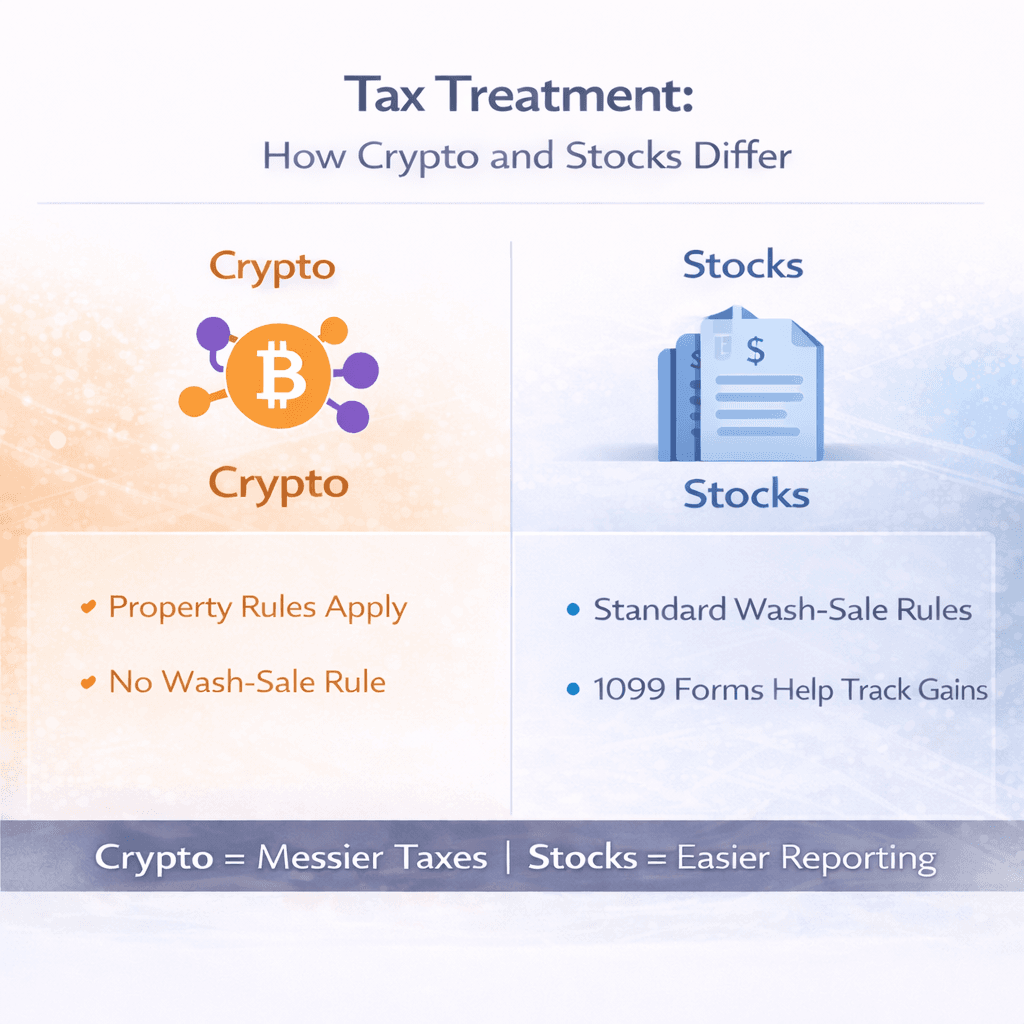 Returns Look Different After Taxes Enter The Picture
Both Can Trigger Capital Gains Taxes
In the U.S., both stocks and digital assets can create taxable gains or losses when they are sold or exchanged. The IRS treats digital assets as property, which means general tax principles apply to crypto transactions too. Gain or loss depends on the sale price versus your adjusted cost basis, and those transactions are generally reported on Form 8949 and Schedule D.
That said, local rules matter. This section is general education, not tax advice, and anyone dealing with cross-border activity, frequent trading, or complex crypto flows should check the rules that apply in their own jurisdiction. The U.S. framework is useful for comparison, but it is not universal.
Why the Wash-Sale Rule Matters in the U.S.
This is one of the most practical differences for active investors. The IRS wash-sale rule applies to stocks and securities sold at a loss when you buy substantially identical stock or securities within 30 days before or after the sale. That can block a tax loss that an investor expected to claim.
Crypto has historically been treated differently in the U.S. because digital assets are generally taxed as property, not stock or securities. That is why many investors have viewed crypto as outside the standard wash-sale restriction, even though tax rules can change, and the reporting landscape is getting tighter. The IRS’s newer Form 1099-DA instructions show how digital asset reporting is becoming more formal, which makes this an area worth watching closely.
Recordkeeping Is Usually Harder in Crypto
Stock investors usually get cleaner brokerage statements, cost basis information, and year-end tax documents. That does not remove the need for care, but it makes recordkeeping much more manageable for most people.
Crypto is harder to track because activity can spread across exchanges, wallets, and on-chain transactions. The IRS says taxpayers must report digital asset transactions, whether or not they receive an information form, and staking rewards can create taxable income, too. Once wallet transfers, staking, or multiple platforms get involved, the paper trail gets harder to manage than a standard stock account.
Which Is Better for Beginners?
For most beginners, stocks are the easier starting point. Buying a diversified ETF or index fund tied to the S&P 500 is simpler, more familiar, and easier to hold for years without constant decision-making. Crypto can still have a place, but the learning curve is steeper, and the price swings are harder to sit through. That is why beginners usually do better when stocks form the base and crypto stays small.
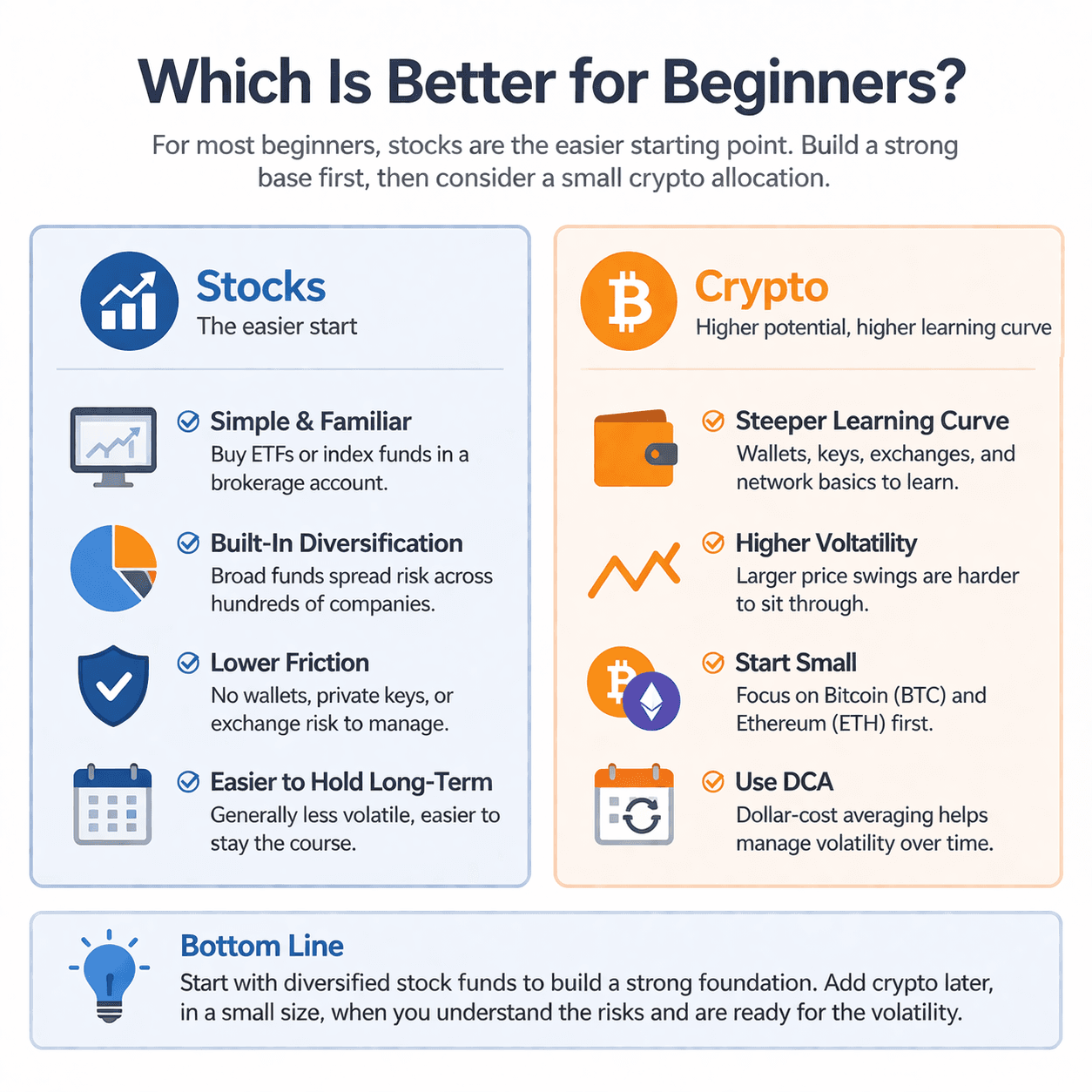 Starting Simple Usually Beats Starting Exciting
Why Stocks Are Usually the Better Starting Point
Stocks usually win for beginners because the setup is easier and the structure is more forgiving. Broad funds spread risk across many companies, which reduces the damage a single holding can do. SEC and FINRA investor materials both point beginners toward diversification and explain that funds and ETFs are common ways to get it. That makes stock investing easier to understand and easier to stick with over the long run.
There is also less operational friction. Opening a Vanguard, Fidelity, or Robinhood brokerage account and buying a market fund is usually more straightforward than learning wallets, transfers, private keys, and exchange risk. For a beginner, that simplicity matters because fewer moving parts usually mean fewer avoidable mistakes.
When Crypto Can Still Make Sense for a Beginner
Crypto can still make sense for a beginner, but only in a smaller role. If someone wants exposure, the cleanest starting point is usually Bitcoin and maybe Ethereum, not a basket of speculative altcoins. Even Coinbase’s beginner education splits the space this way by treating Bitcoin and Ethereum as the main entry points into understanding crypto before moving into more complex territory.
That smaller size matters because crypto remains much more volatile than stock funds. A beginner can handle that better when crypto is an add-on rather than the whole plan. Once the allocation is small, the investor gets exposure without making every portfolio move depend on a highly volatile asset class.
A Simple Beginner Framework
A practical beginner framework is simple. Start with core stock exposure through diversified funds. Add crypto only if you are comfortable with higher risk and sharper drawdowns. Then use DCA instead of trying to time entries perfectly. Coinbase describes dollar-cost averaging as a strategy that spreads purchases over time to reduce the impact of volatility, and that logic applies especially well to beginners.
So if the question is where to begin, stocks usually deserve the first allocation. Crypto can come later, in a smaller size, once the investor understands the risk tolerance needed to hold it properly.
How Much Crypto vs Stocks Should You Hold?
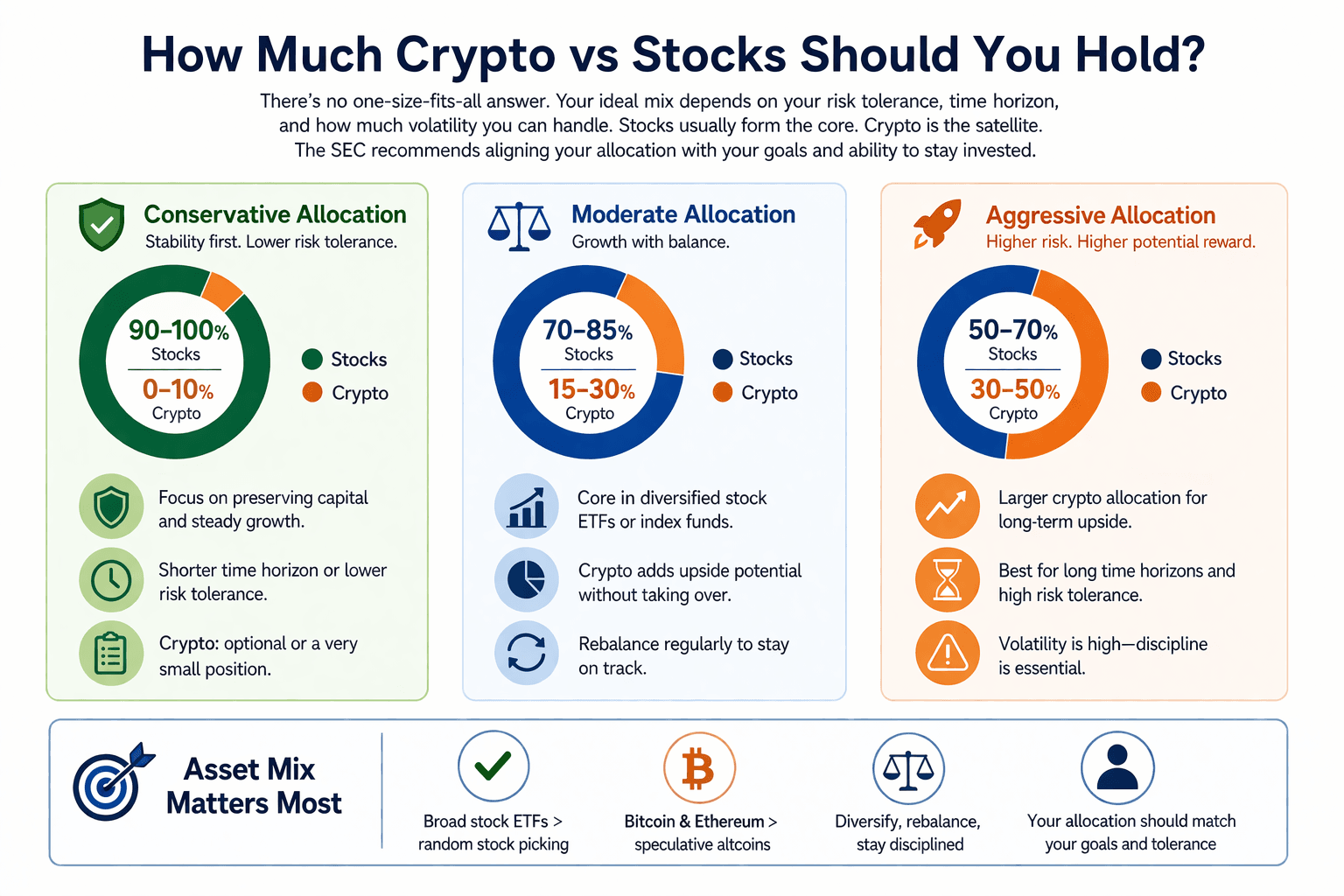
There is no universal split that works for everyone. The right allocation depends on risk tolerance, time horizon, and how much volatility you can handle without changing course at the worst moment.
The useful rule is simpler than most allocation debates make it sound. Stocks usually carry the core load, while crypto works better as a smaller sleeve for investors who want extra upside and can live with deeper drawdowns. The SEC’s asset allocation guidance makes the same basic point in broader terms. Your mix should reflect your goals, your timeline, and your ability to stay invested through market stress.
 Allocation Matters More Than Bold Market Opinions
Conservative Allocation
A conservative mix usually means stocks do most of the work, with little or no crypto. This suits investors with lower risk tolerance, shorter patience for drawdowns, or a stronger preference for stability over upside.
That does not mean zero ambition. It means the portfolio is built to be easier to hold. Vanguard’s investor questionnaire frames allocation around risk tolerance, experience, time horizon, and financial situation, which is the right way to think about this. If crypto is included here at all, it is usually a very small position rather than a defining feature of the portfolio.
Moderate Allocation
A moderate mix is where the comparison becomes more practical for many readers. Stocks remain the clear majority, often through index funds or ETFs, while crypto sits in a smaller sleeve.
This setup works for investors who want asymmetric upside without making crypto the engine of the whole portfolio. It gives exposure to Bitcoin and maybe Ethereum while keeping the base of the portfolio tied to more stable compounding assets. That balance also makes rebalancing easier when crypto moves sharply in either direction. Fidelity’s guidance on diversification and rebalancing supports this kind of disciplined approach.
Aggressive Allocation
An aggressive mix can hold a larger crypto slice, but for most people, it still stays stock-heavy. Aggression does not mean recklessness. It means taking more risk with intention and knowing that deeper volatility comes with the deal.
This kind of mix suits investors with a long time horizon, higher risk tolerance, and enough discipline to avoid panic-selling through sharp drawdowns. Even then, quality matters. A larger allocation to Bitcoin and Ethereum is one thing. Loading up on thin altcoins is another. A portfolio can be aggressive without becoming random.
Asset Mix Matters More Than Labels
This is the part that matters most. A portfolio is not “safe” just because it owns stocks, and it is not automatically smart just because it owns crypto. Broad stock ETFs usually make more sense than random stock picking for most people. In the same way, Bitcoin and Ethereum sit in a very different risk bucket from speculative altcoins.
That is why asset quality matters more than labels. Diversification, rebalancing, and a realistic view of risk tolerance usually matter more than chasing a perfect percentage. If the stock side is weak and the crypto side is chaotic, the allocation number will not save the portfolio.
Liquidity, Trading Hours, and Ease of Access
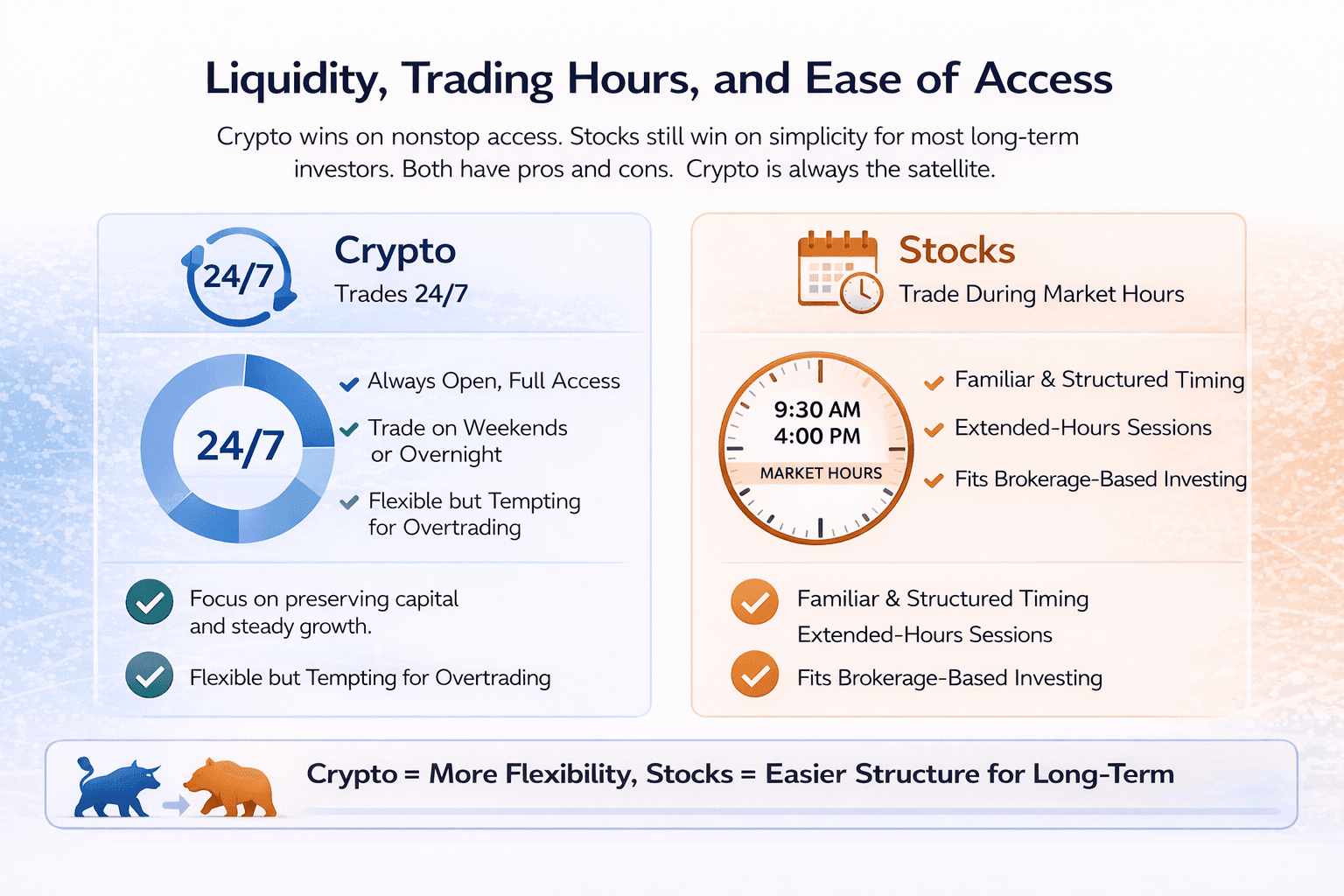
Crypto wins on nonstop access. Stocks still win on simplicity for most long-term investors.
That gap has narrowed, especially now that crypto ETFs sit inside normal brokerage accounts, but the experience is still different. Crypto is always open, which gives investors more flexibility. Stocks run through a more structured market system, which is less flexible but often better suited to disciplined long-term investing.
 Access Is Easier Now, But Still Uneven
Crypto Trades 24/7
Crypto markets do not close. Trading can happen on weekends, overnight, and during periods when stock markets are shut. That gives investors full-time access and makes crypto easier to react to in real time. Coinbase highlights this always-on structure across its crypto markets, and its derivatives arm began offering regulated 24/7 futures trading in 2025.
That flexibility has a downside, too. Constant access can make overtrading easier. When the market never closes, the temptation to react to every move gets stronger, especially for newer investors. For long-term portfolio building, nonstop access is not always an advantage in practice.
Stocks Trade During Market Hours
Stocks trade inside set market hours. Robinhood notes that regular U.S. stock market hours run from 9:30 a.m. to 4:00 p.m. ET, with extended-hours windows before and after the session. That structure is less flexible than crypto, but it is familiar and easier to manage for investors using brokerages, retirement accounts, and ETF-based portfolios.
That setup also fits the way many people actually invest. Vanguard’s ETF material centers around brokerage-based investing and standard order handling for stocks and ETFs, which works well for people building long-term positions instead of trading around the clock.
Accessibility Is Now Closer Than It Used to Be
The access gap is smaller than it was a few years ago. Crypto is still easy to reach through platforms like Coinbase and Robinhood, but ETF wrappers now let investors buy crypto exposure through the same kind of brokerage flow used for stocks. At the same time, stock investing remains simple through ETFs and index funds that trade on major exchanges.
So access is closer, but not identical. Crypto gives more flexibility and more hours. Stocks still offer the cleaner setup for many mainstream investors, especially those focused on long-term investing rather than constant trading.
Why Some Investors Still Prefer Crypto
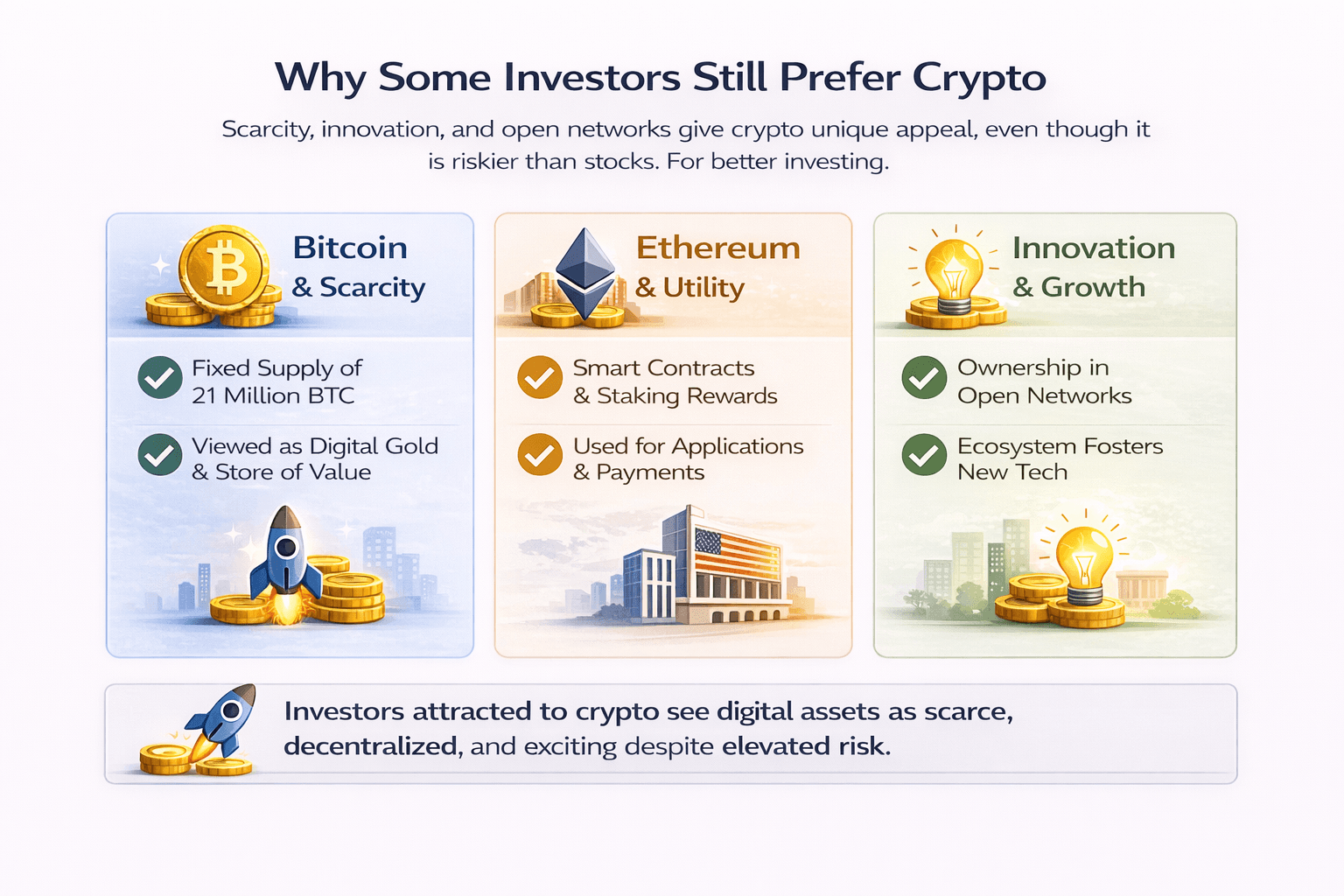
Crypto still appeals to a certain kind of investor because it offers something stocks do not. The case is not just about price. It is about owning an asset class built around scarcity, open networks, and digital infrastructure. That case can be overstated, and often is, but it is not imaginary. Bitcoin and Ethereum gave crypto a clearer identity than the market had a few years ago, which is why some investors still choose to keep exposure even when stocks remain the safer core holding.
 The Crypto Case Goes Beyond Pure Speculation
Bitcoin’s Appeal
Bitcoin’s main appeal starts with supply. Bitcoin.org states that only 21 million bitcoins will ever be created, and that fixed cap is a big part of why many holders view it as a scarce digital asset rather than just another speculative trade. That is where the digital gold thesis comes from. Some investors see Bitcoin as an alternative store of value that sits outside the normal company earnings cycle and outside direct central control.
That does not make the thesis automatically correct, and it definitely does not make Bitcoin stable. Still, it explains why some investors treat Bitcoin differently from equities. A stock gives exposure to a company and its future earnings. Bitcoin gives exposure to a scarce network asset whose value depends on adoption, liquidity, market trust, and long-term belief in its role.
Ethereum Extends the Case Beyond Pure Price Exposure
Ethereum pushes the case further by adding utility. Ethereum.org describes smart contracts as programs that run on the Ethereum blockchain, and ETH itself powers transactions on the network and helps secure it through staking. That gives Ethereum a wider role than pure price speculation, because investors are also buying into a network used for applications, payments, and on-chain activity.
Staking adds another layer. Ethereum’s official staking documentation explains that validators stake ETH, help process transactions, and earn rewards for helping secure the network. That gives ETH holders a form of network-linked yield, which is different from stock dividends but still matters for people who want exposure to crypto infrastructure rather than just a trade.
Innovation Is Real, but It Is Not a Free Pass
This is where the section needs some restraint. Crypto does have real innovation behind it. Bitcoin introduced a scarce digital asset without a central issuer, and Ethereum created a programmable blockchain environment built around smart contracts and staking. Those are genuine features, not marketing slogans.
But innovation does not cancel risk. Ethereum’s own security guidance warns users to be careful when interacting with smart contracts, and staking itself comes with technical and operational demands. More broadly, even strong networks can still face valuation risk, execution risk, and regulatory risk. So the crypto case is real, but it only makes sense when it is held with clear eyes and sized like a high-risk part of a portfolio rather than a guaranteed winner.
To better understand how crypto returns actually work in practice:
- Build a clearer view on whether crypto actually belongs in your portfolio (adds context, not a direct allocation rule)
- Understand how Bitcoin generates returns across different strategies (including higher-risk approaches)
- Learn how crypto trading works before taking execution risk (important if you plan to actively trade)
- See how crypto ETFs fit into a traditional brokerage portfolio setup (easier access, same volatility underneath)
- Start with a structured breakdown of crypto investing basics and positioning (use as a base, not a full strategy)

Verdict: Crypto or Stocks?
For most people, stocks are still the better first choice. They are easier to understand, easier to hold, and easier to build around for long-term investing. A portfolio built on ETFs, index funds, and S&P 500 exposure gives investors a cleaner path to compounding, stronger investor protections, and fewer operational risks. Crypto has earned a place in modern portfolios, especially after the rise of products like IBIT, but it still behaves like a high-volatility asset class rather than a core substitute for stocks.
Stocks Are Better for Most Investors
Stocks are better for beginners, better for long-term core allocation, and better for people who want lower-volatility compounding with less day-to-day decision-making.
That edge comes from structure as much as returns. The SEC’s investor guidance frames asset allocation around time horizon and risk tolerance, while Vanguard’s education on index funds keeps pointing back to simple, diversified investing as a practical foundation. For most readers, that is still a sounder starting point than trying to build a portfolio around crypto first.
Crypto Can Improve a Portfolio
Crypto can still improve a portfolio when it is used in the right role. Bitcoin brings a different risk and return profile from stocks, and Ethereum adds exposure to a network built around smart contracts and staking.
That upside comes with a cost. BlackRock states that IBIT is designed to track the price of bitcoin, not own productive businesses, and Ethereum’s own documentation makes clear that staking involves validator responsibilities and network-specific mechanics. So crypto works best as a smaller satellite position for investors who understand the downside, not as a replacement for a stock portfolio.
The Practical 2026 Takeaway
If you are choosing one place to start, stocks usually win.
If you are building a modern diversified portfolio, both can coexist. Stocks should usually carry the main compounding load. Crypto can sit beside them in a smaller size for investors with the risk tolerance to handle sharp drawdowns and a reasoned case for owning Bitcoin or Ethereum. What this comes down to is simple. Crypto can complement a portfolio. For most readers, it should not replace one.