Zcash is a privacy-focused cryptocurrency that lets users choose between public and shielded transactions. Its main promise is private payments on a public blockchain, but that privacy only works when users choose the right wallet, address type and transaction path.
This guide explains what Zcash is, how shielded transactions work, which wallets actually support private ZEC, and why Zcash privacy depends as much on user habits as on cryptography.
Editor's Note (July 4, 2026): We fully updated this guide in July 2026 to reflect the current Zcash ecosystem. We expanded our coverage of shielded vs transparent transactions, privacy best practices, unified addresses, view keys, wallet and exchange support, tokenomics, mining, network health, regulatory considerations and the June 2026 Orchard vulnerability. We also added clearer comparisons with Monero, Bitcoin and Dash, strengthened the guidance on who Zcash is best suited for, and rewrote the article to better explain how Zcash privacy works in practice, not just in theory.
What Is Zcash? Quick Answer
Zcash is a proof-of-work cryptocurrency with a 21 million ZEC supply cap and optional shielded payments. It uses zero-knowledge proofs, known as zk-SNARKs, to let users make private transactions when their wallet, exchange and transaction path support shielded ZEC.
Key Takeaways on Zcash
-
Zcash is privacy-optional ZEC transactions can be transparent or shielded, so privacy depends on how the user sends, receives and stores funds.
-
Shielded transactions hide key payment details When used correctly, shielded Zcash transactions can hide the sender, receiver and amount while still proving that the transaction is valid.
-
zk-SNARKs power Zcash privacy Zcash uses zero-knowledge proofs to verify shielded transactions without making every payment detail public on-chain.
-
Zcash has Bitcoin-style monetary design The network uses proof-of-work mining, has a fixed 21 million ZEC supply cap and follows a halving-style issuance schedule.
-
Wallet choice is critical Many wallets support transparent ZEC, but fewer support shielded ZEC properly. Zodl, formerly Zashi, is built around shielded ZEC use.
-
Exchange support can be uneven Some exchanges list ZEC but only support transparent deposits or withdrawals, which can limit private-use workflows.
-
Privacy depends on transaction habits Fully shielded z→z transactions offer the strongest privacy, while transparent and mixed flows can leave linkable patterns.
-
View keys support selective disclosure Zcash can let users keep payments private from the public chain while still sharing records with accountants, auditors or other chosen parties.
-
Regulatory pressure affects access Privacy coins can face delistings, regional restrictions and stricter exchange rules, even when holding or using the asset is legal.
-
Zcash is powerful, but not automatic The privacy tools are serious, but users need compatible wallets, careful transaction paths and good privacy hygiene to benefit from them.
Best For
- Users who want optional privacy
- Users who need selective disclosure or auditability
- People who want a Bitcoin-like asset with shielded payment features
- Privacy-aware users willing to learn safe transaction habits
Not Best For
- Users who want privacy by default with no setup
- Users who need maximum exchange availability
- Beginners who do not want to think about address types
- Anyone expecting all wallets and exchanges to support shielded ZEC
Disclaimer
This guide is for educational purposes only and is not financial advice.
Disclosure
Some links in this guide may be affiliate links. If you choose to use a service through these links, we may earn a commission at no additional cost to you.
Zcash At A Glance
Zcash combines Bitcoin-style monetary design with optional shielded payments. The network launched in 2016, uses proof-of-work, and has a fixed supply cap of 21 million ZEC, but its privacy model is the feature that gives it a separate identity from ordinary transparent blockchains.
| Item | Zcash Detail |
|---|---|
| Ticker | ZEC |
| Launch Year | 2016 |
| Supply Cap | 21 million ZEC |
| Consensus | Proof-of-work |
| Mining Algorithm | Equihash |
| Privacy Model | Optional privacy |
| Default Transaction Reality | Transparent unless the user chooses shielded tools and the wallet supports them |
| Core Privacy Technology | zk-SNARKs |
| Main Address Types | Transparent, shielded and unified |
| Best-Known Wallet | Zashi, now rebranded as Zodl |
| Hardware Wallet Caveat | Transparent and shielded support varies by device and wallet integration |
| Main Risk | Privacy depends on user behavior and platform support |
Zcash is not run by one organization. Electric Coin Company helped launch and continues to support Zcash development, while the Zcash Foundation, Zcash Community Grants and independent contributors all play roles in the ecosystem.
How Zcash Privacy Works
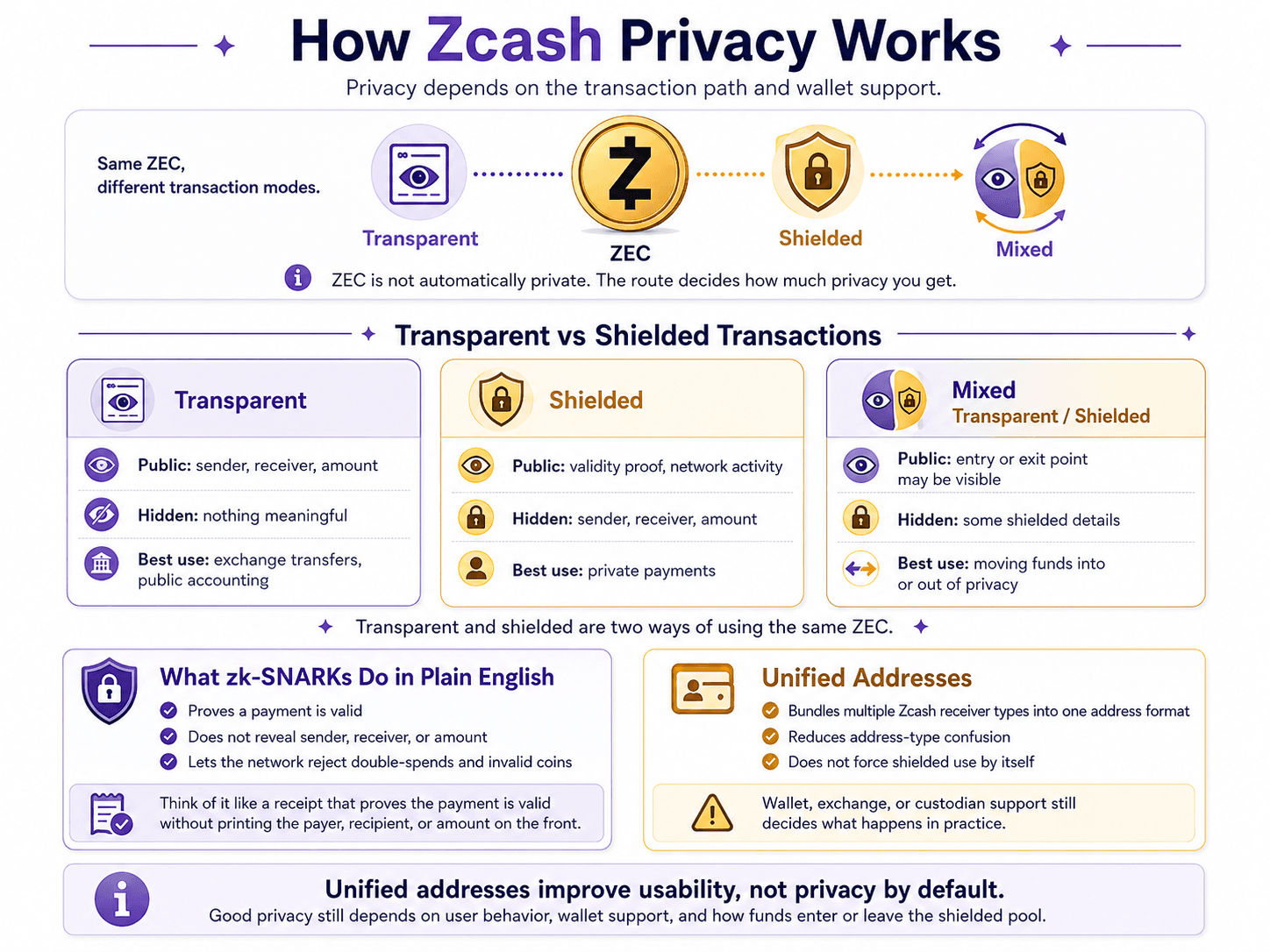
Zcash privacy works by giving users different transaction modes. Some transactions look public, similar to Bitcoin. Others use zero-knowledge proofs to confirm that the payment is valid without exposing the payment details.
 Public Chains Can Still Support Private Payments
Transparent Vs Shielded Transactions
Transparent Zcash transactions work like Bitcoin transactions. Sender, receiver and amount can be viewed on-chain. Shielded Zcash transactions hide those details while still allowing the network to check that the transaction is valid.
| Transaction Type | What Is Public? | What Is Hidden? | Best Use |
|---|---|---|---|
| Transparent | Sender, receiver and amount | Nothing meaningful | Exchange transfers and public accounting |
| Shielded | Validity proof and network activity | Sender, receiver and amount | Private payments |
| Mixed Transparent/Shielded | Entry or exit point may be visible | Some shielded details | Moving funds into or out of privacy |
Transparent and shielded Zcash are not two different type of coins. They are just two ways of using ZEC. The same asset can move from transparent to shielded, from shielded to transparent, or remain inside the shielded pool.
A user who receives ZEC to a transparent address and later shields it has improved privacy from that point onward, but the original transparent receipt is still public. A user who later sends the same amount back to a transparent address may create a link that weakens the privacy benefit.
What zk-SNARKs Do
zk-SNARKs allow Zcash to prove that a transaction follows the rules without showing the transaction details. The network can check that coins are not being double-spent or created improperly, while the sender, receiver and amount remain hidden in a shielded transaction.
The cryptography is complex. The purpose is simple: prove validity without exposing payment details. Zcash does not need every transaction detail to be public for the network to reject invalid transactions.
A zero-knowledge proof works like a private receipt: it proves the payment is valid without exposing the payer, recipient or amount.
Unified Addresses And Why They Exist
Unified addresses reduce address-type confusion by bundling different Zcash receiver types into one address format. Instead of making users manually choose between separate transparent and shielded receiver addresses every time, a unified address can support multiple receiver types.
Not every wallet or exchange uses the shielded path automatically. Wallet support still decides what happens in practice. A unified address can make Zcash easier to use, but users still need to check whether the wallet, exchange or custodian supports shielded ZEC.
Unified addresses are a usability layer, not a privacy switch on their own.
Is Zcash Really Private?
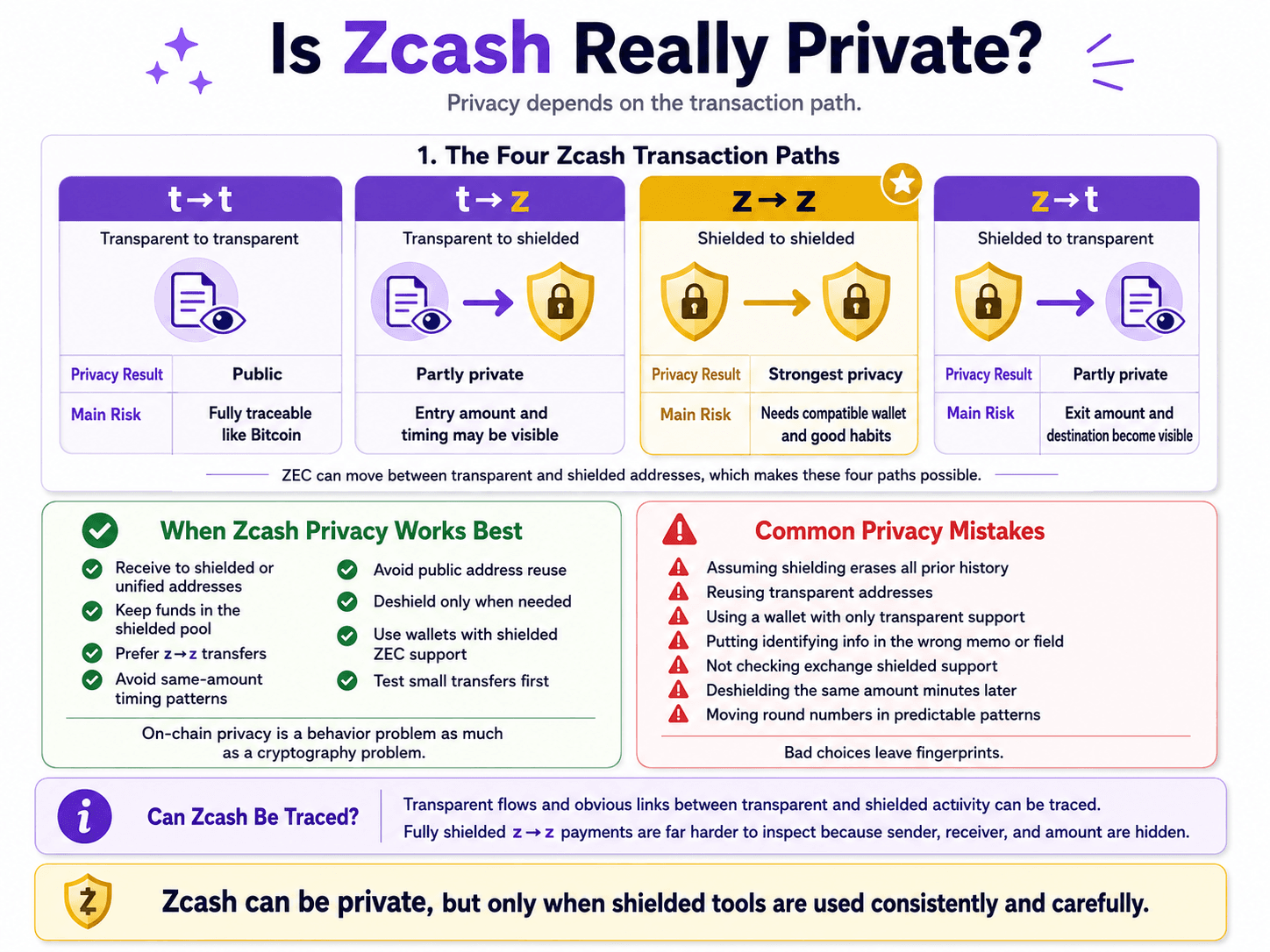
Zcash can be private, but only under the right transaction path. Fully shielded z→z transactions provide the strongest privacy because sender, receiver and amount are hidden. Transparent transactions remain public, and mixed flows can expose entry or exit points.
Zcash privacy depends on the transaction path.
 Privacy Depends On The Path ZEC Takes
The Four Zcash Transaction Paths
ZEC can move between transparent and shielded addresses in four basic ways. Those paths have very different privacy outcomes.
| Flow | Meaning | Privacy Result | Main Risk |
|---|---|---|---|
| t→t | Transparent to transparent | Public | Fully traceable like Bitcoin |
| t→z | Transparent to shielded | Partly private | Entry amount and timing may be visible |
| z→z | Shielded to shielded | Strongest privacy | Requires compatible wallet and good habits |
| z→t | Shielded to transparent | Partly private | Exit amount and destination become visible |
That flexibility supports privacy and auditability, but it can also create linkable patterns.
When Zcash Privacy Works Best
Zcash privacy is strongest when users receive to a shielded address, keep funds in the shielded pool, use z→z transactions and avoid obvious patterns that connect public and private activity.
Good privacy habits include:
- Receive to shielded or unified addresses when possible.
- Keep funds shielded before making private payments.
- Prefer z→z transactions for private transfers.
- Avoid same-amount timing patterns.
- Avoid public address reuse.
- Deshield only when needed.
- Use wallets that clearly support shielded ZEC.
- Test small transfers before moving meaningful amounts.
On-chain privacy depends on behavior as much as cryptography. Strong tools help, but poor habits can weaken the result.
Common Zcash Privacy Mistakes
The most common Zcash privacy mistakes come from treating shielding as a one-time cleanup step.
A user might buy ZEC on a KYC exchange, withdraw to a transparent address, shield the amount, then immediately deshield the same amount to another transparent address. The shielded leg may hide internal details, but the amount and timing can still make the flow linkable.
Other common mistakes include:
- Sending from a transparent address and assuming the entire history disappears.
- Reusing public addresses.
- Using a wallet that only supports transparent ZEC.
- Sending identifying information in the wrong memo or payment field.
- Assuming an exchange supports shielded withdrawals without checking.
- Deshielding funds only minutes after shielding the same amount.
- Moving round numbers in predictable patterns.
Unlike privacy-by-default systems, Zcash gives users choices. Poor transaction habits can leave linkable patterns.
Can Zcash Be Traced?
Zcash can be traceable when users rely on transparent transactions or create obvious links between transparent and shielded flows. Fully shielded z→z payments are much harder to inspect because sender, receiver and amount are hidden.
However, shielded Zcash transactions encrypt the addresses, amount and memo field, while transparent addresses leave holdings and transaction history publicly visible. The main privacy risk appears when funds move between transparent and shielded pools.
Strong Zcash privacy depends on consistent shielded use, not briefly moving funds through the shielded pool before returning to transparent flows.
Zcash Wallets: Where Shielded ZEC Actually Works
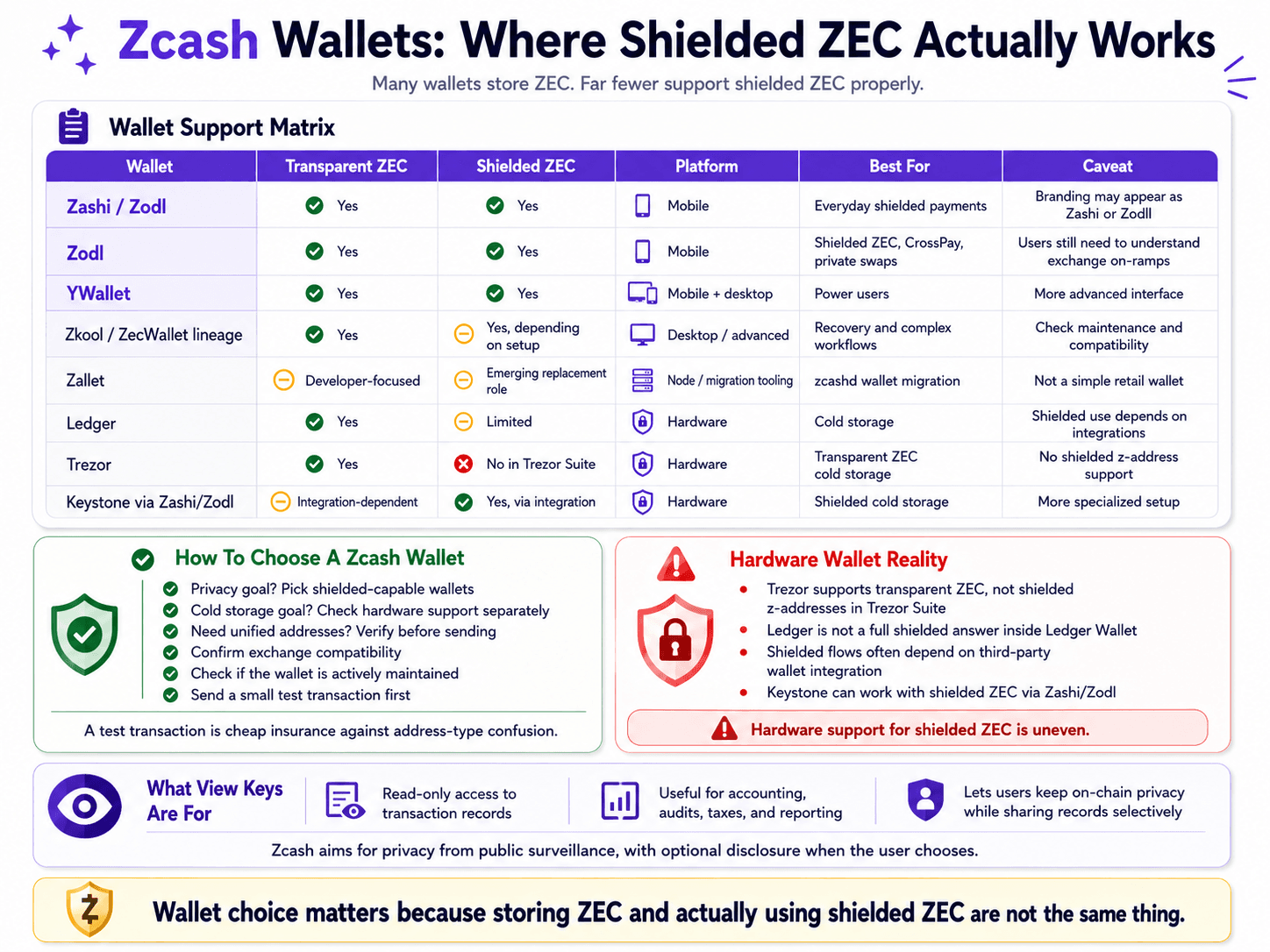
Wallet choice is more significant for Zcash than for many other cryptocurrencies. Plenty of wallets can store or send transparent ZEC. Far fewer support shielded ZEC properly, and hardware wallet support is especially uneven.
 Wallet Choice Decides How Private ZEC Becomes
Wallet Support Matrix
A wallet that stores ZEC does not always support shielded ZEC. The matrix below separates basic ZEC support from actual shielded functionality.
| Wallet | Transparent ZEC | Shielded ZEC | Platform | Best For | Caveat |
|---|---|---|---|---|---|
| Zashi / Zodl | Yes | Yes | Mobile | Everyday shielded payments | Zashi has rebranded to Zodl, though some references may still use the older name |
| Zodl | Yes | Yes | Mobile | Shielded ZEC, CrossPay and private swaps | Built for shielded ZEC, but users still need to understand exchange on-ramps |
| YWallet | Yes | Yes | Mobile and desktop | Power users and multi-pool support | More advanced interface than beginner wallets |
| Zkool / ZecWallet lineage | Yes | Yes | Desktop / advanced | Advanced or legacy Zcash wallet workflows | Check current maintenance and compatibility before relying on it |
| Zallet | Advanced tooling | Migration-focused | Node / wallet migration tooling | zcashd wallet migration and advanced users | Not a simple retail wallet |
| Ledger | Yes | Limited and integration-dependent | Hardware | Cold storage and transparent ZEC | Ledger Wallet receive addresses are unshielded, and shielded use depends on third-party wallet flows |
| Trezor | Yes | No shielded ZEC in Trezor Suite | Hardware | Transparent ZEC cold storage | Trezor states that shielded z-addresses are not compatible with Zcash on Trezor devices |
| Keystone via Zashi/Zodl | Integration-dependent | Yes | Hardware | Hardware-backed shielded use through Zcash-specific integrations | More specialized setup than standard hardware-wallet storage |
Zashi now Zodl, was built around self-custody and shielded ZEC. Zodl focuses on shielded ZEC, CrossPay, swaps and one-click shielding for transparent ZEC received in the wallet. For privacy-focused ZEC use, shielded-capable wallets matter more than generic multi-asset wallets.
Trezor supports Zcash in Trezor Suite, but only for public t-address transactions. Ledger is not a simple shielded-ZEC answer inside Ledger Wallet itself.
Choosing a storage solution for ZEC? Our best Zcash wallets guide compares the main options.
How To Choose A Zcash Wallet
Choose the wallet based on the job.
Use a shielded-capable wallet if privacy is the goal. Use hardware storage if cold storage is the goal. Use a more advanced wallet if you need view keys, multiple pools, recovery tools or node-connected workflows.
Before sending ZEC, check:
- Does the wallet support transparent ZEC?
- Does it support shielded ZEC?
- Does it support unified addresses?
- Can it receive from the exchange you are using?
- Can it send to the address type you need?
- Is the wallet actively maintained?
- Does it clearly show whether funds are transparent or shielded?
Use a small test transaction before moving meaningful ZEC. It helps catch address-type mistakes early.
What View Keys Are For
View keys give read-only access to transaction information without giving someone the ability to spend funds. They are useful when a user needs privacy from the public blockchain but still needs records for accounting, audits, taxes or business reporting.
Zcash’s viewing key model means privacy does not have to block recordkeeping. A freelancer could receive shielded payments and still share records with an accountant. A business could keep customer payments private on-chain while maintaining internal books. A user could prove transaction history selectively without exposing every payment to the world.
Zcash supports private public-chain payments with optional disclosure when the user chooses.
How To Buy, Store And Use Zcash Safely
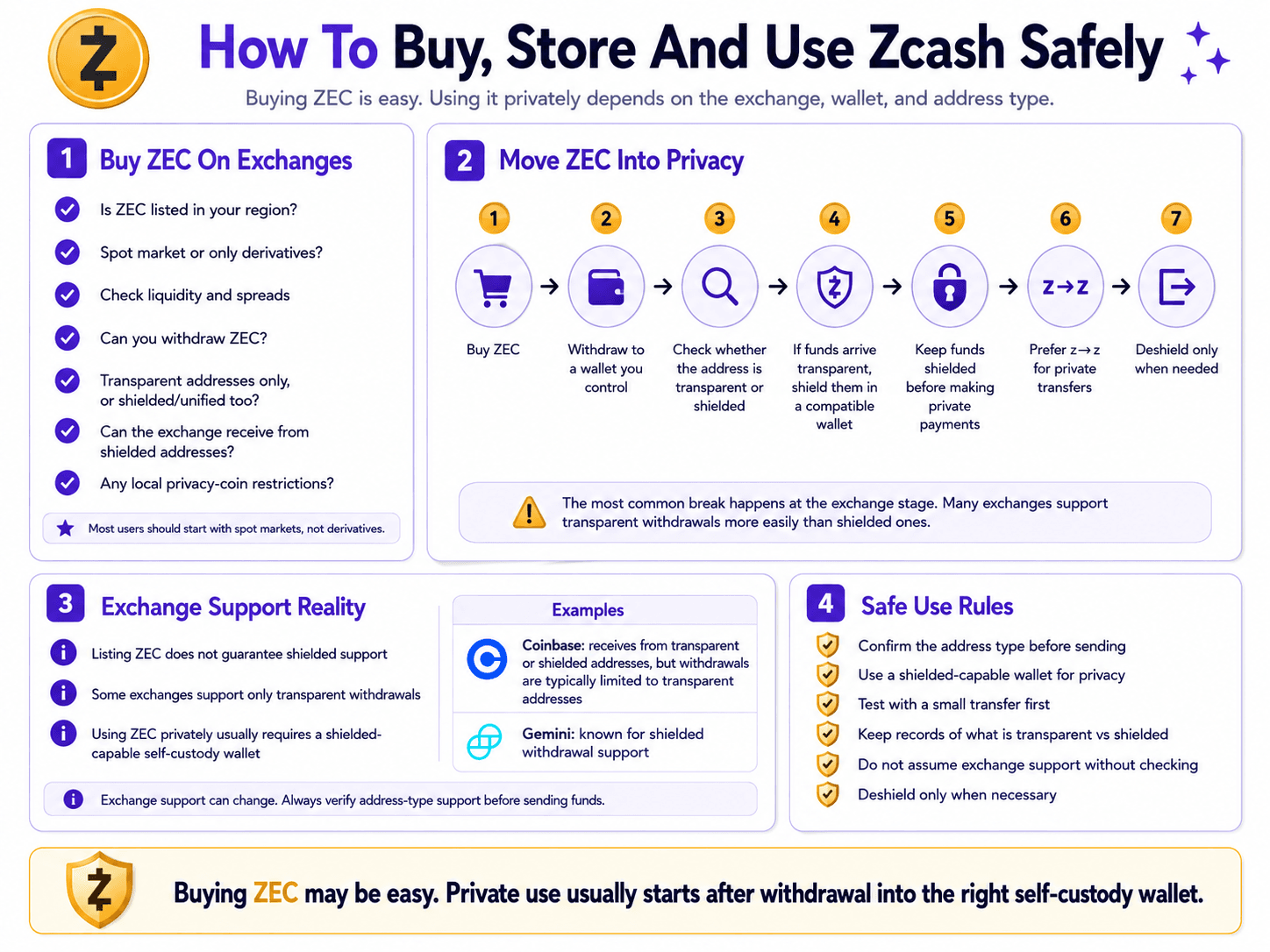
Most users buy ZEC through centralized spot exchanges, then decide whether to leave it on the exchange, withdraw to a transparent wallet or move it into shielded self-custody. The privacy result changes at each step.
 Buying ZEC Is Easier Than Using It Privately
Buying ZEC On Exchanges
ZEC is available on many centralized exchanges such as Binance and Coinbase, but support varies by region, exchange policy and address type.
Before buying ZEC, check:
- Is ZEC listed in your region?
- Is spot trading available, or only derivatives?
- What are the liquidity and spreads?
- Can you withdraw ZEC?
- Does the exchange support transparent addresses only?
- Can it send to shielded or unified addresses?
- Can it receive from shielded addresses?
- Are there local privacy-coin restrictions?
Spot markets are usually the cleaner route for users who want withdrawable ZEC.
Buying ZEC for the first time? Our how to buy Zcash guide keeps that part simple.
Moving ZEC Into Privacy
Basic Private-Use Flow:
- Buy ZEC.
- Withdraw to a wallet you control.
- Confirm whether the receiving address is transparent or shielded.
- If funds arrive transparent, shield them inside a compatible wallet.
- Keep funds shielded before making private payments.
- Use z→z where possible.
- Deshield only when needed.
The exchange stage is often where private use breaks down. Many exchanges are comfortable with transparent ZEC but more restrictive with shielded withdrawals. That means users may have to withdraw to a transparent address first, then shield funds in a proper Zcash wallet.
Withdrawing to a transparent address and shielding later can still improve privacy, but it is weaker than receiving directly into a shielded wallet.
Zcash Tokenomics, Mining And Network Health
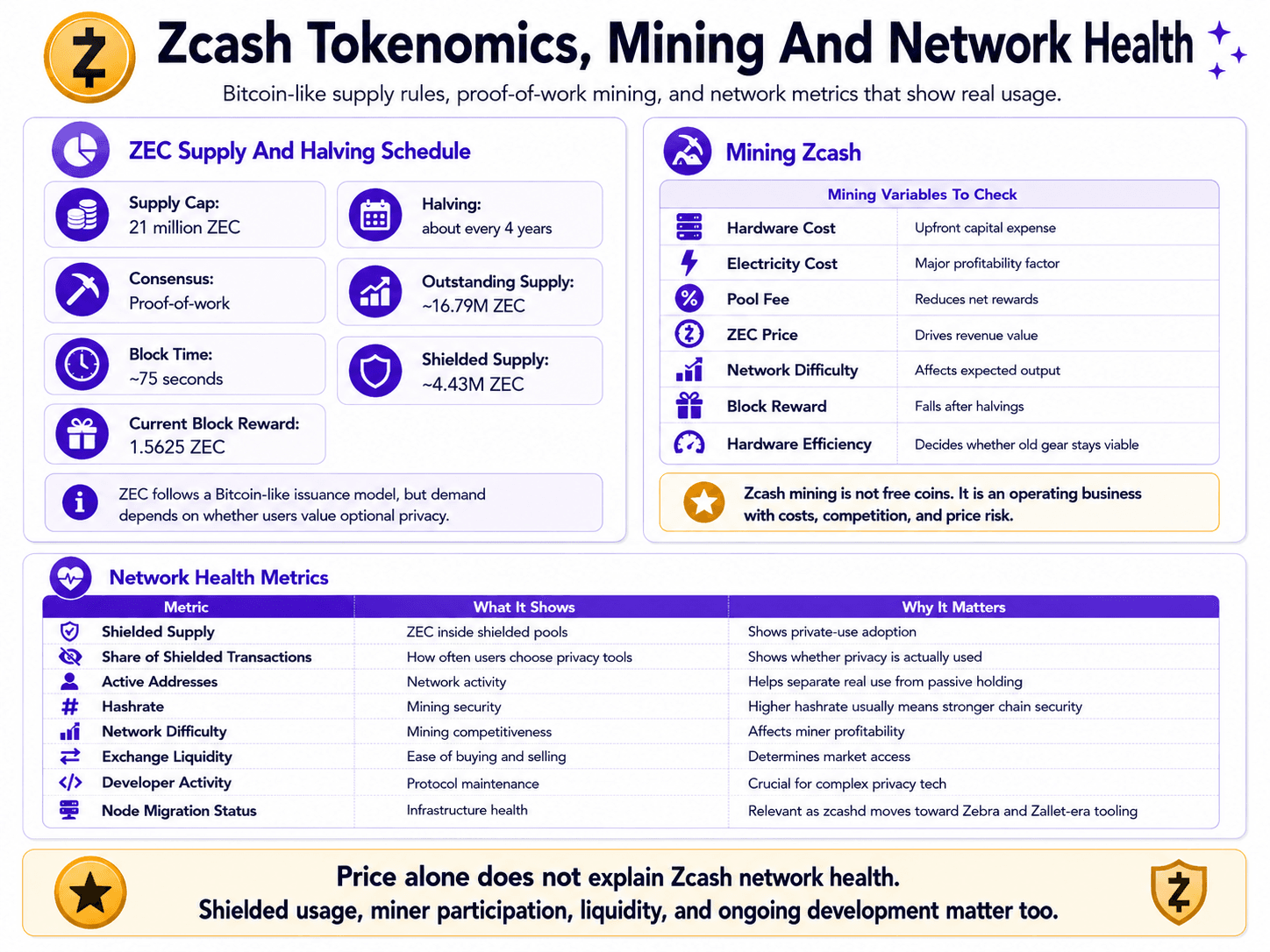
ZEC’s economics are intentionally Bitcoin-like. It has a fixed 21 million supply cap, proof-of-work mining, regular block rewards and a halving schedule. The privacy layer changes how payments can work, but the issuance model is closer to Bitcoin than to most modern DeFi tokens.
 Bitcoin-Like Supply Meets Privacy-Focused Network Usage
ZEC Supply And Halving Schedule
Zcash has a fixed supply cap of 21 million ZEC. A new block is mined roughly every 75 seconds. As of July 4, 2026, the block reward is 1.5625 ZEC, and the reward halves about every four years. The next Zcash halving is expected to take place in November 2028.
The fixed cap is why Zcash often gets compared with Bitcoin. Long-term demand still depends on whether users continue to value optional shielded payments.
Mining Zcash
Zcash uses proof-of-work and can be mined, but mining profitability depends on hardware, electricity cost, mining pool fees, ZEC price, network difficulty and future halvings.
Zcash mining is not "free coins." It is an operating business with input costs, competition and price risk.
Mining variables to check include:
| Metric | Why It Matters |
|---|---|
| Hardware Cost | Determines upfront capital expense |
| Electricity Cost | Can make or break profitability |
| Pool Fee | Reduces net mining rewards |
| ZEC Price | Drives revenue value |
| Network Difficulty | Affects expected output |
| Block Reward | Falls after halvings |
| Hardware Efficiency | Decides whether old equipment remains viable |
Zcash mining can make sense for experienced miners with the right hardware and power costs. It is not a beginner shortcut into cheap ZEC.
Mining ZEC seriously? Our best Zcash mining pools guide goes deeper into pool selection.
Shielded Supply And Network Metrics
Zcash network health is broader than price. The more useful metrics show whether the network is being used, whether shielded adoption is growing and whether miners continue securing the chain.
| Metric | What It Shows | Why It Matters |
|---|---|---|
| Shielded Supply | ZEC held inside shielded pools | Shows private-use adoption |
| Share Of Shielded Transactions | How often users choose privacy tools | Shows whether privacy is actually being used |
| Active Addresses | Network activity | Helps separate real use from passive holding |
| Hashrate | Mining security | Higher hashrate generally means stronger mining competition |
| Network Difficulty | Mining competitiveness | Affects miner profitability |
| Exchange Liquidity | Ease of buying and selling | Determines practical market access |
| Developer Activity | Protocol maintenance | Crucial for complex privacy tech |
| Node Migration Status | Infrastructure health | Relevant as zcashd moves toward Zebra/Zallet-era tooling |
Shielded supply is one of the more useful live Zcash metrics because it shows how much ZEC sits inside private pools. A larger shielded pool can improve the anonymity set, but user behavior still affects individual privacy.
Zcash Risks And Trade-Offs
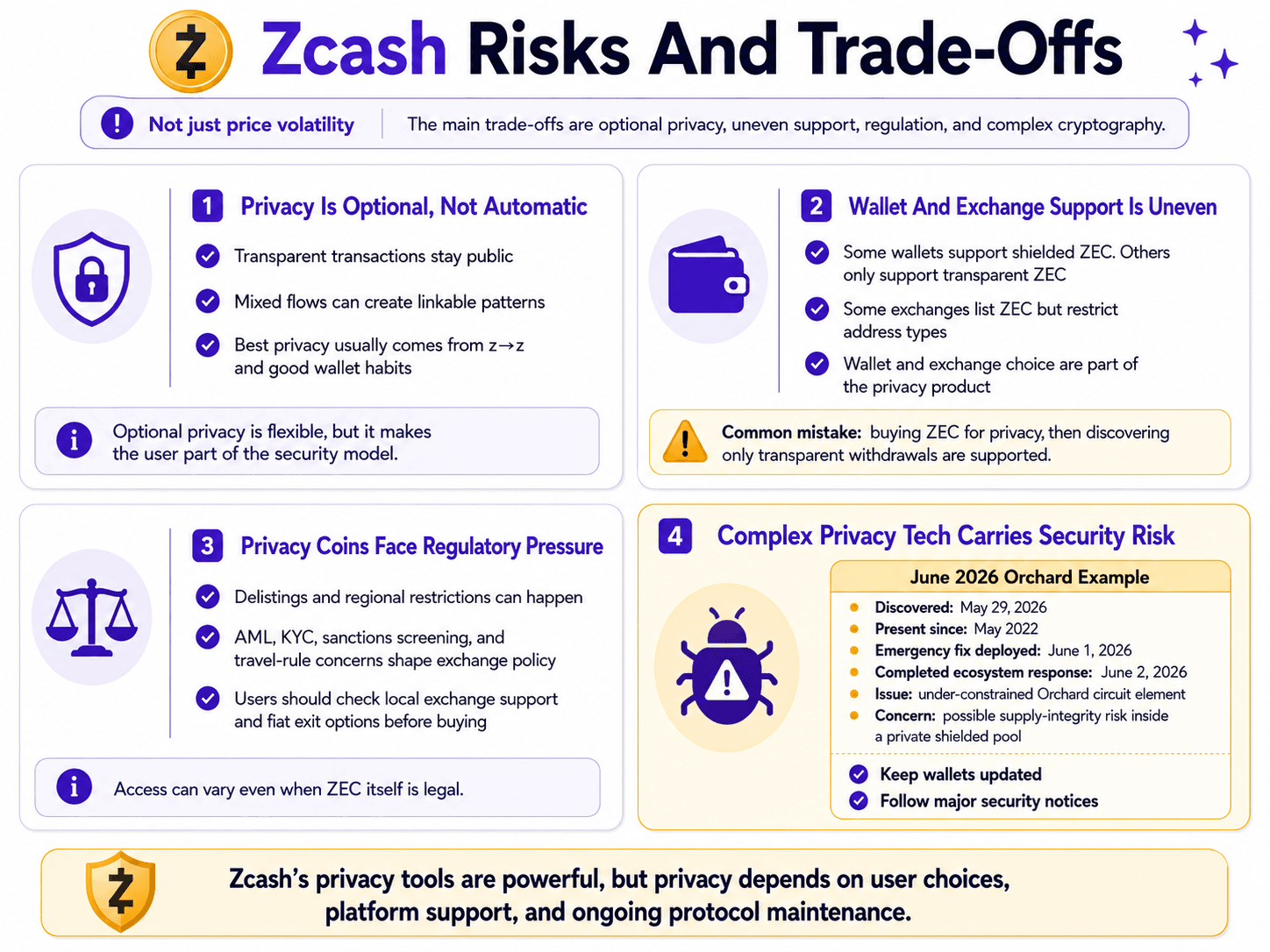
Zcash’s risks are not only price volatility. The real trade-offs sit around optional privacy, uneven wallet support, exchange restrictions, regulation and complex cryptography.
 Optional Privacy Adds Power, Complexity And Responsibility
Privacy Is Optional, Not Automatic
Zcash gives users privacy tools, but it does not make every transaction private by default. Transparent transactions remain public. Mixed flows can create linkable patterns. The strongest privacy comes from z→z transactions and good wallet habits.
Someone can buy ZEC, use only transparent addresses and get very little privacy beyond what they would expect from a public ledger asset. Optional privacy is flexible, but it makes the user part of the security model.
Wallet And Exchange Support Is Uneven
Some wallets support shielded ZEC. Others support only transparent ZEC. Some exchanges list ZEC but restrict deposits or withdrawals by address type.
The common failure case is simple: a user buys ZEC expecting private payments, then realizes the exchange only allows transparent withdrawals or the wallet does not support the shielded flow they need.
With Zcash, wallet choice and exchange choice are not minor details. They are part of the privacy product.
Privacy Coins Face Regulatory Pressure
Privacy coins face delistings, regional restrictions and tighter exchange controls because exchanges and regulators worry about AML, KYC, sanctions screening and travel-rule compliance. Zcash is not automatically illegal, but access can vary.
Privacy coins behave differently from mainstream crypto assets. Even when holding or using the asset is legal, exchanges may decide the compliance burden is not worth it in certain regions.
Users should check local exchange support before buying ZEC, especially if they need a clean exit path back to fiat.
Complex Privacy Tech Carries Security Risk
Zcash depends on advanced cryptography. The same complexity that makes shielded transactions possible also creates technical risk.
The June 2026 Orchard vulnerability is the cleanest example. The issue involved an under-constrained element in the Orchard circuit, was present from Orchard’s activation in May 2022 until an emergency fix was deployed on June 1, 2026, and raised supply-integrity concerns because shielded pools are intentionally private.
Keep wallets updated, follow major security notices and understand that complex privacy systems require constant maintenance. Zcash’s privacy tech is serious, but it is not immune to implementation risk.
Is Zcash Legal? Regulation, Delistings And Compliance
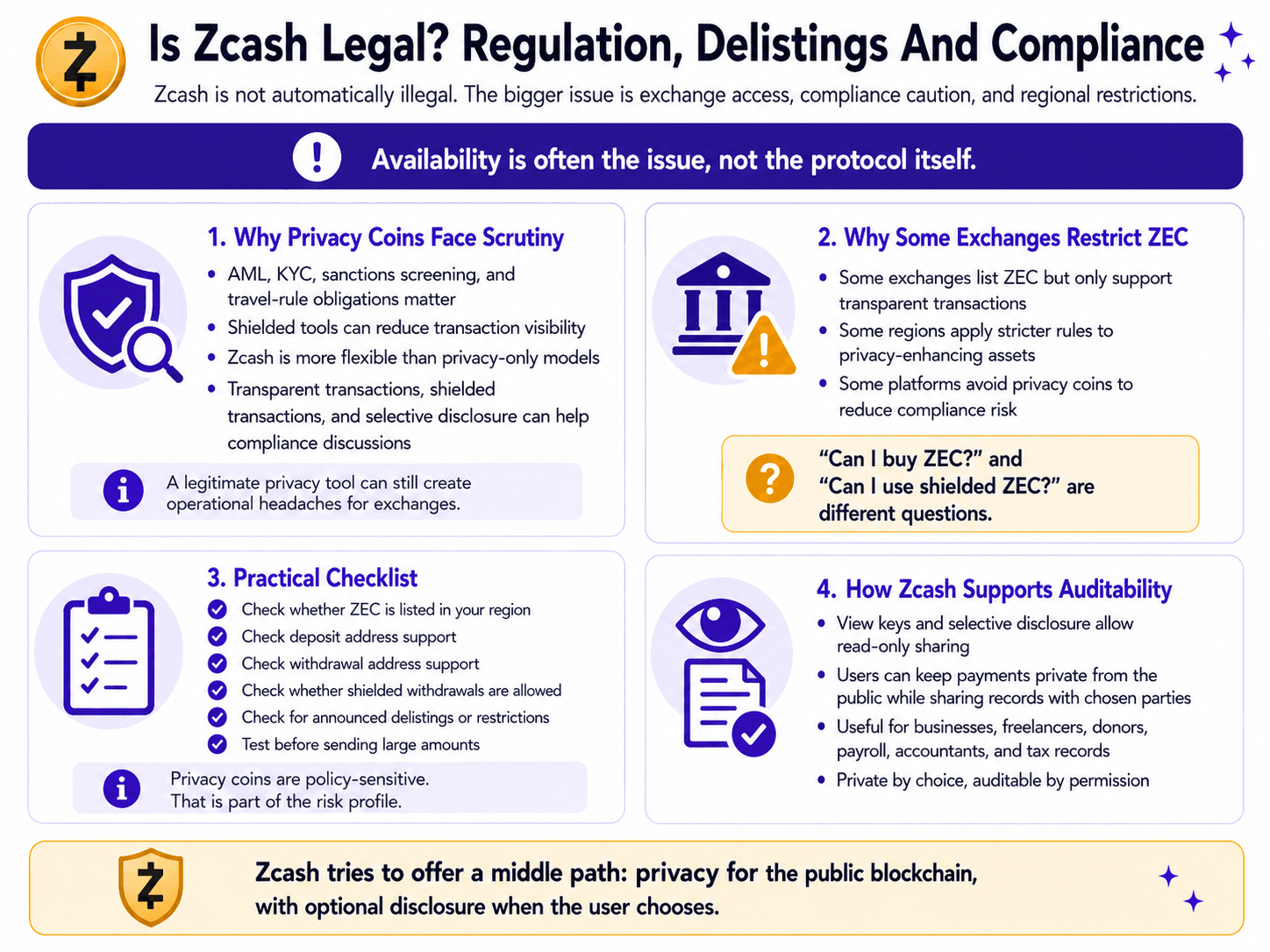
Zcash is not automatically illegal because it has privacy features. The real issue is that privacy-enhancing assets can make exchanges, custodians and regulators more cautious. That affects availability more than the protocol itself.
 Privacy Features Create Real Exchange And Compliance Friction
Why Privacy Coins Face Scrutiny
Regulators and exchanges worry about anti-money-laundering controls, customer identification, sanctions screening and travel-rule obligations. Privacy coins complicate those workflows because transaction visibility can be reduced when users rely on shielded tools.
Zcash’s design is more flexible than a privacy-only model because it supports transparent transactions, shielded transactions and selective disclosure. This can help compliance conversations, but it does not remove the policy concern.
A privacy tool can be legitimate and still create operational headaches for exchanges.
Why Some Exchanges Restrict ZEC
Some exchanges list ZEC but only support transparent transactions. Some regions apply stricter rules for privacy-enhancing assets. Some platforms avoid privacy coins to reduce compliance risk.
A user may be able to trade ZEC on an exchange while still being unable to withdraw directly to a shielded address.
The practical checklist:
- Check whether ZEC is listed in your region.
- Check deposit address support.
- Check withdrawal address support.
- Check whether shielded withdrawals are allowed.
- Check whether the exchange has announced delistings or restrictions.
- Test before sending large amounts.
How Zcash Supports Auditability
Zcash is not just for hiding payments. Selective disclosure and view keys allow users to keep transactions private from the public while still sharing records with chosen parties.
Businesses, freelancers, donors and payroll teams may need privacy from the public chain while still keeping records for accountants or tax reporting.
Zcash tries to give users that middle path: private by choice, auditable by permission.
Zcash Vs Monero, Bitcoin And Dash
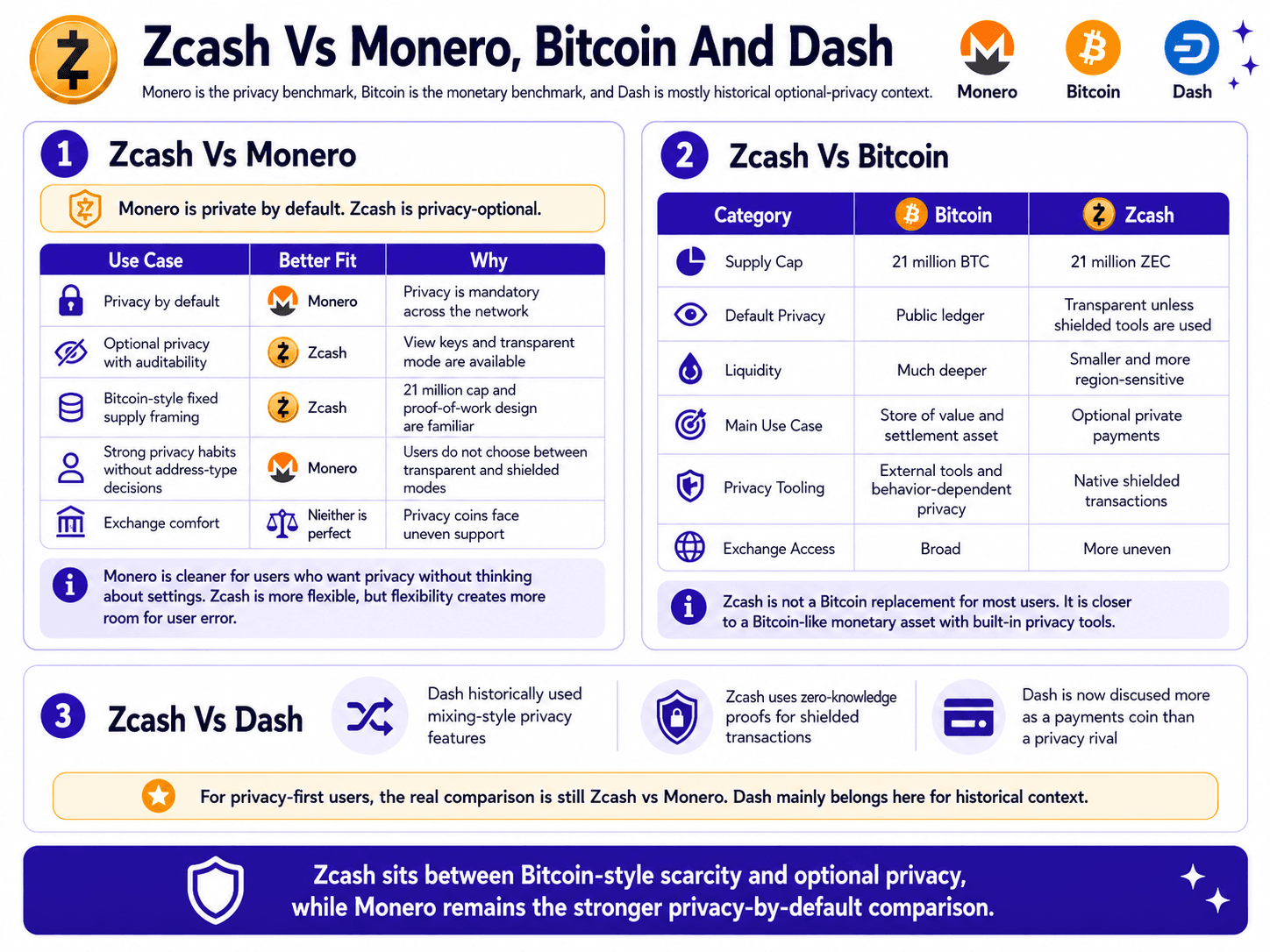
Zcash is usually compared with Monero first, Bitcoin second and Dash third. Monero is the strongest privacy comparison, Bitcoin is the clearest monetary-design comparison, and Dash is mostly useful for older optional-privacy context.
 Zcash Sits Between Bitcoin Transparency And Monero Privacy
Zcash Vs Monero
Monero is private by default. Zcash is privacy-optional.
| Use Case | Better Fit | Why |
|---|---|---|
| Privacy By Default | Monero | Privacy is mandatory across the network |
| Optional Privacy With Auditability | Zcash | View keys and transparent mode are available |
| Bitcoin-Style Fixed Supply Framing | Zcash | 21 million cap and proof-of-work design are familiar |
| Strong Privacy Habits Without Address-Type Decisions | Monero | Users do not choose between transparent and shielded modes |
| Exchange Comfort | Uneven for both | Privacy coins face uneven support |
Monero is better for users who want privacy without thinking about settings. Zcash is more flexible for users who want private payments, transparent accounting and selective disclosure in the same system.
Flexibility gives Zcash wider use cases, but it also creates more room for user error.
Zcash Vs Bitcoin
Bitcoin is transparent by default. Zcash has a similar fixed-supply idea but adds optional shielded transactions. Bitcoin also has deeper liquidity, broader exchange support, stronger institutional recognition and a much larger network effect. Zcash has stronger native privacy tools but more exchange friction and a smaller user base.
| Category | Bitcoin | Zcash |
|---|---|---|
| Supply Cap | 21 million BTC | 21 million ZEC |
| Default Privacy | Public ledger | Transparent unless shielded tools are used |
| Liquidity | Much deeper | Smaller and more region-sensitive |
| Main Use Case | Store of value and settlement asset | Optional private payments |
| Privacy Tooling | External tools and behavior-dependent privacy | Native shielded transactions |
| Exchange Access | Broad | More uneven |
Zcash is not a Bitcoin replacement for most users. It is closer to a Bitcoin-like monetary asset with built-in privacy tools.
Zcash Vs Dash
Dash is no longer the main privacy comparison, but it still helps explain the difference between privacy as a base-layer cryptographic design and privacy as an optional payment feature.
Dash historically used mixing-style privacy features. Zcash uses zero-knowledge proofs for shielded transactions. In practice, Dash is now more often discussed as a payments-focused cryptocurrency than as a serious rival to Monero or Zcash on privacy.
Who Should Use Zcash?
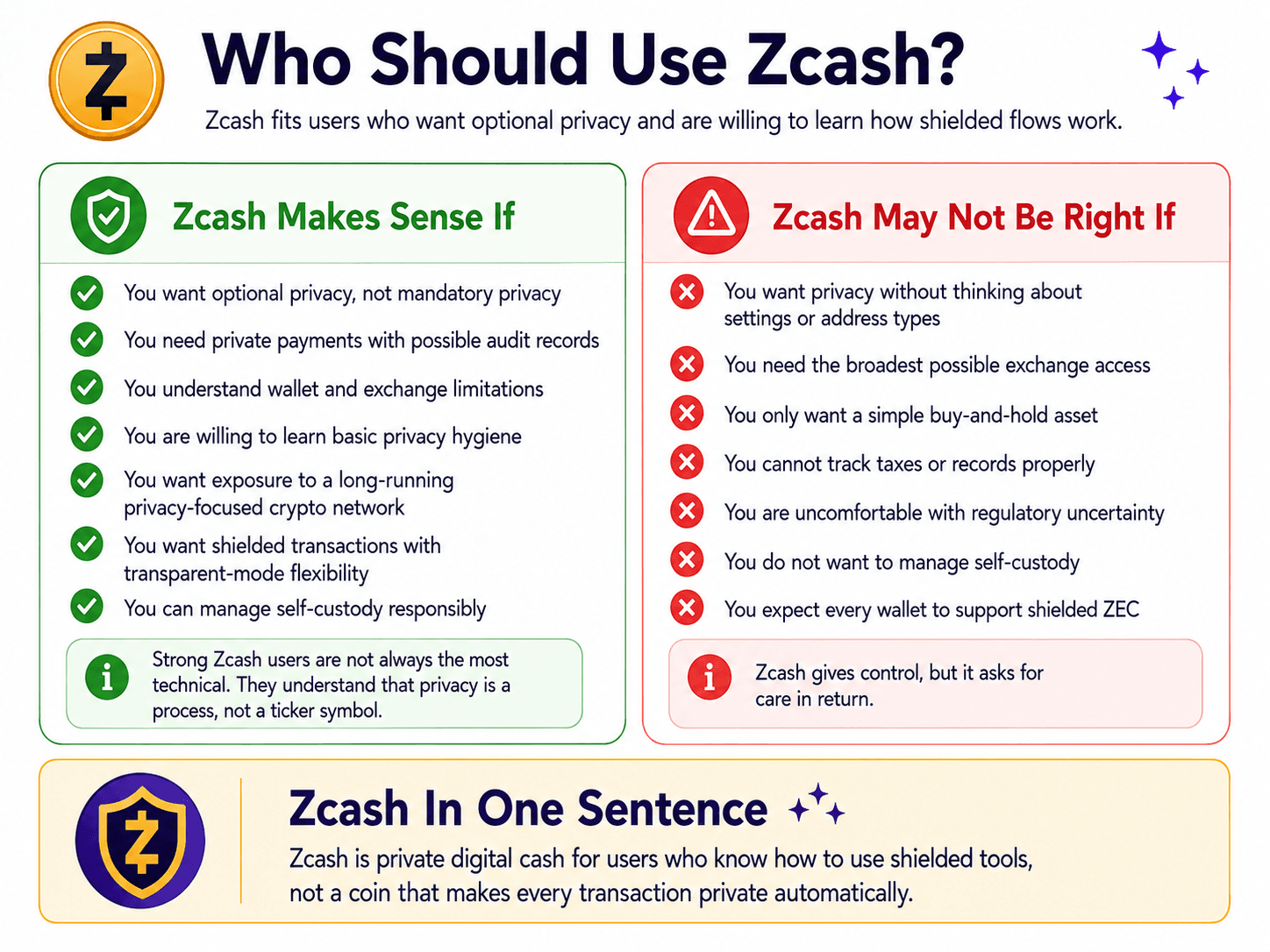
Zcash makes sense for users who want optional privacy and are willing to learn how shielded flows work. It is less suitable for users who want maximum simplicity, universal exchange access or privacy that happens automatically without wallet decisions.
 Best For Users Who Understand Shielded Transaction Habits
Zcash Makes Sense If
- You want optional privacy, not mandatory privacy.
- You need private payments with possible audit records.
- You understand wallet and exchange limitations.
- You are willing to learn basic privacy hygiene.
- You want exposure to a long-running privacy-focused crypto network.
- You care about shielded transactions but still want transparent-mode flexibility.
- You can manage self-custody responsibly.
Zcash May Not Be Right If
- You want privacy without thinking about settings or address types.
- You need the broadest possible exchange access.
- You only want a simple buy-and-hold asset.
- You cannot track taxes or records properly.
- You are uncomfortable with regulatory uncertainty.
- You do not want to manage self-custody.
- You expect every wallet to support shielded ZEC.
Zcash gives users control, but it asks for more care than simpler payment coins.

Final Verdict: What Zcash Is Really For
Zcash is one of crypto’s longest-running attempts to make private payments work on a public blockchain. Its strongest feature is optional shielded privacy, backed by zero-knowledge proofs and selective disclosure.
ts biggest weakness is that privacy is not automatic. Users need the right wallet, the right transaction path and careful habits. A transparent ZEC transfer is not meaningfully different from other public-chain payments. A clean z→z flow inside a supported wallet is a very different story.
Zcash is still relevant because financial privacy is still unresolved in crypto. Bitcoin is transparent. Most DeFi is transparent. Exchanges are increasingly surveilled. Zcash offers a serious privacy tool inside a scarce proof-of-work asset, but the user has to know how to use it.