Uphold is not trying to be the cheapest crypto exchange or the most advanced trading terminal. Its pitch is simpler: one app for buying, selling, holding, and swapping crypto, fiat currencies, stablecoins, and precious metals.
That makes Uphold useful for beginners, DCA buyers, and users who want simple cross-asset swaps without dealing with complex trading pairs. But convenience has a cost. Uphold uses spread-based pricing, has limited advanced trading tools, and remains a custodial platform, so it is not the best fit for active traders or long-term storage of large crypto balances.
This Uphold review breaks down its fees, safety, supported assets, card, app experience, pros and cons, and whether Uphold is worth using in 2026.
Editor's Note (June 12, 2026): We fully updated this Uphold review in June 2026 to reflect the platform’s current fees, supported assets, reserve transparency, security certifications, card availability, Earn restrictions, regulatory footprint and overall fit for users. We also refreshed the scorecard, comparison tables, pros and cons, and verdict to better show where Uphold works well and where users may be better served by a pro exchange or self-custody.
Uphold Review 2026: Quick Verdict
Uphold is a custodial multi-asset platform built for simple access to crypto, fiat currencies, stablecoins, and precious metals. Its main edge is convenience: users can buy, hold, swap, and spend supported assets from one clean app.
Our take: Uphold is worth considering if you want an easy way to buy crypto, set recurring purchases, swap between supported assets, or access crypto, fiat, and metals in one place. It is not the best choice for active traders, users who need the lowest fees, margin, futures, deep charting, or long-term storage for large crypto balances.
Scorecard
-
1Ease of Use 4.5/5 Uphold is beginner-friendly, with a clean app, simple buy and swap flows, recurring purchases, and a less intimidating interface than most professional trading platforms.
-
2Asset Variety 4/5 Uphold supports crypto, fiat currencies, stablecoins, and precious metals, giving it a wider multi-asset feel than most crypto-only apps.
-
3Fees 3.8/5 Uphold’s spread-based pricing is easy to understand, but it can be expensive for active traders, larger trades, and frequent altcoin swaps.
-
4Security and Transparency 4.8/5 Uphold offers 2FA, encryption, monitoring, SOC 2 Type 2, ISO 27001, PCI DSS, a bug bounty program, real-time assets and liabilities, and 100%+ reserve positioning.
-
5Advanced Trading 2/5 Uphold has useful order tools, but it is not built for professional traders who need deep order books, advanced charting, low maker/taker fees, margin, futures, or complex execution tools.
-
6User Experience 4/5 The app is smooth and approachable for casual users, though account reviews, regional restrictions, fee visibility, and custodial trade-offs can still frustrate some customers.
-
7Overall Score 3.85/5 Uphold scores well as a simple multi-asset app, with its strongest marks for ease of use, transparency, reserve positioning, and broad asset access.
Best For
- Beginners who want a simple crypto app
- Users who want crypto, fiat, and metals in one place
- DCA buyers and casual investors
- Users who value real-time reserve transparency
- UK users who want card access where supported
Not Ideal For
- Active traders who need low fees
- Users who want margin or futures
- High-volume traders who need deep order books
- Long-term holders with large crypto balances
- Users who want full private key control
Disclosure and Methodology
Some links in this article may be affiliate links. If you choose to use a service through these links, we may earn a commission at no additional cost to you.
For this Uphold review, we evaluated the platform across six main categories: ease of use, asset variety, fees, security and transparency, advanced trading, and user experience. We looked at Uphold as a beginner-friendly multi-asset app rather than judging it only as a professional crypto exchange.
We also weighed the main limitations carefully, including spread-based pricing, regional restrictions, account access complaints, custodial risk, limited advanced trading tools, Earn availability, card availability, and the need for self-custody when holding larger crypto balances.
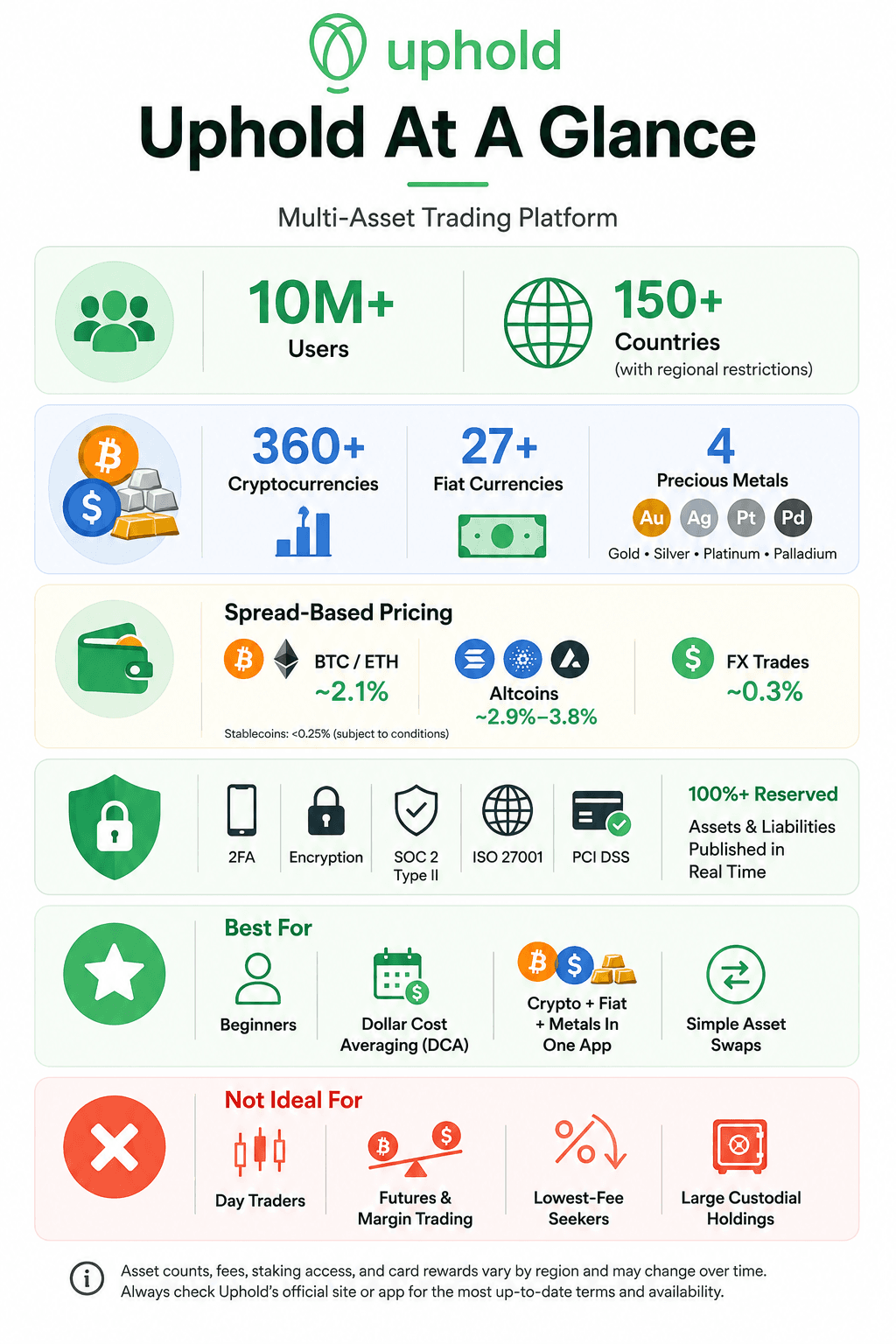
Uphold At A Glance
| Detail | Uphold |
|---|---|
| Type | Multi-Asset Trading Platform |
| Founded | 2013, With Consumer Launch Following Later |
| CEO | Simon McLoughlin |
| Founder | Halsey Minor |
| Users | 10M+ |
| Availability | 150+ Countries, With Regional Restrictions |
| Crypto Assets | 250+ To 360+ Depending On Page And Region |
| Fiat Currencies | 27+ National Currencies Listed On App Pages, Region-Dependent |
| Precious Metals | Gold, Silver, Platinum, Palladium |
| Fee Model | Spread-Based |
| Typical BTC/ETH Fees | 2.05%–2.20% In The U.S., U.K., And Europe |
| Typical Altcoin Fees | 2.85%–3.80% In The U.S., U.K., And Europe |
| Stablecoin Spread | Most Stablecoins Under 0.25%, Subject To Conditions |
| Major FX Spread | Around 0.3% |
| Staking / Earn | Available In Supported Regions With Restrictions |
| Card | Region-Dependent, With UK Debit Card Availability |
| UK Card Rewards | 1% Cashback In GBP On Eligible GBP-Funded Purchases |
| Security | 2FA, Encryption, Monitoring, SOC 2 Type 2, ISO 27001, PCI DSS |
| Transparency | Assets And Liabilities Published In Real Time |
| Reserve Positioning | Uphold Says The Platform Is 100%+ Reserved |
| Regulation | FinCEN, State Regulators, FCA, FINTRAC, Bank Of Portugal |
| Best For | Simple Buying, DCA, Cross-Asset Swaps, Fiat/Crypto/Metals In One App |
| Not For | Active Trading, Lowest Fees, Margin, Futures, Large Custodial Holdings |
Note: Data current as of June 12, 2026.
 Key Platform Details, Fees, Assets, And Availability
What Is Uphold?
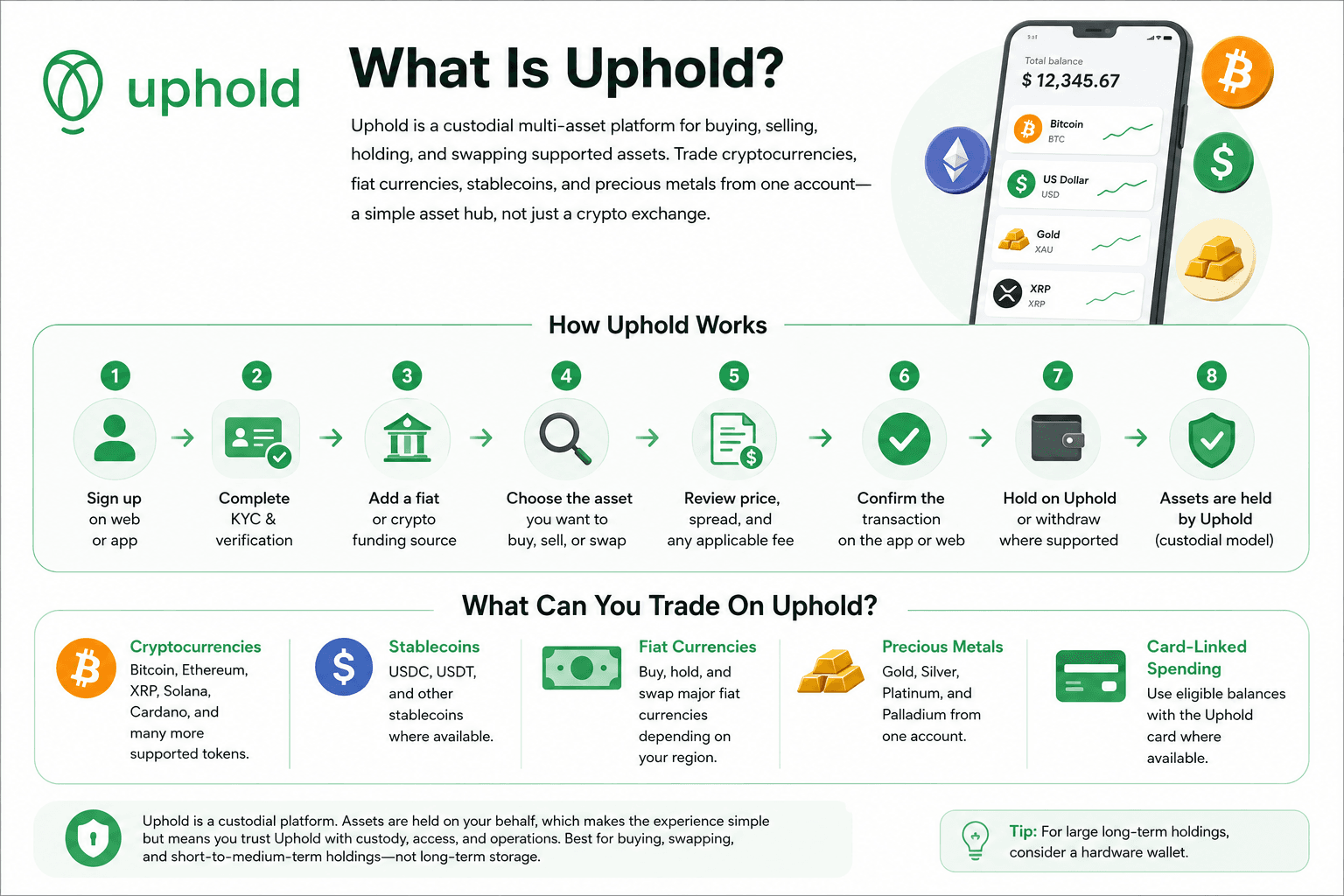
Uphold is a custodial multi-asset platform for buying, selling, holding, and swapping supported assets. Users can trade cryptocurrencies, fiat currencies, stablecoins, and precious metals from one account, which makes it feel more like a simple asset hub than a pure crypto exchange.
 How Uphold Combines Crypto, Fiat, And Metals
Its standout feature is Anything-to-Anything trading. Instead of forcing users to move through several trading pairs, Uphold lets users swap directly between supported assets. A user can move from gold to Bitcoin, USD to XRP, or EUR to Ethereum in one flow, depending on regional availability and asset support.
That helps beginners because many exchanges still make users think in pairs, quote currencies, and order types. Uphold compresses that into a simpler flow: choose what you have, choose what you want, review the quote, and confirm. The downside is that this convenience is priced into the spread.
Uphold is not a full professional trading exchange in the same way Kraken Pro or Coinbase Advanced are. It is easier to use, but it does not offer the same depth for active traders who need advanced charting, order book tools, margin, futures, low maker/taker fees, or complex execution strategies.
How Uphold Works
Uphold works through a standard custodial account model. The basic flow is simple:
- Sign up through Uphold’s official website or app.
- Complete KYC and identity verification.
- Add a fiat or crypto funding source.
- Choose the asset you want to buy, sell, or swap.
- Review the quoted price, spread, and any applicable fee.
- Confirm the transaction from the app or web platform.
- Hold the asset on Uphold or withdraw it where supported.
What Can You Trade On Uphold?
Uphold supports several asset categories from one account:
- Cryptocurrencies such as Bitcoin, Ethereum, XRP, Solana, Cardano, and other supported tokens
- Stablecoins where available
- Fiat currencies, depending on region
- Precious metals including gold, silver, platinum, and palladium
- Card-linked spending balances where card services are available
This mix gives Uphold a different identity from crypto-only exchanges. A beginner can buy Bitcoin, hold USD or GBP, swap into XRP, and add gold from the same app. That is useful for users who want a simple multi-asset account rather than separate apps for crypto, forex-style fiat exposure, and metals.
The metals angle is especially relevant. Most mainstream crypto exchanges do not make gold, silver, platinum, and palladium part of the same casual trading flow. Uphold does, which gives it a niche among users who want crypto exposure but still like traditional store-of-value assets.
Is Uphold Safe?
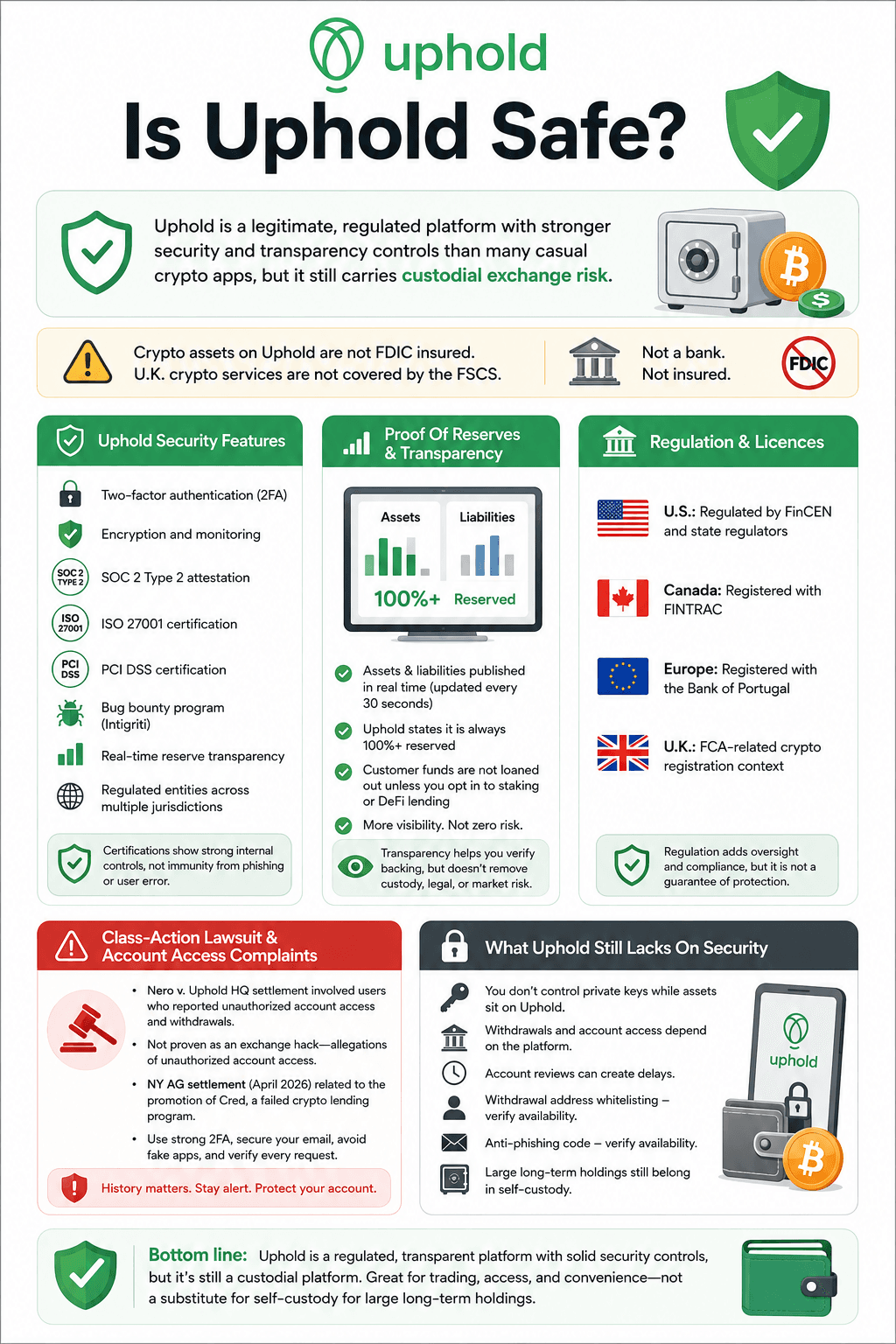
Yes, Uphold is a safe, legitimate and regulated platform with strong security and transparency controls than many crypto apps.
 Uphold’s Security, Reserves, Regulation, And Custody Risks
Platform security refers to how Uphold protects systems, data, reserves, payment infrastructure, and accounts. User-account security depends on how customers protect passwords, 2FA, devices, emails, and withdrawal behavior. Even a regulated platform cannot protect a user who approves a phishing request, installs a fake app, or exposes login access.
Uphold Security Features
Uphold uses standard platform and account security controls, including two-factor authentication, encryption, monitoring, and compliance certifications.
Its main security controls include:
- Two-factor authentication for account protection
- Encryption and platform monitoring
- SOC 2 Type 2 attestation
- ISO 27001 certification
- PCI DSS certification
- A bug bounty program through Intigriti
- Real-time reserve transparency
- Regulated or registered entities across several jurisdictions
The stronger part of its security story is certification. Uphold says it holds SOC 2 Type 2, ISO 27001, and PCI DSS certifications. SOC 2 Type 2 looks at controls over time, ISO 27001 covers information security management, and PCI DSS relates to secure payment card data handling.
Uphold also runs a bug bounty program through Intigriti, which gives external security researchers a formal channel to report vulnerabilities.
Users holding larger crypto balances should compare dedicated hardware wallets before relying on any custodial platform for long-term storage.
Proof Of Reserves And Transparency
Uphold’s transparency system is one of its stronger trust signals.
The company publishes assets and liabilities in real time, and Uphold’s public pages say those figures are updated every 30 seconds. Uphold also says the platform is always 100%+ reserved and that customer funds are not loaned out unless users explicitly choose staking or DeFi lending products.
Regulation And Licenses
Uphold is regulated or registered across several major jurisdictions.
Uphold says it is regulated in the U.S. by FinCEN and state regulators, registered in Canada with FINTRAC, and registered in Europe through the Bank of Portugal. Its U.K. structure also includes FCA-linked crypto registration context, though U.K. cryptoasset services remain subject to specific risk warnings and regulatory limits.
This gives Uphold a clearer regulatory footprint than an offshore exchange with no public registration trail. It also means the platform has to operate inside stricter compliance systems, including KYC, AML checks, sanctions screening, and jurisdiction-specific product rules.
Class-Action Lawsuit And Account Access Complaints
Uphold has faced account access complaints and a class-action lawsuit connected to alleged unauthorized account access.
The Nero v. Uphold HQ settlement notice states that the settlement involved users who reported unauthorized access to their accounts and unauthorized withdrawals.
In April 2026, the New York Attorney General announced a settlement with Uphold tied to the promotion of Cred, a failed crypto lending program.
For users, the practical lesson is clear. Use strong 2FA, avoid fake apps, download only from official links, secure your email account, and treat every urgent exchange email as suspicious until verified.
What Uphold Still Lacks On Security
Uphold’s security setup is stronger than many casual crypto apps, but the gaps still exist.
The main limitations are:
- Users do not control private keys while assets sit on Uphold.
- Withdrawals and account access depend on the platform.
- Account reviews can create delays.
- Withdrawal address whitelisting is not clearly positioned as a core security feature across Uphold's public materials.
- Anti-phishing code support is also not as prominent as on some competing exchanges.
- Large long-term holdings still belong in self-custody.
The biggest issue is custodial risk. Uphold may be convenient, regulated, and transparent, but it still holds assets for users. That makes the app easy to use, but it also means customers depend on Uphold for withdrawals, account access, custody operations, and compliance review outcomes.
For large crypto balances, Uphold should be treated as a trading and access platform, not a permanent vault. Buy or swap there if it fits your use case, then move long-term holdings to self-custody.
Uphold Fees Explained
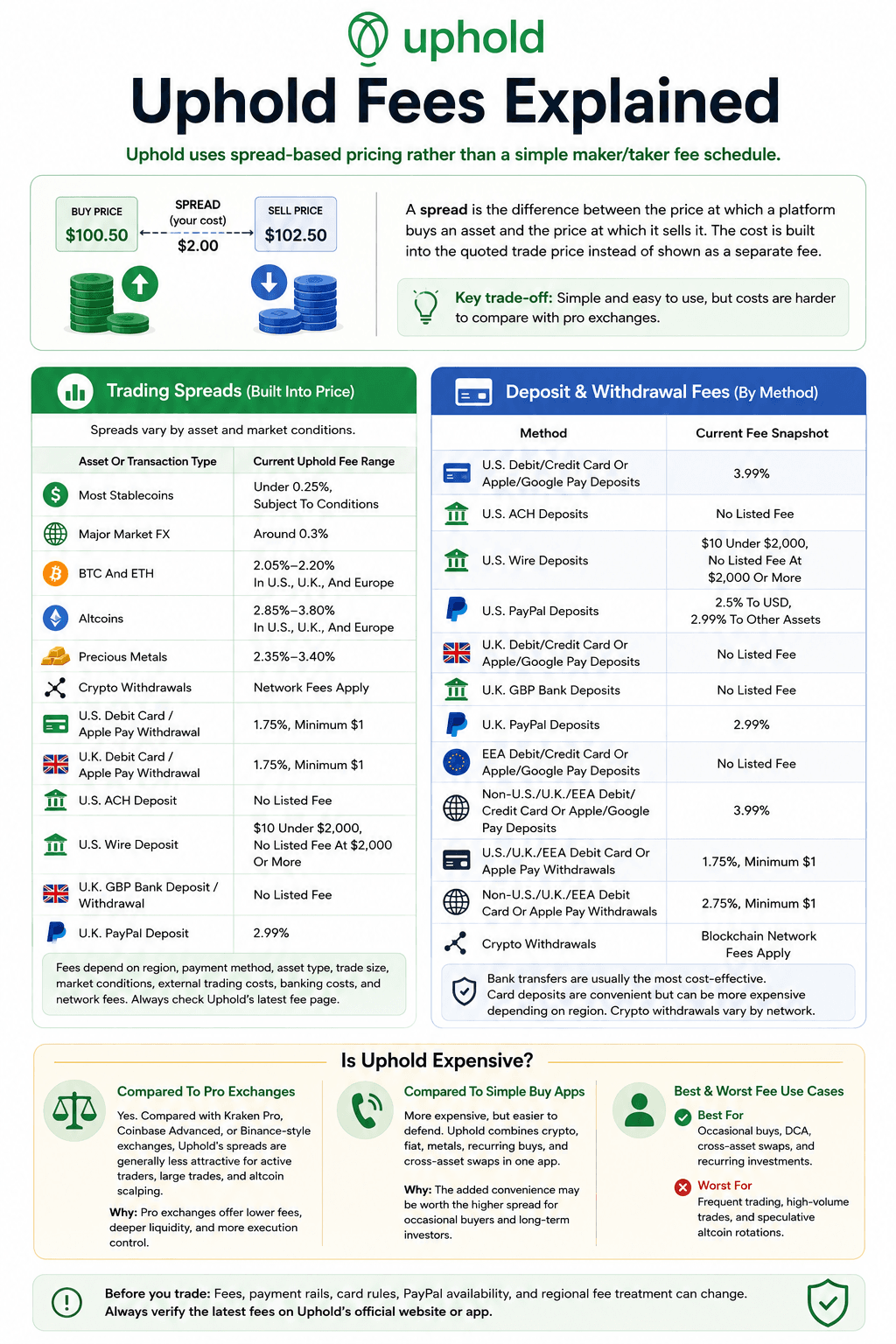
Uphold uses spread-based pricing rather than a simple maker/taker fee schedule.
 Spread-Based Costs Across Crypto, Metals, And Transfers
A spread is the difference between the price at which a platform buys an asset and the price at which it sells it. In practice, the cost is built into the quoted trade price instead of shown as a separate trading commission. This makes the app feel simple, but it can make costs harder to compare with pro exchanges.
| Asset Or Transaction Type | Uphold Fee Range as of June 12, 2026 |
|---|---|
| Most Stablecoins | Under 0.25%, Subject To Conditions |
| Major Market FX | Around 0.3% |
| BTC And ETH | 2.05%–2.20% In U.S., U.K., And Europe |
| Altcoins | 2.85%–3.80% In U.S., U.K., And Europe |
| Precious Metals | 2.35%–3.40% |
| Crypto Withdrawals | Network Fees Apply |
| U.S. Debit Card / Apple Pay Withdrawal | 1.75%, Minimum $1 |
| U.K. Debit Card / Apple Pay Withdrawal | 1.75%, Minimum $1 |
| U.S. ACH Deposit | No Listed Fee |
| U.S. Wire Deposit | $10 Under $2,000, No Listed Fee At $2,000 Or More |
| U.K. GBP Bank Deposit / Withdrawal | No Listed Fee |
| U.K. PayPal Deposit | 2.99% |
Uphold’s service fee page says fees depend on region, payment method, asset type, trade size, market conditions, external trading costs, banking costs, and network fees. Its support page for fees, limits, and processing times gives payment-method details by region.
Crypto Trading Spreads
Uphold’s crypto spreads are simple to understand, but they can be expensive for frequent traders.
For BTC and ETH, Uphold lists typical U.S., U.K., and Europe fees around 2.05% to 2.20%. For altcoins, the typical range is higher at 2.85% to 3.80%. Most stablecoins are listed under 0.25%, subject to conditions around parity and volume.
The difference between BTC and smaller altcoins is logical. Bitcoin and Ethereum tend to have deeper liquidity, tighter markets, and more efficient execution. Smaller tokens can be harder and more expensive to source, so Uphold's spread can be wider.
Spreads can widen during volatility, lower liquidity, larger trade sizes, or fast-moving markets. Uphold says it holds each price open for 18 seconds and shows an in-app notification when market spreads are unusually wide, over 4%. That means the quote shown before confirmation is more useful than any static fee table.
For occasional buys, the simplicity may be acceptable. For active trading, those spreads can eat into returns quickly.
Deposit And Withdrawal Fees
Deposit and withdrawal fees depend on how users fund and exit the platform. The current fee structure is more nuanced than a single “free” or “paid” label.
| Method | Fee Snapshot as of June 12, 2026 |
|---|---|
| U.S. Debit/Credit Card Or Apple/Google Pay Deposits | 3.99% |
| U.S. ACH Deposits | No Listed Fee |
| U.S. Wire Deposits | $10 Under $2,000, No Listed Fee At $2,000 Or More |
| U.S. PayPal Deposits | 2.5% To USD, 2.99% To Other Assets |
| U.K. Debit/Credit Card Or Apple/Google Pay Deposits | No Listed Fee |
| U.K. GBP Bank Deposits | No Listed Fee |
| U.K. PayPal Deposits | 2.99% |
| EEA Debit/Credit Card Or Apple/Google Pay Deposits | No Listed Fee |
| Non-U.S./U.K./EEA Debit/Credit Card Or Apple/Google Pay Deposits | 3.99% |
| U.S./U.K./EEA Debit Card Or Apple Pay Withdrawals | 1.75%, Minimum $1 |
| Non-U.S./U.K./EEA Debit Card Or Apple Pay Withdrawals | 2.75%, Minimum $1 |
| Crypto Withdrawals | Blockchain Network Fees Apply |
Is Uphold Expensive?
Yes, Uphold can be expensive for active traders.
Compared with Kraken Pro, Coinbase Advanced, or Binance-style maker/taker exchanges, Uphold’s spread model is usually less attractive for high-frequency trades, larger trades, and altcoin scalping. Pro exchanges often give users tighter fees, deeper liquidity, and more control over execution.
Compared with simple buy platforms, Uphold is easier to defend because it combines crypto, fiat, metals, recurring buys, and direct asset swaps in one app. The cost may be acceptable for users who buy occasionally or use DCA.
A user buying $50 of Bitcoin every week may care more about simplicity than shaving off every basis point. A trader rotating between altcoins several times a day should not think that way. For active trading, the spread is not a small detail. It is the business model.
Uphold Features
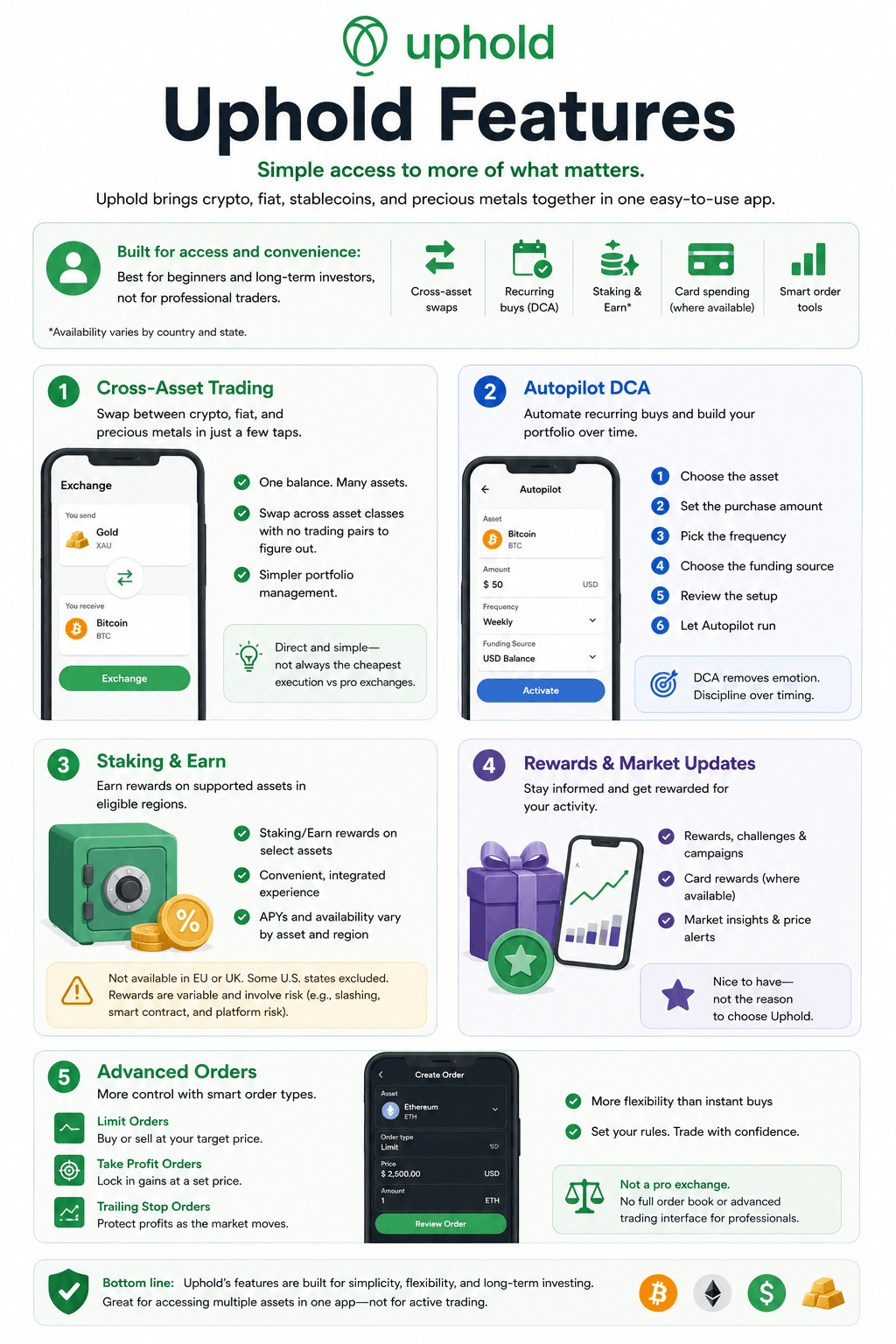
Uphold’s feature set works best when judged as a beginner-friendly asset app, not as a pro trading venue.
 Trading, DCA, Rewards, And Earn Tools Explained
The platform is built around simple buying, cross-asset swaps, recurring buys, staking or Earn-style products in supported regions, card spending where available, and some order tools. That makes it useful for casual users who want less dashboard clutter. It also makes the limits obvious for serious traders.
The deeper point is that Uphold’s features all serve the same user: someone who wants access and convenience first. If you judge it by professional exchange standards, it will look thin. If you judge it by beginner usability and asset flexibility, the feature set starts to make more sense.
Cross-Asset Trading
Cross-asset trading is Uphold’s signature feature and the clearest reason to use the platform over a standard crypto-only exchange.
Most exchanges still make users think in pairs. If you hold gold exposure and want Bitcoin, or USD and want XRP, the app usually forces you through specific routes. Uphold’s model is simpler. Users can swap between supported crypto, fiat, and metals without manually routing through several pairs.
That can make portfolio changes feel less intimidating. A beginner does not have to understand whether they are trading BTC/USD, XRP/USDT, or ETH/EUR. They only need to know what they want to exchange and what they want to receive.
This is especially useful for users who see their portfolio as a mix of value buckets rather than trading pairs. Someone might hold cash, Bitcoin, XRP, and gold. Uphold makes movement between those buckets feel natural.
Autopilot DCA
Uphold’s Autopilot feature is built for recurring buys and dollar-cost averaging.
The flow is straightforward:
- Choose the asset.
- Set the purchase amount.
- Pick the frequency.
- Choose the funding source.
- Review the setup.
- Let recurring buys run automatically.
DCA helps users buy a fixed amount at regular intervals instead of trying to time every market move. That can be useful for Bitcoin, Ethereum, XRP, Solana, or other assets a user wants to accumulate slowly.
The feature fits Uphold’s broader design. A user can set a recurring purchase, fund it from a supported payment method, and build a position without logging in every day. For beginners, that removes the emotional trap of buying only when prices are already running.
Staking And Earn
Uphold offers staking or Earn-style rewards in supported regions, but eligibility needs careful checking.
As of June 12, 2026, Uphold’s Earn support page mentions that Earn is available in Latin America, the U.S., and rest-of-world regions, but not in the EU or the U.K. It also excludes some U.S. states, including American Samoa, Illinois, Louisiana, New York, the U.S. Virgin Islands, Texas, and Washington. Australia, Singapore, and South Africa are also excluded from Earn availability.
Read our top picks for the best DeFi staking platforms.
Rewards Program And Market Updates
Uphold also offers rewards and market update features, but they should be treated as extras.
The platform has promoted rewards, daily challenges, direct deposit rewards, card rewards, and market update emails in different contexts. These features can help users stay engaged, but they are not the main reason to choose Uphold.
Advanced Orders
The platform has also added order tools such as limit orders, take profit orders, and trailing stop orders. That improves the advanced trading experience for users who want more control than instant buys.
- A limit order lets users set the price at which they want to buy or sell.
- A take profit order can help lock in gains at a chosen level.
- A trailing stop can follow price movement and trigger when the market reverses by a set amount.
These tools make Uphold more useful than a simple “buy now” app. Still, this does not make Uphold a full pro exchange. It lacks the depth of Kraken Pro or Coinbase Advanced for active traders. There is no full order book trading experience in the same sense, no deep charting suite, and no professional execution environment for serious traders.
The feature is best seen as a bridge. It helps casual users place smarter orders, but it does not turn Uphold into a trader’s main terminal.
Uphold Crypto Card
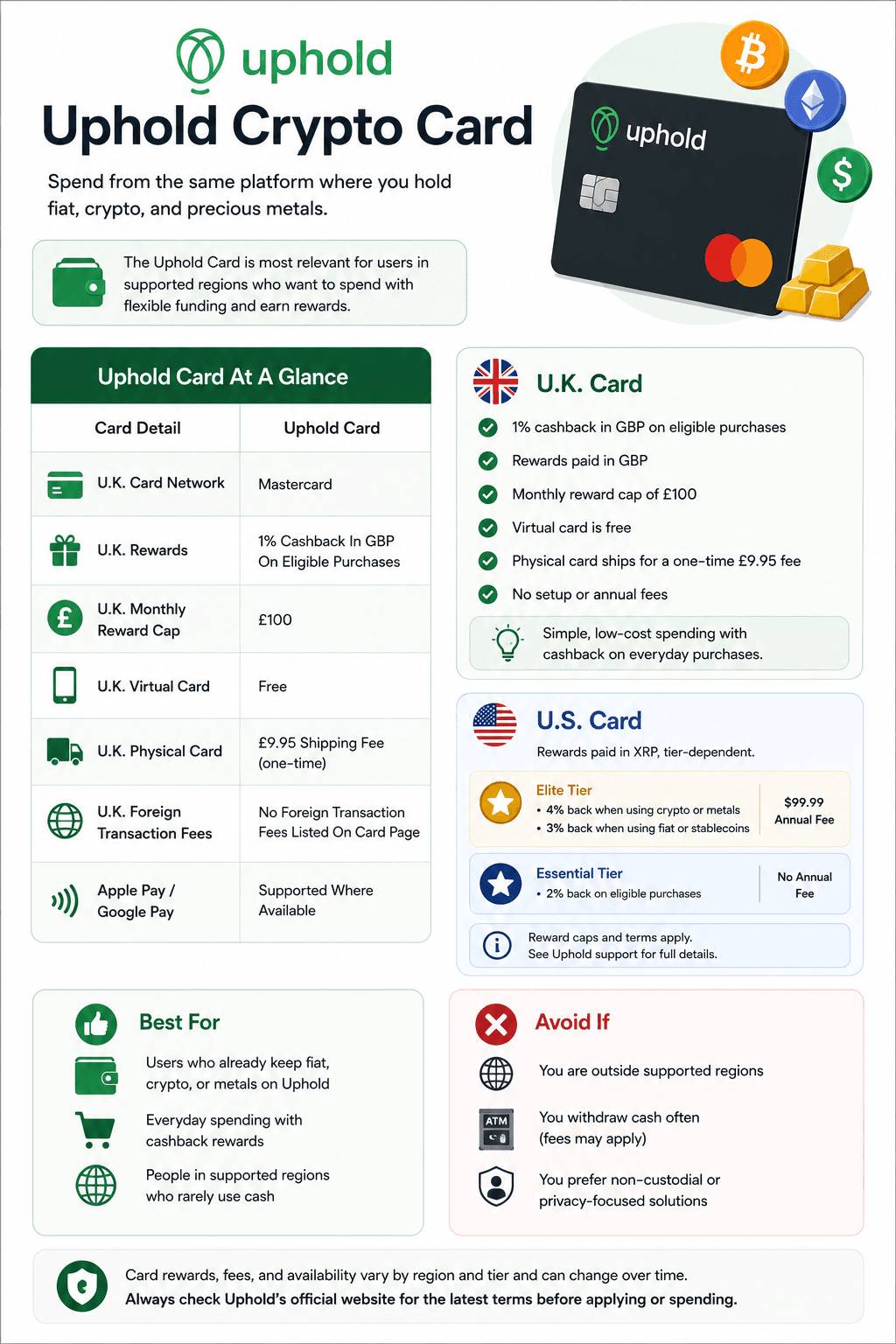
The Uphold Card is most relevant for users in supported regions who want to spend from the same platform where they hold fiat or crypto.
 Card Rewards, Regional Access, And Spending Limits
Uphold’s U.K. card is a Mastercard debit card available to U.K. users. Its U.K. page says users can earn 1% cashback on eligible purchases, paid in GBP, with rewards capped at £100 per month. It also says the virtual card is free, physical cards can be requested for a one-time £9.95 shipping fee, and the card has no setup or annual fees.
U.S. card rewards are different. Uphold’s rewards support page says U.S. card rewards are paid in XRP, with an Elite tier offering 4% back when using crypto or metals and 3% when using fiat or stablecoins, while the Essential tier offers 2% back on eligible purchases. The Elite tier has a $99.99 annual fee, and reward caps apply.
| Card Detail | Uphold Card |
|---|---|
| U.K. Card Network | Mastercard |
| U.K. Rewards | 1% Cashback In GBP On Eligible Purchases |
| U.K. Monthly Reward Cap | £100 |
| U.K. Virtual Card | Free |
| U.K. Physical Card | £9.95 Shipping Fee |
| U.K. Foreign Transaction Fees | No Foreign Transaction Fees Listed On Card Page |
| Apple Pay / Google Pay | Supported Where Available |
| U.S. Rewards | XRP Rewards, Tier-Dependent |
| U.S. Elite Tier | 4% Crypto/Metals, 3% Fiat/Stablecoins |
| U.S. Essential Tier | 2% On Eligible Purchases |
| Best For | Users Already Holding Spendable Balances On Uphold |
| Avoid If | You Are Outside Supported Regions Or Use ATMs Often |
The card fits users who already keep money in Uphold and want easier spending access. It is less compelling for people who do not use Uphold regularly, live outside supported regions, withdraw cash often, or do not want spending tied to a custodial crypto platform.
Compare and review the best credit and debit cards available in the Web3 market.
Uphold App And User Experience
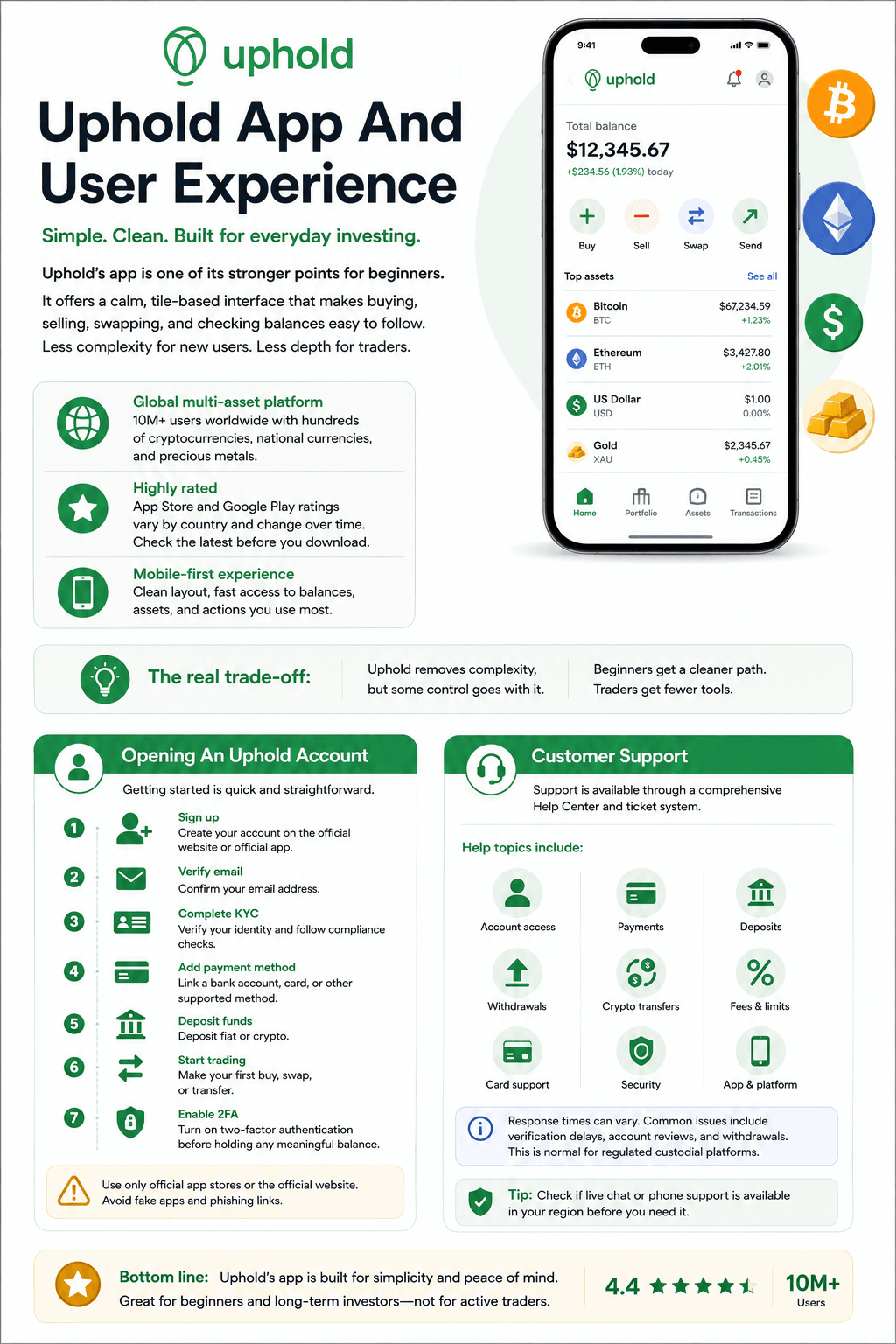
Uphold’s app is one of its stronger points for beginners. The web platform and mobile app are simple, with a tile-based interface that makes buying, selling, swapping, and checking balances easy to follow. Compared with pro exchanges, it feels calmer and less intimidating. That is good for first-time users, but it can feel limiting for traders who want depth.
 A Beginner-Friendly App With Custodial Trade-Offs
Uphold’s Google Play listing describes it as a global multi-asset digital trading platform with more than 5M users, hundreds of supported cryptocurrencies, national currencies, and precious metals.
Opening An Uphold Account
Opening an Uphold account follows the usual crypto exchange flow.
- Sign up through the official website or official app.
- Verify your email.
- Complete KYC and identity verification.
- Add a payment method.
- Deposit fiat or crypto.
- Make the first buy, swap, or transfer.
- Turn on 2FA before holding any meaningful balance.
The process is straightforward, which is part of Uphold's beginner appeal. There are fewer screens than a professional exchange and less trading language to decode.
KYC is still part of the experience. Users should expect identity verification, payment method checks, and possible account reviews. That is normal for regulated custodial platforms, but it can surprise users who expect crypto apps to behave like private wallets.
Users should only download Uphold from official app stores or the official website. Fake app and phishing risks are common across crypto platforms, and search ads are not always safe.
Customer Support
Uphold support is built around a support center and ticket system.
The support center covers account access, payments, deposits, withdrawals, crypto transfers, fees, and card questions. That is normal for crypto platforms, but it can be frustrating when users need urgent help with account access or withdrawals.
Common user complaints across exchange-style platforms include slow response times, verification delays, account reviews, and withdrawal checks. Uphold is not unique here, but beginners should know that “easy app” does not always mean instant support.
Customer support is especially relevant because Uphold is custodial. If something goes wrong inside a private wallet, the user has control but also full responsibility. If something goes wrong inside Uphold, the user often needs support to resolve it. That makes response quality part of the product, not a side issue.
Uphold Vs Coinbase Vs Kraken Vs eToro
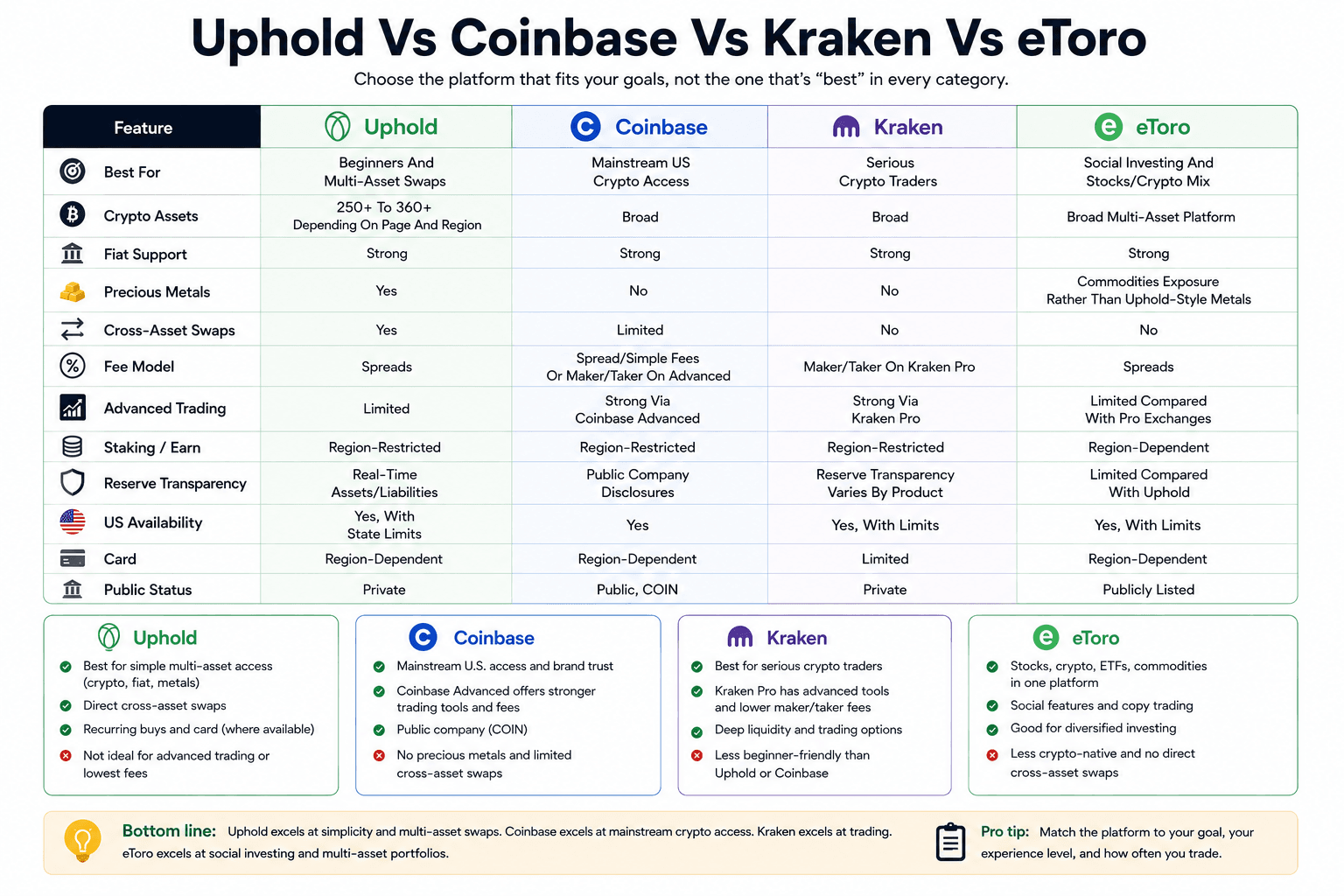
Uphold is best compared by use case, not by asking which platform is “best” in every category.
| Platform | Best For | Crypto Assets | Fiat Support | Precious Metals | Cross-Asset Swaps | Fee Model | Advanced Trading | Staking / Earn | Reserve Transparency | US Availability | Card | Public Status |
| Uphold | Beginners And Multi-Asset Swaps | 250+ To 360+ Depending On Page And Region | Strong | Yes | Yes | Spreads | Limited | Region-Restricted | Real-Time Assets/Liabilities | Yes, With State Limits | Region-Dependent | Private |
| Coinbase | Mainstream US Crypto Access | Broad | Strong | No | Limited | Spread/Simple Fees Or Maker/Taker On Advanced | Strong Via Coinbase Advanced | Region-Restricted | Public Company Disclosures | Yes | Region-Dependent | Public, COIN |
| Kraken | Serious Crypto Traders | Broad | Strong | No | No | Maker/Taker On Kraken Pro | Strong Via Kraken Pro | Region-Restricted | Reserve Transparency Varies By Product | Yes, With Limits | Limited | Private |
| eToro | Social Investing And Stocks/Crypto Mix | Broad Multi-Asset Platform | Strong | Commodities Exposure Rather Than Uphold-Style Metals | No | Spreads | Limited Compared With Pro Exchanges | Region-Dependent | Limited Compared With Uphold | Yes, With Limits | Region-Dependent | Publicly Listed |
 How Uphold Compares With Major Trading Platforms
Uphold Vs Coinbase
Uphold is better for users who want metals and direct cross-asset swaps.
Coinbase is better for mainstream U.S. crypto access, institutional brand recognition, and a stronger advanced interface through Coinbase Advanced. Coinbase Advanced uses a volume-based fee structure, which can be more attractive for active users than Uphold’s spread model.
A beginner who wants to buy XRP, hold some gold, and set recurring buys may find Uphold easier. A user placing regular limit orders on BTC and ETH pairs may find Coinbase Advanced more efficient.
Choose Uphold for simple multi-asset flexibility.
Choose Coinbase for stronger crypto trading tools and better fee control.
Uphold Vs Kraken
Kraken is better for serious crypto traders. The Kraken Pro offers stronger trading tools, lower maker/taker-style pricing for many users, and a more exchange-native experience. Kraken’s standard platform is geared toward beginners, while Kraken Pro uses a 30-day trading volume-based maker/taker model for advanced traders.
That makes Kraken a better choice for users who care about execution. If someone places frequent limit orders, manages entries and exits carefully, or trades size, fee structure and liquidity matter more than a simple app flow.
Uphold is better for users who do not want that complexity. It is easier for someone who wants to buy Bitcoin, swap into XRP, hold gold, or automate recurring buys without learning a professional interface.
Kraken is the better exchange.
Uphold is the simpler multi-asset app.
Uphold Vs eToro
eToro is better for users who want stocks plus crypto exposure in one investing app.
The eToro platform supports a broad investing experience across stocks, crypto, ETFs, commodities, currencies, and social trading features. It also leans into community-led investing, which gives it a different identity from Uphold.
Uphold is better for users who care more about crypto, fiat, metals, direct swaps, and card use where supported. It feels more like a multi-asset wallet and trading app, while eToro feels more like a social investing platform.
Who Should Use Uphold?
Uphold is best for users who want one simple app for crypto, fiat, and metals.
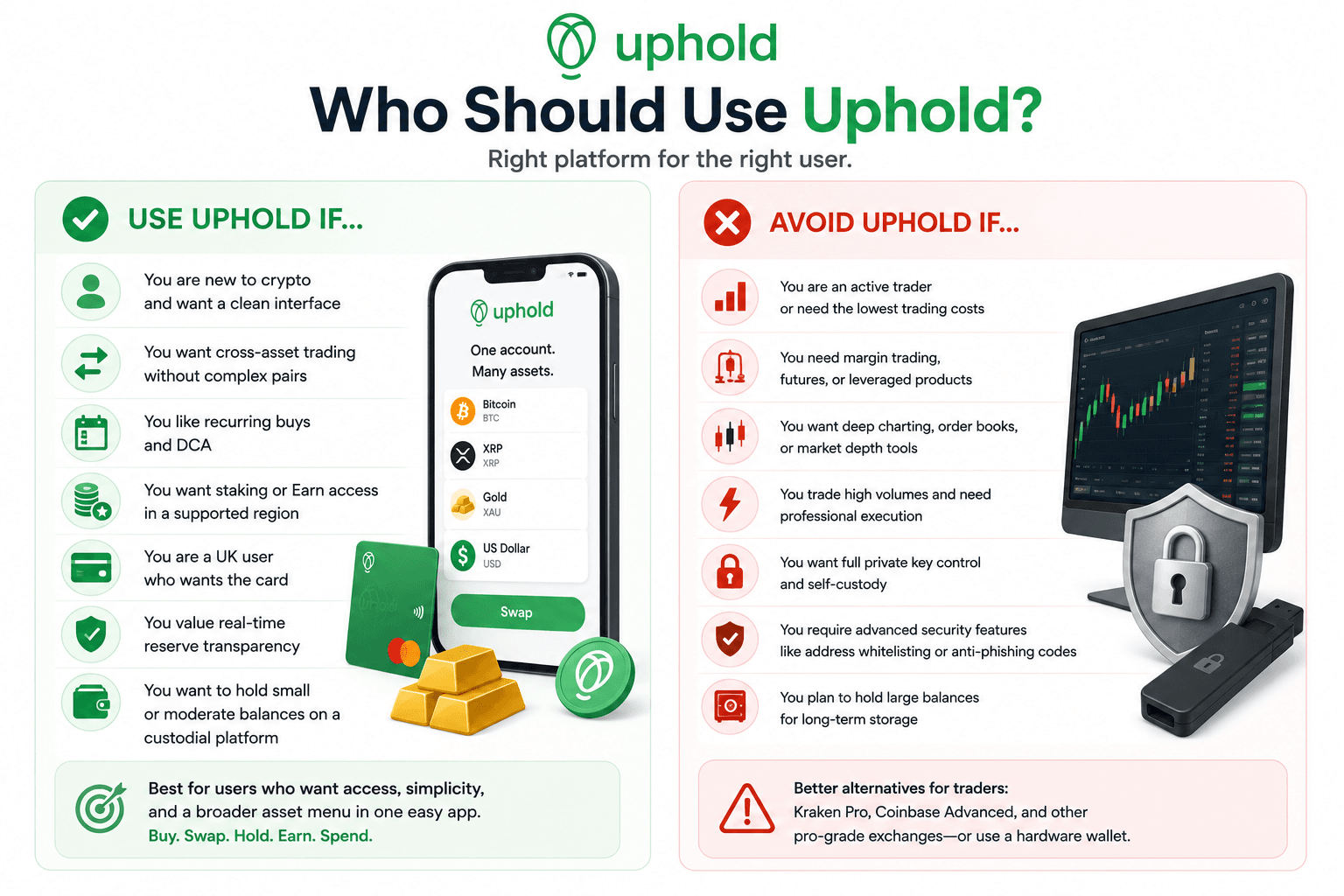 The Best Fit For Uphold’s Simple Asset Access
Use Uphold if:
- You are new to crypto and want a clean interface
- You want cross-asset trading without complex pairs
- You like recurring buys and DCA
- You want staking or Earn access in a supported region
- You are a UK user who wants the card
- You value real-time reserve transparency
- You want to hold small or moderate balances on a custodial platform
The platform fits users who think in plain terms: buy Bitcoin, swap into XRP, hold some gold, set a recurring buy, or spend through a card where supported. It is less suited to users who think in order books, leverage, execution fees, and market depth.
The best Uphold user is probably not trying to beat the market every day. They want access, simplicity, and a broader asset menu than a crypto-only app. For that person, Uphold has a clear place.
Who Should Avoid Uphold?
Avoid Uphold if you are an active trader or need the lowest trading costs.
It is also a poor fit if you want margin, futures, deep charting, high-volume execution, or advanced order book tools.
Security-conscious users should also think carefully before holding large balances on Uphold. If you want withdrawal address whitelisting, anti-phishing codes, full private key control, or long-term cold storage, use a hardware wallet instead.
Uphold is useful for access and convenience. It should not be treated as the only storage plan for a serious crypto portfolio.

Final Verdict: Is Uphold Worth Using In 2026?
Uphold is worth considering in 2026 if you are a beginner, casual investor, or multi-asset user who wants crypto, fiat, and metals in one simple custodial app.
The platform is strong because of its real-time reserve transparency, security certifications, card updates, rewards access in eligible regions, and broader asset coverage. It is especially useful for simple buys, cross-asset swaps, DCA, supported Earn or staking products, and card use where available.
It is not the cheapest exchange and it is not the best pro trading platform. Active traders should compare Coinbase Advanced, Kraken Pro, and other maker/taker exchanges before choosing Uphold. Long-term holders with large crypto balances should move funds to self-custody once they are done buying or swapping.
Our recommendation: Use Uphold for convenience, use a pro exchange for active trading.