Ethereum wallets are no longer just places to park ETH. They are the gateway to DApps, DeFi, NFTs, staking, Layer 2 networks and the wider Ethereum ecosystem.
The best Ethereum wallets in 2026 include MetaMask and Rabby for everyday DApp access, Ledger, Trezor, Safe, Rainbow, Trust Wallet, Coinbase Wallet/Base App, Exodus and MyEtherWallet.
This guide compares the top Ethereum wallets. We’ll look at what each wallet does well, where it falls short and which setup makes the most sense for beginners, DeFi users, NFT collectors, long-term ETH holders and teams managing shared funds.
Editor's Note (June 18, 2026): We fully updated this article in June 2026 to reflect the current Ethereum wallet landscape, including new wallet rankings, updated hardware wallet options, stronger DeFi and NFT guidance, Layer 2 support, staking routes, smart wallet adoption, multisig use cases and modern wallet security practices. We also expanded the guide with clearer setup recommendations for beginners, DeFi users, NFT collectors, long-term ETH holders, teams and high-value wallet users.
Quick Answer: Best Ethereum Wallets in 2026
MetaMask is best for broad Ethereum DApp access, Rabby is best for active DeFi users, Ledger is best for long-term ETH storage, Trezor is best for open-source cold storage, Coinbase Wallet / Base App is best for beginners and Base users, Safe is best for teams and treasuries, Trust Wallet is best for mobile multi-chain users, Rainbow is best for NFTs, Exodus is best for simple desktop and mobile use, and MyEtherWallet is best for classic Ethereum tooling.
MetaMask
Best for users who want broad Ethereum, EVM, NFT marketplace and DApp compatibility across the largest range of onchain apps.
Rabby
Best for active EVM users who want stronger transaction previews, automatic chain switching and clearer approval visibility.
Ledger
Best for long-term ETH holders who want offline private-key storage while still keeping access to Ethereum apps through Ledger Wallet, MetaMask or Rabby.
Trezor
Best for users who value open-source design, transparent cold storage and hardware signing for ETH and ERC-20 tokens.
Coinbase Wallet / Base App
Best for Coinbase users, Base users and beginners who want an easier path into Ethereum self-custody and smart wallet onboarding.
Safe
Best for shared funds because teams can set signer roles, approval thresholds and multisig rules before treasury transactions move.
Trust Wallet
Best for mobile users who want Ethereum support alongside many other chains, tokens, NFTs, swaps and DApp access.
Rainbow
Best for NFT collectors and Ethereum-native mobile users who want cleaner asset display and a smoother wallet experience across Ethereum and L2s.
Exodus
Best for casual ETH holders who want a polished wallet for desktop, mobile, portfolio tracking, swaps and simple asset management.
MyEtherWallet
Best for experienced Ethereum users who want long-running ETH tooling, ERC-20 support, NFT support, staking options and hardware wallet integrations.
| Use Case | Best Wallet | Wallet Type | Why It Fits | Main Drawback |
|---|---|---|---|---|
| Best overall Ethereum wallet | MetaMask | Software wallet | Broad DApp, Ethereum and EVM compatibility | Phishing risk and seed phrase responsibility |
| Best Ethereum wallet for DeFi | Rabby | Software wallet | Strong transaction previews, automatic chain switching and EVM focus | Less familiar to beginners |
| Best Ethereum hardware wallet | Ledger | Hardware wallet | Keeps private keys offline while supporting ETH, tokens, NFTs and staking routes | Costs money and still requires careful signing |
| Best open-source hardware wallet | Trezor | Hardware wallet | Strong transparency, Ethereum support and cold-storage reputation | Deeper DApp use often needs third-party interfaces |
| Best beginner Ethereum wallet | Coinbase Wallet / Base App | Self-custody wallet / smart wallet | Cleaner onboarding, Base ecosystem alignment and passkey support | Users may confuse it with Coinbase exchange custody |
| Best wallet for teams and treasuries | Safe | Multisig smart wallet | Multiple approvals before funds move | Too complex for casual users |
| Best mobile Ethereum wallet | Trust Wallet | Mobile self-custody wallet | Broad mobile support for ETH, NFTs, DApps and many chains | Less advanced DeFi transaction analysis |
| Best Ethereum NFT wallet | Rainbow | Ethereum-focused wallet | Strong NFT display and clean Ethereum-native mobile UX | Less suited to heavy DeFi power users |
| Best wallet for desktop/mobile simplicity | Exodus | Desktop and mobile wallet | Polished interface, portfolio tracking, swaps and hardware support | Not fully open source and less DeFi-native |
| Best classic Ethereum wallet | MyEtherWallet | Ethereum wallet interface | Long-running ETH wallet with ERC-20, NFT, staking and hardware support | Less modern than newer beginner wallets |
Disclaimer
This guide is for educational purposes only and is not financial advice. Always verify wallet URLs, device authenticity, supported networks, recovery flows, token approvals and transaction details before sending assets or connecting to any DApp.
Disclosure
Some links in this guide may be affiliate links. If you choose to use a service through these links, we may earn a commission at no additional cost to you.
How We Chose The Best Ethereum Wallets (Methodology)
The best Ethereum wallet is not always the one with the most coins, chains or features. It is the one that fits how people actually use Ethereum, whether that means holding ETH, connecting to DApps, trading in DeFi, collecting NFTs, staking, using Layer 2s, or managing funds with other signers.
- We prioritized wallets that support Ethereum mainnet, major Layer 2 networks and the EVM apps users are most likely to encounter.
- We looked at whether each wallet gives users clear control over private keys, seed phrases, smart accounts, multisig rules, or recovery options.
- We considered transaction previews, approval visibility, hardware wallet support and signing clarity, since many Ethereum wallet mistakes happen before assets actually move.
- We favored wallets that make routine actions easier, including sending ETH, switching networks, viewing tokens, connecting to DApps, managing NFTs and using WalletConnect.
- We also checked staking access, swap and bridge support, mobile and browser usability, security history, transparency, reputation and fit for specific users.
In simple terms, we focused on real Ethereum use over raw token count.
What We Did Not Prioritize
The number of supported coins was not treated as the deciding factor. A wallet can support thousands of assets and still be weak for Ethereum if it handles DApp approvals poorly, makes Layer 2 navigation confusing, or gives users little context before signing.
A beautiful interface was not enough either. Ethereum wallets need good design, but a shiny app does not automatically make token approvals safer or recovery easier.
The most overrated signal is popularity. Popular wallets attract more DApp support, but they also attract more phishing pages, fake browser extensions and fake support accounts. In Ethereum, the biggest wallet brand often has the biggest target on its back.
Best Ethereum Wallets Compared
| Wallet | Best For | Type | Custody | Platforms | Hardware Support | Ethereum L2 Support | NFTs | Staking | Main Limitation |
|---|---|---|---|---|---|---|---|---|---|
| MetaMask | Broad Ethereum access | Browser extension and mobile wallet | Self-custody | Browser, iOS, Android | Ledger and Trezor via extension | Strong EVM and custom network support | Yes | Via MetaMask Portfolio and providers | Phishing exposure and seed phrase responsibility |
| Rabby | Active DeFi users | Browser extension, desktop and mobile wallet | Self-custody | Browser, desktop, iOS, Android | Yes | Strong EVM and L2 support | Yes | Via DApps and integrations | Less beginner recognition |
| Ledger | Long-term ETH storage | Hardware wallet | Self-custody | Hardware device plus Ledger Wallet app | Native hardware signer | Via Ledger app and external wallets | Yes | Via providers inside Ledger Wallet | Device cost and signing education |
| Trezor | Open-source cold storage | Hardware wallet | Self-custody | Hardware device plus Trezor Suite | Native hardware signer | Via Suite and third-party interfaces | Supported through compatible interfaces | Selected routes | DApp experience can rely on external wallets |
| Coinbase Wallet / Base App | Beginners and Base users | Mobile wallet / smart wallet | Self-custody | Mobile and browser-based access | Limited versus MetaMask/Rabby setups | Strong Base and EVM support | Yes | Via DApps and integrations | Exchange-wallet confusion |
| Safe | Teams, DAOs and treasuries | Smart contract multisig wallet | Shared self-custody | Web app and integrations | Hardware wallets can act as signers | Major EVM networks | Yes | Via connected DApps | Signer coordination |
| Trust Wallet | Mobile multi-chain users | Mobile wallet and browser extension | Self-custody | iOS, Android, browser extension | Limited compared with hardware-first setups | Multi-chain and EVM support | Yes | Selected in-app options | Mobile hot-wallet exposure |
| Rainbow | NFTs and Ethereum-native mobile use | Mobile and desktop wallet | Self-custody | iOS, Android, desktop | Not the main focus | Ethereum, Base, Arbitrum, Optimism, Polygon, Zora and more | Strong | Via DApps | Less advanced DeFi tooling |
| Exodus | Simple desktop and mobile use | Desktop, mobile and Web3 wallet | Self-custody | Desktop, iOS, Android, browser | Ledger and Trezor support | Multi-chain support | Yes | Selected in-app options | Less DeFi-native |
| MyEtherWallet | Advanced ETH users | Ethereum wallet interface | Self-custody | Web, mobile and connected wallets | Ledger, Trezor and other wallets | Ethereum and L2 support | Yes | ETH staking options | Less modern beginner experience |
Readers who want a wider shortlist can read our best crypto wallets guide.
Best Ethereum Wallets in 2026
The Strongest Ethereum Wallets For 2026 Users Today
Ethereum wallets now sit on a spectrum. Hot wallets like MetaMask, Rabby, Trust Wallet and Rainbow are built for daily onchain activity. Hardware wallets like Ledger and Trezor are better for long-term ETH storage, while Safe and Coinbase Wallet/Base App add smart wallet or shared-custody features for more specific users.
1
MetaMask: Best Overall Ethereum Wallet
Best for: Broad Ethereum DApp access and maximum compatibility
⌄
MetaMask: Best Overall Ethereum Wallet
- Works with most Ethereum DApps, NFT marketplaces and DeFi apps.
- Supports Ethereum, EVM chains and custom networks.
- Offers browser extension and mobile wallet access.
- Includes swaps, bridges, NFTs and portfolio tools.
- Supports staking access through integrations.
- Works with Ledger and Trezor for hardware wallet signing.
- Major phishing target because of its popularity.
- Seed phrase security sits fully with the user.
- Transaction previews can feel limited for advanced DeFi.
- Rabby offers a stronger DeFi-first workflow.
- Hot wallet setup is not ideal for large balances alone.
- Everyday Ethereum users.
- DApp access.
- NFT users.
- Users who want maximum compatibility.
- Hardware wallet users who need a familiar DApp interface.
- You want DeFi-first transaction simulation.
- You are not ready to manage a recovery phrase.
- You plan to keep large funds in one hot wallet.
2
Rabby: Best Ethereum Wallet For DeFi Users
Best for: Active DeFi users and EVM power users
⌄
Rabby: Best Ethereum Wallet For DeFi Users
Readers comparing active onchain wallets can use the best DeFi wallets guide before choosing a daily setup.
- Simulates transactions before signing.
- Switches EVM chains automatically.
- Shows token approval risk more clearly.
- Works well across Ethereum, Arbitrum, Optimism, Base and Polygon.
- Supports hardware wallets.
- Fits users who swap, lend, borrow, bridge and stake often.
- Less familiar to beginners than MetaMask.
- Less useful outside Ethereum and EVM ecosystems.
- Some DApps still write instructions around MetaMask first.
- Not the obvious pick for users who only hold ETH.
- Active DeFi users.
- EVM power users.
- Ethereum Layer 2 users.
- Users who approve contracts often.
- Users managing several onchain positions.
- You want the most beginner-recognized wallet.
- You rarely connect to DApps.
- You need broad non-EVM wallet support.
3
Ledger: Best Ethereum Hardware Wallet For Cold Storage
Best for: Long-term ETH storage and hardware signing
⌄
Ledger: Best Ethereum Hardware Wallet For Cold Storage
For wider cold-storage comparisons, the best hardware wallets guide covers Ledger, Trezor and other devices.
- Keeps private keys offline.
- Supports ETH, ERC-20 tokens and NFTs.
- Provides staking access through Ledger Wallet providers.
- Works with MetaMask and Rabby for DApp access.
- Adds a physical signing step before transactions.
- Suits users separating storage from daily wallet activity.
- Hardware device costs money.
- Setup takes more effort than a mobile wallet.
- Users still need to understand blind signing and clear signing.
- Cannot stop every malicious approval.
- Less convenient for frequent small DApp transactions.
- Long-term ETH holders.
- Users with larger balances.
- NFT collectors with valuable assets.
- DeFi users who want hardware signing.
- Users separating cold storage from activity wallets.
- You only hold small balances.
- You want the fastest DApp experience.
- You approve transactions without reading the device screen.
4
Trezor: Best Open-Source Ethereum Hardware Wallet
Best for: Open-source cold storage and external wallet interfaces
⌄
Trezor: Best Open-Source Ethereum Hardware Wallet
- Offers open-source hardware wallet positioning.
- Keeps private keys offline.
- Supports Ethereum and ERC-20 tokens.
- Uses Trezor Suite for asset management.
- Works with MetaMask, Rabby and MyEtherWallet.
- Fits users who want transparent cold storage.
- DApp use often depends on third-party interfaces.
- NFT experience may feel less direct than hot wallets.
- Some users may prefer Ledger’s wider app ecosystem.
- Not the smoothest all-in-one Ethereum experience.
- Users who value open-source design.
- Long-term ETH holders.
- Ledger alternatives.
- Hardware wallet users comfortable with external interfaces.
- Cold-storage-focused investors.
- You want the smoothest built-in DeFi workflow.
- You prefer an all-in-one wallet app.
- You do not want to use third-party interfaces.
5
Coinbase Wallet / Base App: Best Ethereum Wallet For Beginners
Best for: Coinbase users, Base users and easier self-custody onboarding
⌄
Coinbase Wallet / Base App: Best Ethereum Wallet For Beginners
- Offers a beginner-friendly self-custody flow.
- Fits users already familiar with Coinbase.
- Aligns closely with the Base ecosystem.
- Supports Ethereum-style activity with lower-cost L2 access.
- Moves toward smart wallet and passkey-based onboarding.
- Works well as a first Ethereum wallet.
- Users may confuse Coinbase exchange custody with Coinbase Wallet self-custody.
- Less powerful for advanced DeFi than Rabby.
- Less universal for DApp support than MetaMask.
- Hardware wallet workflows are not the main strength.
- Smart wallet recovery models still require user understanding.
- Beginners.
- Base users.
- Coinbase users moving into self-custody.
- Users who want an easier first wallet.
- Users trying lower-cost Ethereum L2 activity.
- You want advanced DeFi transaction simulation.
- You need heavy EVM power-user tooling.
- You want a hardware-wallet-first setup.
6
Safe: Best Ethereum Wallet For Teams, DAOs And Treasuries
Best for: Multisig, shared control and onchain treasuries
⌄
Safe: Best Ethereum Wallet For Teams, DAOs And Treasuries
- Uses multisig approvals for shared control.
- Supports treasury management.
- Reduces single-key failure risk.
- Allows signer thresholds such as 2-of-3 or 3-of-5.
- Works across Ethereum and major EVM networks.
- Lets teams use hardware wallets as signers.
- Too complex for casual beginners.
- Requires signer coordination.
- Smart contract wallet behavior can confuse new users.
- Slower than a personal hot wallet.
- Not built for simple daily wallet activity.
- DAOs.
- Protocol teams.
- Companies.
- Crypto funds.
- Onchain treasuries.
- Large shared balances.
- You only need a personal wallet.
- You want quick casual mobile payments.
- You do not need shared approval rules.
7
Trust Wallet: Best Mobile Ethereum Wallet For Multi-Chain Users
Best for: Mobile-first Ethereum and broad multi-chain use
⌄
Trust Wallet: Best Mobile Ethereum Wallet For Multi-Chain Users
- Offers mobile-first self-custody.
- Supports Ethereum and many other networks.
- Handles ETH, ERC-20 tokens and NFTs.
- Includes DApp and Web3 access.
- Gives users one app for broad crypto activity.
- Works well for casual multi-chain users.
- Mobile hot-wallet exposure.
- Less advanced DeFi transaction analysis.
- Not ideal for large cold-storage balances.
- Seed phrase security remains fully on the user.
- Less suited to deep EVM protocol activity.
- Mobile users.
- Multi-chain users.
- Beginners with smaller balances.
- Users who want Ethereum support in one broad wallet.
- Casual DApp and NFT users.
- You want DeFi-grade transaction simulation.
- You hold large balances without a hardware wallet.
- You need a desktop-first Ethereum setup.
8
Rainbow: Best Ethereum Wallet For NFTs And Ethereum-Native Mobile Use
Best for: NFT collectors, ENS users and Ethereum-native mobile users
⌄
Rainbow: Best Ethereum Wallet For NFTs And Ethereum-Native Mobile Use
- Displays Ethereum NFTs cleanly.
- Offers a polished mobile-first experience.
- Supports Ethereum mainnet and several L2s.
- Works well for ENS users and collectors.
- Feels more Ethereum-native than broad multi-chain wallets.
- Makes assets easier to view and organize.
- Rabby is stronger for active DeFi.
- MetaMask still has broader DApp recognition.
- Hardware wallet support is not the main selling point.
- Less useful for non-Ethereum ecosystems.
- Not ideal for heavy EVM power users.
- NFT collectors.
- Ethereum-native mobile users.
- ENS users.
- Users active across Ethereum L2s.
- Users who want a cleaner wallet experience.
- You mainly trade DeFi across many EVM chains.
- You want the most universal DApp support.
- You need hardware-wallet-first storage.
9
Exodus: Best Ethereum Wallet For Simple Desktop And Mobile Use
Best for: Casual ETH users and simple portfolio tracking
⌄
Exodus: Best Ethereum Wallet For Simple Desktop And Mobile Use
- Offers a clean desktop and mobile interface.
- Tracks portfolios across many assets.
- Supports built-in swaps.
- Includes selected staking options.
- Works with Ledger and Trezor.
- Suits users who want simplicity over DeFi depth.
- Less suited to advanced Ethereum DeFi.
- Not fully open source.
- Built-in swaps may include spreads or provider costs.
- Not the strongest wallet for token approval visibility.
- Less DApp-native than MetaMask or Rabby.
- Casual ETH users.
- Desktop-first users.
- Portfolio trackers.
- Users holding several assets, not only ETH.
- Users who prefer simplicity over power-user controls.
- You need advanced DApp controls.
- You want fully open-source wallet software.
- You are an active DeFi power user.
10
MyEtherWallet: Best Classic Ethereum Wallet For Advanced ETH Users
Best for: Classic Ethereum tooling and experienced ETH users
⌄
MyEtherWallet: Best Classic Ethereum Wallet For Advanced ETH Users
- Offers a long-running Ethereum wallet interface.
- Supports ETH and ERC-20 tokens.
- Supports NFTs, including ERC-721 and ERC-1155 assets.
- Provides hardware wallet integrations.
- Includes ETH staking options.
- Keeps an Ethereum-focused identity.
- Less modern beginner experience.
- Not as plug-and-play as MetaMask for many DApps.
- Less visually polished than Rainbow.
- Better suited to experienced ETH users.
- Not the easiest first wallet.
- Advanced ETH users.
- Long-time Ethereum users.
- Hardware wallet users.
- Users who want classic Ethereum tooling.
- ETH staking users.
- You want the easiest first wallet.
- You prefer a polished mobile-first NFT wallet.
- You need the smoothest DeFi daily driver.
Best Ethereum Wallet Setup by User Type
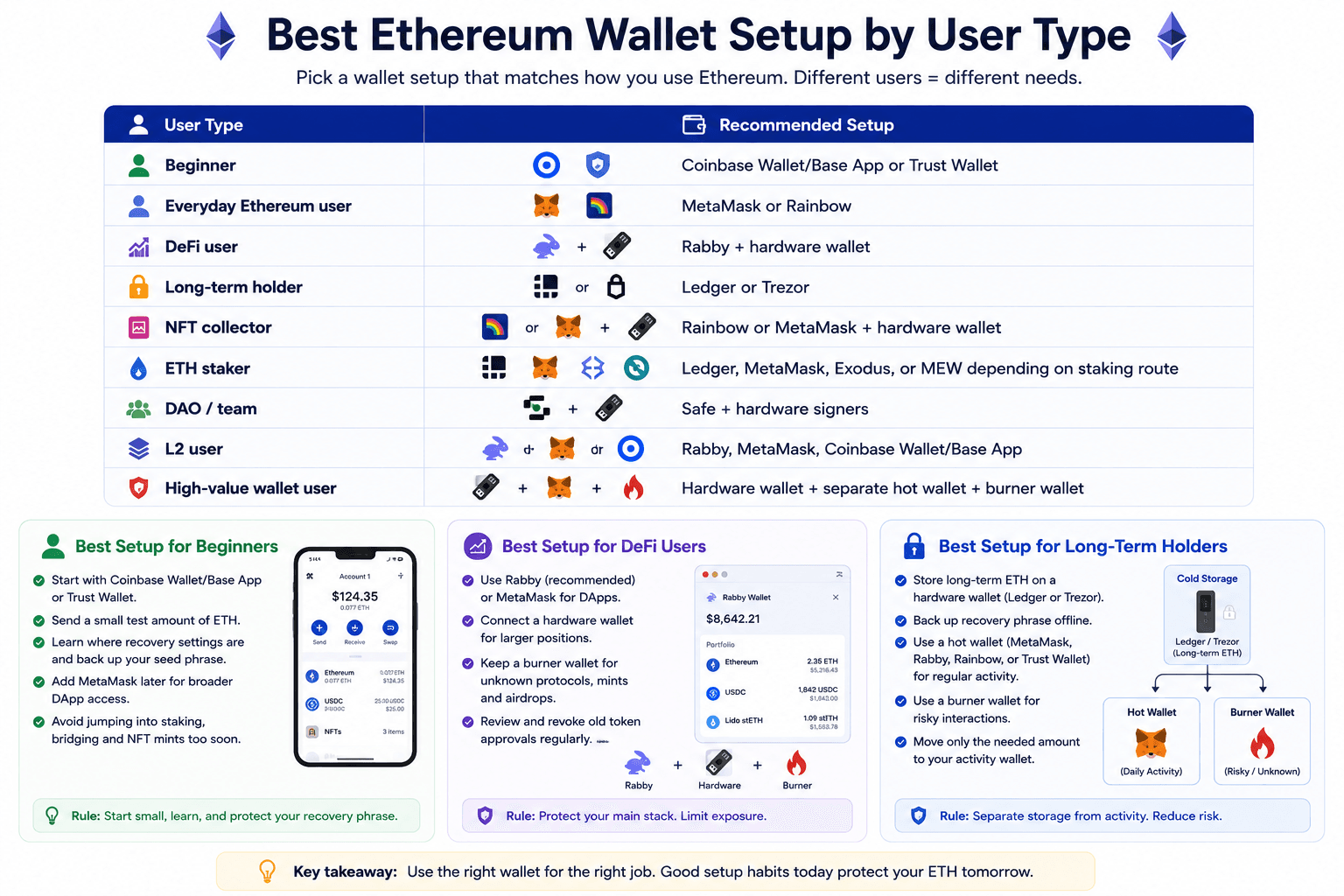
The best Ethereum wallet setup depends on the user’s behavior. A beginner should not start with a complex multisig. A DAO should not rely on one person’s mobile wallet. A DeFi user should not keep every asset in the same hot wallet used for unknown mints.
 Practical Ethereum Wallet Setups For Every User Profile
Our best crypto hot wallets guide is useful for readers comparing daily-use software wallets.
| User Type | Recommended Setup |
|---|---|
| Beginner | Coinbase Wallet/Base App or Trust Wallet |
| Everyday Ethereum user | MetaMask or Rainbow |
| DeFi user | Rabby + hardware wallet |
| Long-term holder | Ledger or Trezor |
| NFT collector | Rainbow or MetaMask + hardware wallet |
| ETH staker | Ledger, MetaMask, Exodus, or MEW depending on staking route |
| DAO/team | Safe + hardware signers |
| L2 user | Rabby, MetaMask, Coinbase Wallet/Base App |
| High-value wallet user | Hardware wallet + separate hot wallet + burner wallet |
Best Setup for Beginners
Beginners should optimize for clarity, not maximum features. Coinbase Wallet/Base App and Trust Wallet are the easiest starting points because they keep the first wallet experience relatively simple.
The first transfer should be small. Send a tiny amount of ETH, confirm it arrives, check the network, learn where the recovery settings are and understand what happens if the phone or browser is lost. That practice round is boring, but it prevents expensive panic later.
Once the basics are clear, users can add MetaMask for wider DApp compatibility or move larger funds to Ledger or Trezor. The mistake is jumping straight from an exchange account into staking, bridging and NFT mints without understanding recovery.
Best Setup for DeFi Users
DeFi users should use Rabby or MetaMask for DApp access, with a hardware wallet for larger positions. Rabby is the stronger daily wallet for EVM DeFi because it gives better transaction context and smoother network handling. MetaMask remains useful because almost every Ethereum DApp supports it.
The better DeFi setup also includes a burner wallet. This is a separate wallet used for unknown protocols, risky mints, airdrop claims and small experiments. It should not hold meaningful funds.
Token approvals need attention too. DeFi often requires approvals, but old unlimited approvals can sit around long after the user has left a protocol. Active DeFi users should regularly review and revoke stale approvals.
Best Setup for Long-Term ETH Holders
Long-term ETH holders should use a hardware wallet and separate storage from activity. Ledger and Trezor are the main picks.
The storage wallet should not be the wallet used for every mint, swap, bridge and airdrop. That defeats the point of cold storage. A cleaner setup is:
- Keep long-term ETH on a hardware wallet.
- Back up the recovery phrase offline.
- Use MetaMask, Rabby, Rainbow, or Trust Wallet for regular activity.
- Use a burner wallet for unknown protocols.
- Move only the needed amount into the activity wallet.
That structure does not make the user invincible. It limits blast radius, which is the real goal.
Ethereum Wallets for DeFi, NFTs, Staking and L2s
Ethereum wallet choice becomes clearer once it is mapped to actual activity. DeFi needs signing clarity. NFTs need display and marketplace support. Staking needs route selection. Layer 2 users need clean network handling and fewer wrong-chain mistakes.
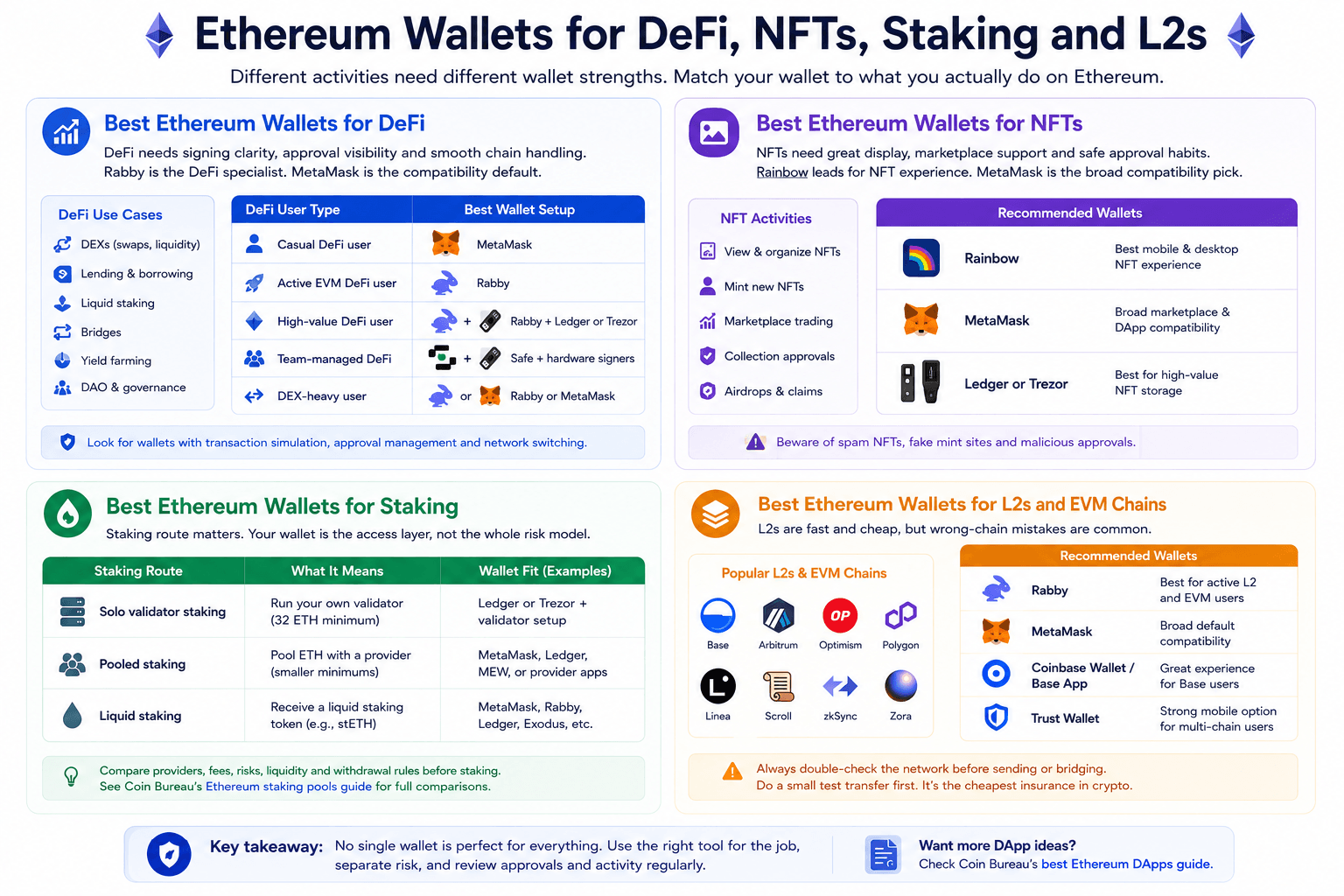 Best Wallet Choices For Ethereum’s Main Onchain Activities
Best Ethereum Wallets for DeFi
Rabby is the best Ethereum wallet for active DeFi users. MetaMask is the broad compatibility pick. Safe is better for team-managed DeFi positions. Ledger and Trezor make sense when users want hardware signing for larger balances.
DeFi wallet use is more demanding than simple ETH storage. Users may interact with decentralized exchanges, lending markets, liquid staking protocols and bridges. Each interaction can involve approvals, smart contract calls, network switching and gas decisions. That is why transaction simulation and approval visibility are useful.
| DeFi User Type | Best Wallet Setup |
|---|---|
| Casual DeFi user | MetaMask |
| Active EVM DeFi user | Rabby |
| High-value DeFi user | Rabby + Ledger or Trezor |
| Team-managed DeFi | Safe + hardware signers |
| DEX-heavy user | Rabby or MetaMask |
Best Ethereum Wallets for NFTs
Rainbow is the best Ethereum wallet for NFT display and mobile NFT use. MetaMask is still the safest broad marketplace compatibility pick. Ledger and Trezor are better for storing higher-value NFTs when paired with careful signing habits.
NFT users deal with a different kind of wallet risk. Spam NFTs can lure users into malicious claim sites. Marketplace approvals can give contracts permission over collections. Fake mint pages can copy real project branding and drain wallets through malicious signatures.
A practical NFT setup is Rainbow or MetaMask for browsing and collecting, plus a hardware wallet for valuable NFTs that are not actively listed or traded.
Check out our top picks for the best NFT marketplaces.
Best Ethereum Wallets for Staking
ETH staking depends on the staking route. A wallet can help users access staking, but the staking provider, smart contract, validator setup and liquidity model matter too.
There are three broad paths:
| Staking Route | What It Means | Wallet Fit |
|---|---|---|
| Solo validator staking | Running validator infrastructure with 32 ETH | Hardware wallet plus validator setup |
| Pooled staking | Smaller users pool ETH through a provider | MetaMask, Ledger, MEW, or provider interfaces |
| Liquid staking | Users receive a liquid staking token | MetaMask, Rabby, Ledger, or DeFi wallet setup |
MetaMask supports staking routes through MetaMask Portfolio. Ledger Wallet supports staking through integrated providers. Exodus and MyEtherWallet also offer selected staking routes.
ETH staking is not the same as earning interest in a bank account. It can involve smart contract risk, liquidity risk, validator risk, slashing, withdrawal queues and provider fees. The wallet is the access layer, not the whole risk model.
Best Ethereum Wallets for L2s and EVM Chains
Rabby is the strongest wallet for active Ethereum L2 and EVM users because it handles chain switching well. MetaMask remains the broad default. Coinbase Wallet/Base App is a good fit for Base users. Trust Wallet works well for mobile users who want Ethereum support alongside many other networks.
Ethereum Layer 2 networks include Base, Arbitrum, Optimism, Polygon, Linea, Scroll, zkSync and Zora. These networks reduce costs and improve throughput, but they also create more room for user mistakes. ETH on Ethereum mainnet and ETH on Base are not the same wallet context. The address may look the same, but the network is different.
The most common beginner error is sending funds through the wrong network or assuming every exchange supports every L2 deposit path. A small test transfer is still the cheapest insurance in crypto.
What Is an Ethereum Wallet?
An Ethereum wallet is the tool that lets users control an Ethereum account. It can send and receive ETH, manage ERC-20 tokens, hold NFTs, connect to DApps, sign transactions and interact with smart contracts across Ethereum mainnet and Ethereum-compatible networks.
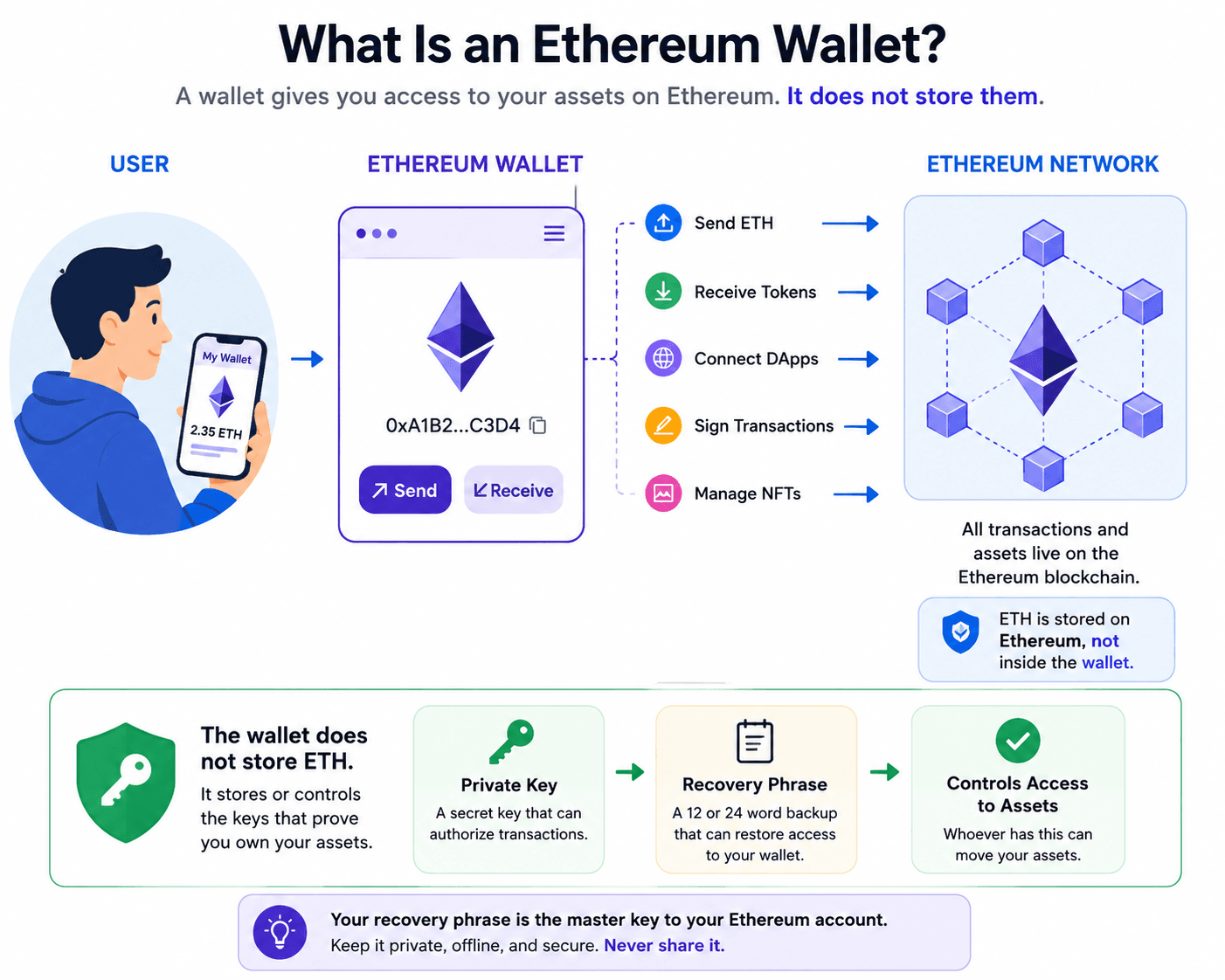 How Ethereum Wallets Control Accounts, Keys And Onchain Access
The key point is that the wallet does not literally store ETH. ETH remains on the Ethereum blockchain. The wallet stores or controls access to the private keys that prove you can move assets from a specific account. If someone gets the private key or recovery phrase, they do not need your password, email or permission.
| Term | Plain-English Meaning |
|---|---|
| Wallet address | The public address others use to send assets to you |
| Private key | The secret key that can authorize transactions |
| Public key | Cryptographic data connected to the wallet address |
| Seed phrase / recovery phrase | The backup phrase that can restore access to the wallet |
| ERC-20 token | The main fungible token standard on Ethereum |
| ERC-721 | A common standard for one-of-one NFTs |
| ERC-1155 | A token standard used for mixed NFT and gaming assets |
| DApp | An app that connects to a blockchain wallet |
| Smart contract | Code on Ethereum that can hold assets and execute rules |
A beginner does not need to understand every cryptographic detail before using a wallet. But they do need to understand the power of the recovery phrase. It is not a normal password. It is closer to the master key for the account.
Ethereum Wallets vs Crypto Exchanges
An exchange account and an Ethereum wallet can both show an ETH balance, but they are not the same thing.
With a crypto exchange, the platform usually controls custody until you withdraw assets to your own wallet. You log in with an email, password, 2FA and account recovery process. That is convenient, especially for buying crypto with fiat, but it also means you are relying on the exchange to hold assets properly and process withdrawals when needed.
A self-custody Ethereum wallet flips the responsibility. You control the keys. You can connect directly to DApps, NFT marketplaces, DeFi protocols and Layer 2 networks without waiting for an exchange to support every onchain action. The price of that freedom is personal responsibility. If you lose the recovery phrase, send assets to the wrong network, or sign a malicious approval, there is usually no support desk that can reverse it.
Most beginners end up using both. They buy ETH on an exchange, send a small test amount to a wallet, learn how recovery works and then decide how much they want to self-custody.
Ethereum Wallets vs Bitcoin Wallets
Bitcoin wallets are usually built around sending, receiving and storing BTC. Some support advanced Bitcoin features, but the basic use case is narrower.
Ethereum wallets have to handle more surface area. A typical ETH wallet may need to support ERC-20 tokens, NFTs, staking flows, token approvals, DApp connections, bridge transactions, smart contract calls and multiple Layer 2 networks. The wallet is not just a vault. It is the remote control for an onchain app ecosystem.
That is why Ethereum wallet choice is more personal than Bitcoin wallet choice. A wallet that is excellent for cold ETH storage may feel clumsy inside DeFi. A slick mobile NFT wallet may not be the best place to manage a treasury. A DeFi wallet with strong transaction simulation may be excessive for someone who only holds ETH and USDC.
Hot Wallets vs Cold Wallets vs Smart Wallets
A MetaMask hot wallet, a Ledger hardware wallet and a Safe multisig wallet all help users manage ETH, but they solve different problems.
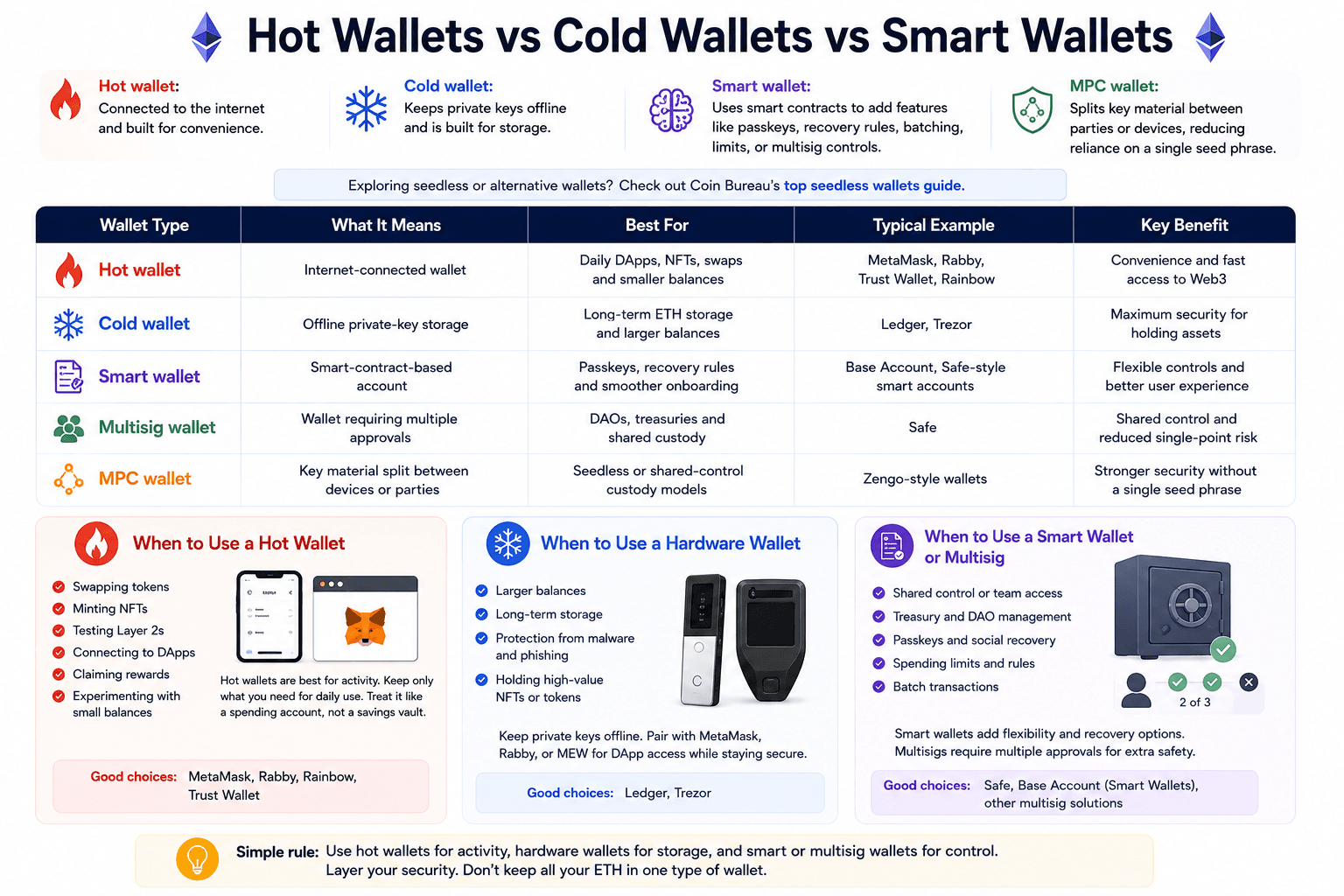 How Different Ethereum Wallet Types Fit Different Users
A hot wallet is connected to the internet and built for convenience. A cold wallet keeps private keys offline and is built for storage. A smart wallet uses smart contracts to add features such as passkeys, recovery rules, batched transactions, spending limits, or multisig controls. An MPC wallet splits key material between parties or devices, reducing reliance on a single seed phrase.
Our top seedless wallets guide is useful for readers exploring alternatives to traditional seed phrases.
| Wallet Type | What It Means | Best For | Typical Example |
|---|---|---|---|
| Hot wallet | Internet-connected wallet | Daily DApps, NFTs, swaps and smaller balances | MetaMask, Rabby, Trust Wallet, Rainbow |
| Cold wallet | Offline private-key storage | Long-term ETH storage and larger balances | Ledger, Trezor |
| Smart wallet | Smart-contract-based account | Passkeys, recovery rules and smoother onboarding | Base Account, Safe-style smart accounts |
| Multisig wallet | Wallet requiring multiple approvals | DAOs, treasuries and shared custody | Safe |
| MPC wallet | Key material split between devices or parties | Seedless or shared-control custody models | Zengo-style wallets |
When to Use a Hot Wallet
A hot wallet is best for activity. If a user is swapping tokens, minting NFTs, testing Layer 2s, connecting to DApps, claiming rewards, or experimenting with small balances, a hot wallet is the easiest tool.
The key is balance size. A hot wallet should hold working capital, not a life-changing stack. Think of it like a spending account. It exists because Ethereum is interactive, and constant hardware-wallet signing can become slow for low-value activity.
MetaMask is the broad default hot wallet. Rabby is the better DeFi hot wallet. Rainbow is better for NFT-heavy Ethereum use. Trust Wallet is the cleaner mobile multi-chain choice.
When to Use a Hardware Wallet
A hardware wallet is best for larger balances and long-term storage. Ledger and Trezor keep private keys offline, which reduces exposure to browser malware, clipboard attacks and hot-wallet compromises.
Hardware wallets can interact with Ethereum DApps when paired with MetaMask, Rabby, MyEtherWallet, or other compatible interfaces. This setup gives users the convenience of a software wallet interface and the stronger key isolation of a hardware signer.
Store long-term ETH on a hardware wallet, use a hot wallet for daily activity and avoid connecting the cold wallet to random DApps.
When to Use a Smart Wallet or Multisig
Smart wallets and multisigs are best when a single seed phrase model is too limited.
Smart wallets can support passkeys, account recovery, spending rules and batch transactions. Multisigs require multiple approvals before assets move. Safe is the strongest example for Ethereum teams and treasuries.
Ethereum account abstraction, including ERC-4337-style smart accounts, is pushing wallets beyond the old seed phrase model. Users do not need to understand the full technical architecture before choosing one. They only need to understand the practical difference: smart wallets can add rules to the account, while traditional wallets rely heavily on one key and one recovery phrase.
Ethereum Wallet Security: What Actually Protects Your ETH
Ethereum wallet security is less about finding a magic app and more about reducing the number of ways one mistake can drain everything. The strongest wallet setup combines key protection, transaction awareness and wallet separation.
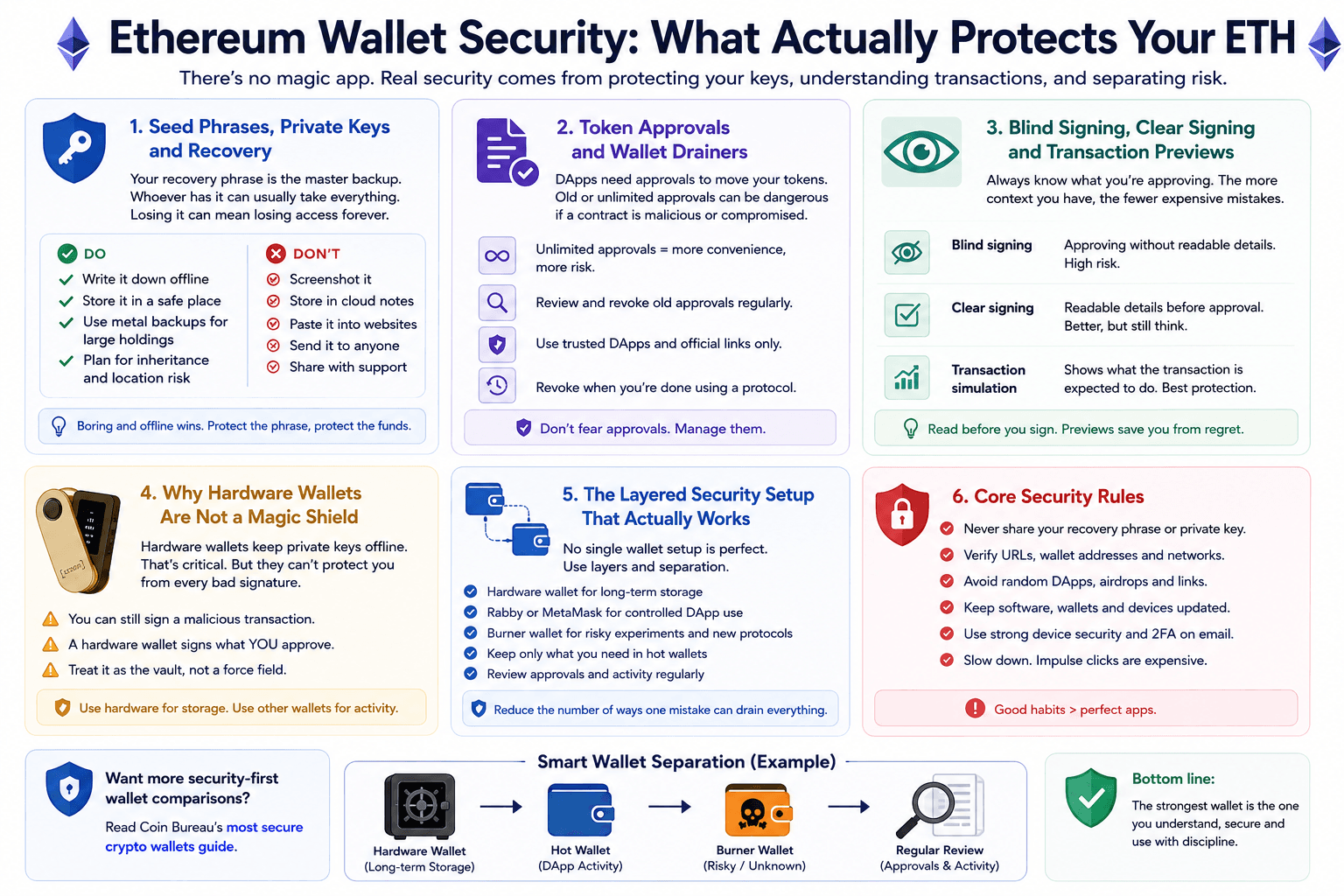 The Real Security Habits That Protect Ethereum Wallets
Read our most secure crypto wallets guide for security-first wallet comparisons.
Seed Phrases, Private Keys and Recovery
The recovery phrase is the master backup for many Ethereum wallets. Anyone who has it can usually restore the wallet and move the assets. Losing it can mean losing access permanently.
Do not screenshot your seed phrase. Do not store it in cloud notes. Do not paste it into a website. Do not send it to a support agent. No legitimate wallet support flow needs the full recovery phrase.
A better recovery setup is offline and boring. Paper can work for small balances if stored well. Metal backups make more sense for larger holdings. Users with meaningful funds should also think about inheritance and location risk. A recovery phrase hidden so well that nobody can ever find it can become its own problem.
You can also read our wallet recovery guide to understand what can and cannot be recovered after losing access.
Token Approvals and Wallet Drainers
Ethereum DApps often need token approvals. If a user wants to swap a token on a DEX, list an NFT, deposit into a lending market, or use a bridge, a smart contract may need permission to move a specific asset.
That permission can become dangerous when it is too broad or forgotten. Unlimited approvals are convenient because they reduce repeated signing. They also increase damage if a malicious contract, fake front end, or compromised approval route is involved.
The practical fix is not to fear every approval. It is to read what the wallet shows, avoid unknown DApps, use transaction simulation where available and review old approvals after periods of heavy activity.
Blind Signing, Clear Signing and Transaction Previews
Blind signing means approving a transaction without readable details. Clear signing makes transaction details easier to understand before approval. Transaction simulation goes a step further by showing what the transaction is expected to do.
This is where modern Ethereum wallets are improving. Rabby focuses heavily on pre-signing transaction visibility. Ledger has also pushed clear signing to make hardware-wallet confirmations more readable.
Better previews do not remove the need to think. They simply give the user a fighting chance before pressing confirm.
Why Hardware Wallets Are Not a Magic Shield
Hardware wallets protect private keys from online exposure. That is their job, and they do it well when set up properly.
They do not automatically protect users from every bad signature. If a user connects a hardware wallet to a malicious DApp and approves a dangerous transaction, the hardware device may still sign what the user confirms. The safer approach is to treat the hardware wallet as the vault and use separate wallets for daily activity.
Our guide to hardware wallet threats is useful for readers who assume cold storage removes every signing risk.
For high-value users, the strongest setup is layered: hardware wallet for storage, Rabby or MetaMask for controlled DApp use, burner wallet for risky experiments and regular approval cleanup.
Ethereum Wallet Fees Explained
Ethereum wallets are often free to download, but Ethereum activity is not free. The wallet is only the interface. The costs come from the network, swap providers, bridges, on-ramp services, staking providers and, in the case of hardware wallets, the physical device.
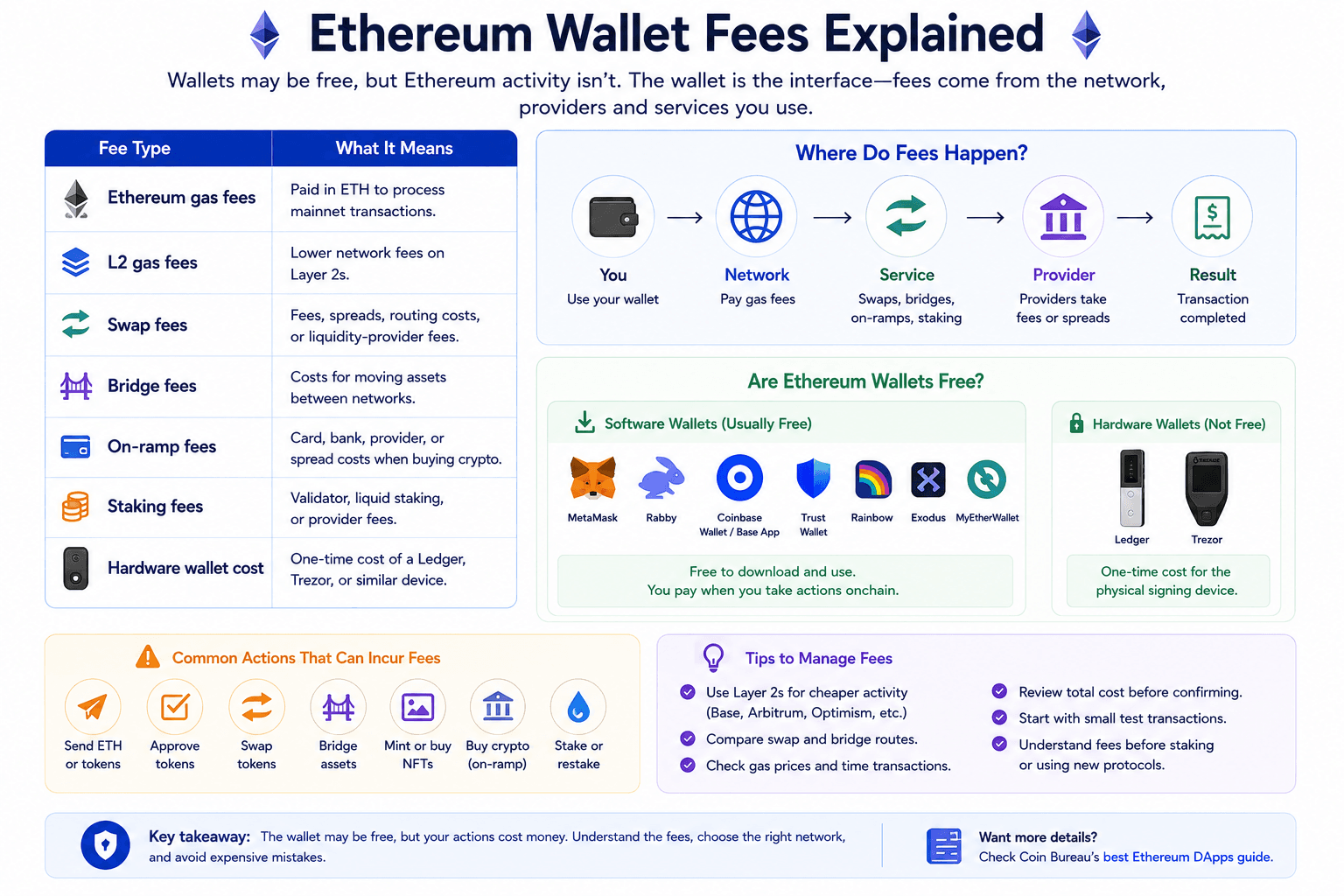 The Real Costs Behind Free Ethereum Wallet Apps
This is where beginners often get caught. “Free wallet” does not mean free transactions. Sending ETH on mainnet costs Ethereum gas fees. Swapping tokens can include DEX fees, wallet routing fees, slippage and spreads. Bridging or using cross-chain swaps can involve source-chain costs, destination-chain costs and provider fees.
| Fee Type | What It Means |
|---|---|
| Ethereum gas fees | Paid in ETH to process mainnet transactions |
| L2 gas fees | Lower network fees on Layer 2s |
| Swap fees | Fees, spreads, routing costs, or liquidity-provider fees |
| Bridge fees | Costs for moving assets between networks |
| On-ramp fees | Card, bank, provider, or spread costs when buying crypto |
| Staking fees | Validator, liquid staking, or provider fees |
| Hardware wallet cost | One-time cost of a Ledger, Trezor, or similar device |
Are Ethereum Wallets Free?
Software wallets such as MetaMask, Rabby, Coinbase Wallet/Base App, Trust Wallet, Rainbow, Exodus and MyEtherWallet are generally free to download or access. Hardware wallets such as Ledger and Trezor cost money because users are buying a physical signing device.
The wallet itself may be free, but actions inside the wallet can cost money. Sending ETH, approving tokens, staking, bridging, minting NFTs, buying crypto and swapping assets can all involve fees.
The clean way to judge wallet costs is by use case. A beginner with $50 in ETH probably does not need to buy hardware immediately. A user holding a serious ETH balance should treat hardware wallet cost as part of basic security infrastructure.
Common Ethereum Wallet Mistakes to Avoid
Most Ethereum wallet losses do not come from exotic hacks. They come from simple mistakes repeated at speed: downloading fake wallet apps, saving seed phrases in screenshots, signing unknown messages, sending funds to the wrong network, or keeping every asset in one hot wallet.
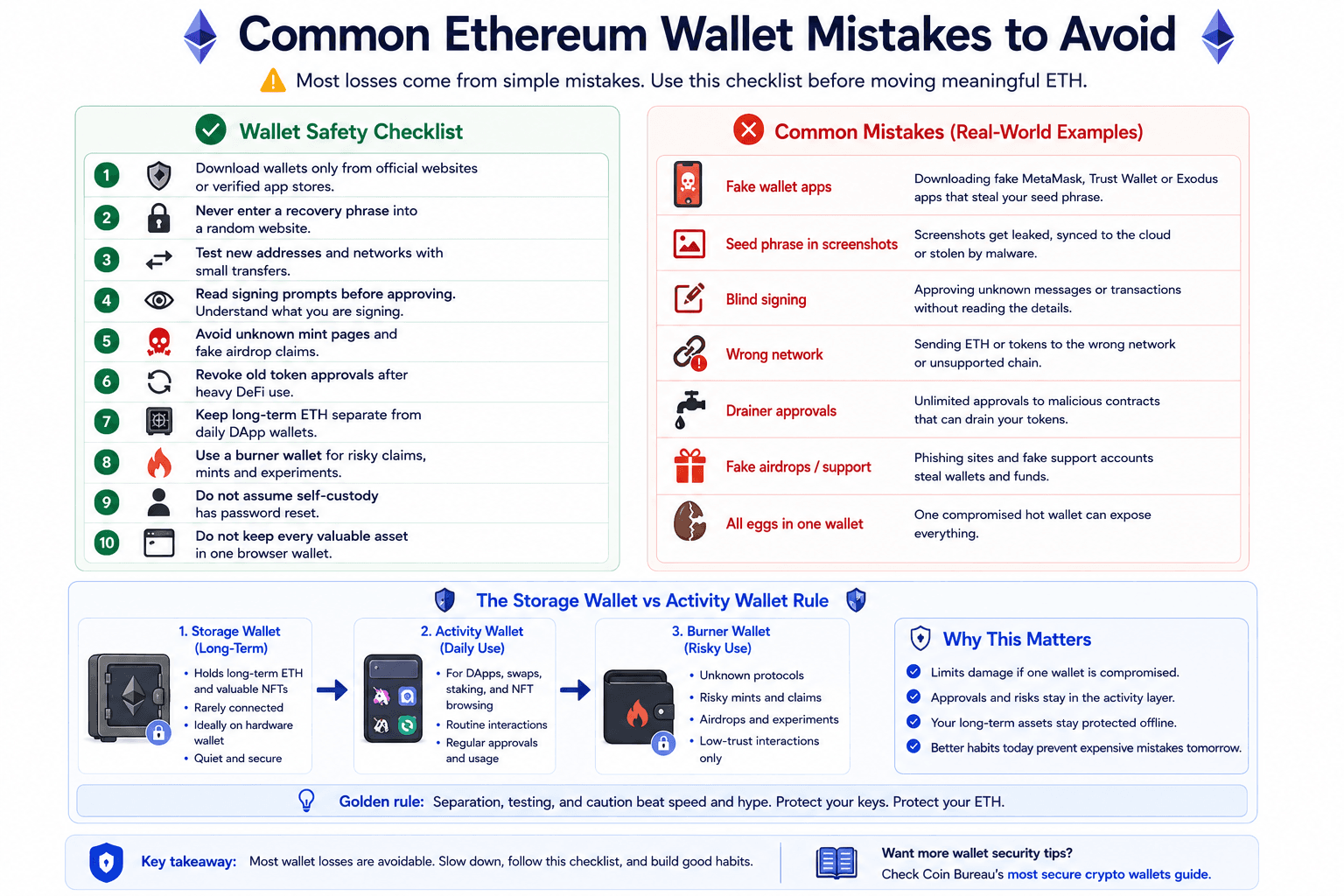 Simple Ethereum Wallet Mistakes That Can Cost Users
Use this checklist before moving meaningful ETH:
- Download wallets only from official websites or verified app stores.
- Never enter a recovery phrase into a random website.
- Test new addresses and networks with small transfers.
- Read signing prompts before approving.
- Avoid unknown mint pages and fake airdrop claims.
- Revoke old token approvals after heavy DeFi use.
- Keep long-term ETH separate from daily DApp wallets.
- Use a burner wallet for risky claims, mints and experiments.
- Do not assume self-custody has password reset.
- Do not keep every valuable asset in one browser wallet.
The Storage Wallet vs Activity Wallet Rule
The easiest wallet security rule is separation. A storage wallet holds long-term ETH and valuable NFTs. It should be quiet, rarely connected and ideally protected by hardware. An activity wallet handles routine DApps, swaps, staking interfaces and NFT browsing. A burner wallet handles unknown protocols, risky mints and low-trust claim pages.
This setup is not glamorous. It is also one of the few habits that meaningfully reduces damage. If the burner wallet gets compromised, the storage wallet should not be exposed. If the activity wallet has old approvals, the cold wallet should not be reachable through them.
Ethereum rewards curiosity, but wallets should be structured for paranoia.

Final Verdict: Which Ethereum Wallet Should You Use?
The best Ethereum wallet for most users is MetaMask because it has the widest DApp support. The best Ethereum wallet for DeFi is Rabby because it gives active EVM users better transaction context and smoother chain switching. The best Ethereum hardware wallets are Ledger and Trezor. The best wallet for teams and treasuries is Safe.
For beginners, Coinbase Wallet/Base App and Trust Wallet are easier starting points. For NFT collectors, Rainbow is the cleanest Ethereum-native mobile wallet. For users who want a polished desktop and mobile portfolio wallet, Exodus makes sense. For advanced ETH users who still like classic Ethereum tooling, MyEtherWallet remains relevant.
The strongest Ethereum setup in 2026 is not one perfect wallet. It is a sensible stack:
- MetaMask or Rabby for DApp access
- Ledger or Trezor for long-term ETH storage
- Safe for shared treasury control
- Rainbow for NFTs and Ethereum-native mobile use
- Coinbase Wallet/Base App or Trust Wallet for easier beginner onboarding
- A burner wallet for risky mints, unknown DApps and airdrop claims
If you only want one answer, choose MetaMask for general Ethereum use. If you use DeFi often, choose Rabby. If you are holding meaningful ETH, add a hardware wallet before you add another app.